rowan rabe . ink

Month: December 2025

  • When the “AI assistant” would probably use the exact same phrasing I do I agonize over it overmuch.

    I have again done that thing where I feel pressed to say something profound and original–read as thoughtful, where effort = care–on a card, and coming around again to the cliche/set phrase from the pre-printed Hallmark.

    “I wish you happiness in the new year.”

    This is the distillation of what I feel. And it’s the most direct and clear way of stating it.

    There’s some tiresome point here about how cliches become cliches for a reason. Is there some way to (unobtrusively, humbly, without looking like I’m looking for affirmation) indicate that I came to that phrasing after some time of deliberation? That it is thoughtful, personalized? This card is for somebody who puts great thought and effort and visible care into gifts, cards, etc, and finds receiving same important.

    Anyway. Merry Christmas to those who celebrate. And if you don’t I hope you have a good day.

  • Nothing actually happens

    Against my better judgement I check Reddit in the morning. I assume at the very least it can tell me if the White House blew up or aliens made first contact* or whatever the fuck major news of the day. I’m also frequently on the elliptical so I’m not looking for something that requires great brain power; rants, puff pieces, ragebait, cats, kvetching end up being a lot of what I click on and the algorithm has correctly clocked me as an overeducated urban leftist. (My Reddit feed is also mostly subreddits I chose to follow, so the algorithm doesn’t exactly have to think very hard to keep me engaged. There is a lot of genuine kvetching to be done right now in, to name one category, science as it is funded and understood and disseminated by the federal government.)

    I click on a cute picture of a kitty-cat. This cat’s name is Melinoë. I think that is delightful. The poster is asking if Ms. Melinoë is a ‘standard issue cat’ (mackerel tabby). I give an utterly anodyne yet genuine message:

    The Princess is a torbie. That’s a lot of orange. Which is delightful, as she is described in the Orphic hymns as “saffron-cloaked nymph of the earth”.

    I am being serious. I do think it is delightful that there is a lovely torbie kitten named Melinoë and I am glad she found a loving home.

    I am wondering if I have just played into giving legitimacy to a bid for attention from a bot.

    I am wondering if this is a recycled picture used for karma-farming. The internet equivalent of a foot-in-the-door or establishing rapport, even though it is attached to a username at large and not a specific action.

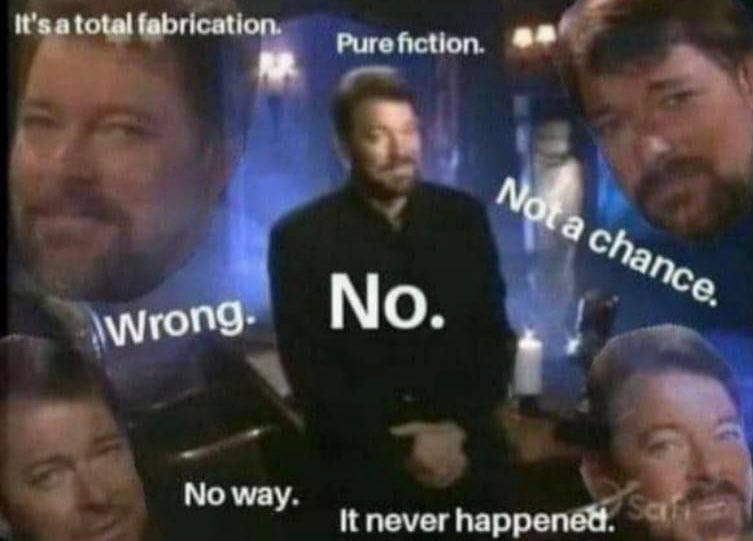
    I am becoming a person who thinks nothing ever happens and there is no whimsy in reality, that it is all staged for twee posts baiting suckers like me into likes or typing something like “I love her :3.” I am becoming a person who fears finding delight in small things because it might be bait, inorganic. The cynicism is increasingly reflected in other comments–a return of the “and then the whole bus clapped” guy in every anecdote thread, or Jonathan Frakes in Beyond Belief. I get it, because I am starting to feel paranoid as well–but I do wonder if I am doubting somebody who just wanted to share a picture of their kitty with the internet. It is related to AI paranoia in that a ‘sucker’ is the most reviled, sneered-at figure in the American consciousness. A cynic might be an asshole but they will not be suckered, which is contemptible.

    Patron saint of the internet.

    Time is circle. I am regressing to the 2000s internet cynicism: everything is made up, and sincerity–believing something somebody said at face value–is the mark of a sucker. It feels like 4chan levels of distrust and hostility have become reasonable. Everything sucks, everything enjoyable is a fabrication designed to manipulate you, and naivety and sincerity are the traits of the dumbest people on the planet.

    Shills and plants have always been writing columns and butting into conversations on politics and policy; none of that is remotely new, although now it can be done with ease on a global scale. You are not restricted to sending a contrarian to the company hearing on establishing a union or the town hall meeting; you can JAQ** off in the comments section of Al Jazeera or the Beeb, or the feminist or Marxist subreddits, or the Xwitter of the NOAA or NASA or NIH. Arguments are made for the people silently reading and not of realistic hope to change the mind of somebody with a strong opinion. But this–suspecting somebody is posting about something innocent like cats to curate a persona that is less clockable as a bot–hits differently.

    Humans have always been a narrative-oriented species. That part hasn’t changed. Humans have always desired attention and adoration and the warm feeling that comes of delighting someone with a story–in sum, humans have always told tall tales, and this included the internet 1.0 of BBS boards and Usenet and mailing lists when the only thing you could gain from making shit up was esteem and a sense of connection. But there is now a monetary incentive to being ‘delightful’ because, in internet terms, accumulated ‘likes’ and posts and this abstract idea of ‘activity’ can be converted into money via selling the influence of that profile. An old profile with lots of stories and a ‘persona’ behind it is worth immense advertising money and can be sold or stolen.

    I’m wondering why that feels worse than just somebody looking for attention. Probably because that attention-seeking person is being genuine, in their own way. Or at the very least not trying to monetize my attention; they genuinely want it. And I am haunted by the increasing sense that the rot of the ‘dead internet’ is becoming the whole organism.

    ——–

    *Nobody is going to make first contact right now unless their primary objective is stewardship of an idiot species, of saving us from ourselves. If we’re held to the standard of showing the wisdom to be part of the intergalactic community nobody is going to be rocking up looking to meet us. Even if we hit some concrete criteria like achieving warp we’ll be approached as a liability that might become Some Other Planet’s Problem, not as kin.

    **”Just Asking Questions”

  • Retro tech

    I am reading Translation State by Ann Leckie (sequel to the Imperial Radch trilogy 1 2 3 I favorably reviewed, fucking hell, ten years ago).

    It is a far-flung high-tech space opera published in 2024, near-Culture levels of tech, or at the very least, well beyond Star Trek with warp capability etc. It’s a lovely book and I am thrilled the author chose to revisit this universe, but that is not really here or there.

    There is, in short, a bloody, shocking, historical event the aftermath of which is well documented on some sort of audiovisual media, and a group of people who think the event was completely made up. They have a motive, granted, and that is the best negation of proof. But the POV character at the time seems to think having seen the footage is proof enough. And my immediate thought is — why are you not considering that it is AI? Of course post-disaster footage can have any narrative attached to it, but I was more interested in the POV character’s immediate faith in the footage itself being real. And I have read a lot of science fiction over the past a lot of years– I am trying to recall what my initial reaction was to like statements (i.e. what is seen is what is) in older novels with a similar level of far-future tech quantum leaps beyond our own. Of course in the narrative structure of science fiction is inherent a lot of technological gotchas and revelations, and generative AI has been a staple of science fiction since its inception, but what I thought was — why does this character, specifically, not consider AI? Not me the genre-savvy reader, but this character who in-universe is not unusually adept in tech or science.

    When did generative AI move, in my mind, from the category of esoteric and theoretical to a given like electricity? When did I assume it was common enough to be first thought for any person of any tech background?

    When would I have begun to wonder if the very fact this character of this high-tech epoch did not immediately draw it to mind might be a clue, an anomaly, some key to a backwater upbringing?

    It isn’t, and wasn’t. It’s beside the point as far as the novel itself is concerned. But I have been wondering about my reaction, me-in-2025, and the-author-in-2024.

    Considerations:

    1. The AI concerns were already addressed in the “backstage” of the novel, temporally or narrative-wise, and there was no narrative point to bringing it up as part of the character’s thought process. I am reminded of Hermann Hesse’s characterization of brevity as respect for the reader in Steppenwolf.* Leckie’s style is also spare and to-the-point. It is good to let some what-ifs breathe.
    2. Advanced AI is at the forefront of this series — consciousness of collectives and machines is a key theme of the original series.
      • Why would I assume generative AI would precede cognitive AI?
        • As a law of nature?
        • As a necessary “upstream” technology of that more advanced AI?

    There is clearly an ‘order’ to scientific discoveries, a sequence — science builds upon itself and many discoveries depend on previous knowledge. So it is not itself a silly thing to believe, that there are forms of tech necessarily upstream of other forms.

    With the advance of time, this disconnect is written off as aesthetic. That is the essence of ‘retro-futuristic’. The aesthetic is intentional in works written after the advent of that tech and merely charming in works written before. The difference in intentionality between original Star Trek as written in the 60s with that tech or lack thereof and the exact same show were it produced today is a question of aesthetic. Or, even more Millennial**, irony.

    My question is — when would non-acknowledgement of generative AI begin to qualify as part of this aesthetic?

    And, are there examples of science fiction that consciously buck this trend for reasons other than aesthetic or irony? That explore the link with more than a gut feeling akin to “well, if they can go warp speed they sure as hell figured out cell phones” arising from the feasibility disconnect between cell phones (where we are now, so very possible) and warp speed (a distant theoretical) in our own reality? Fan works have cleverly messed with the mismatch in tech levels as an intellectual exercise — how would we have become warp-capable when we’re still using 5.25″ floppies — but I’m struggling to think of one where that is the premise from the jump.

    I want to say that the lack of evidence for practical use of the wheel by the highly-architecturally-advanced Maya is the closest I can come to a real-life example, or would be if lack-of-evidence actually had any positive significance, beyond potentially pointing to something so commonplace it is not depicted or clarified. (Will people reading our recipes a thousand years hence know ‘eggs’ means ‘chicken eggs’?)

    *I realize I do not run a respectful blog.

    **Yes, even more than aesthetic.