rowan rabe . ink

Category: Actual things happening

  • Habits of tyranny

    Habits of tyranny

    (Note: I wrote the bulk of this a month ago, when the murder of Alex Pretti was still fresh news. It’s been years since a month ago.)

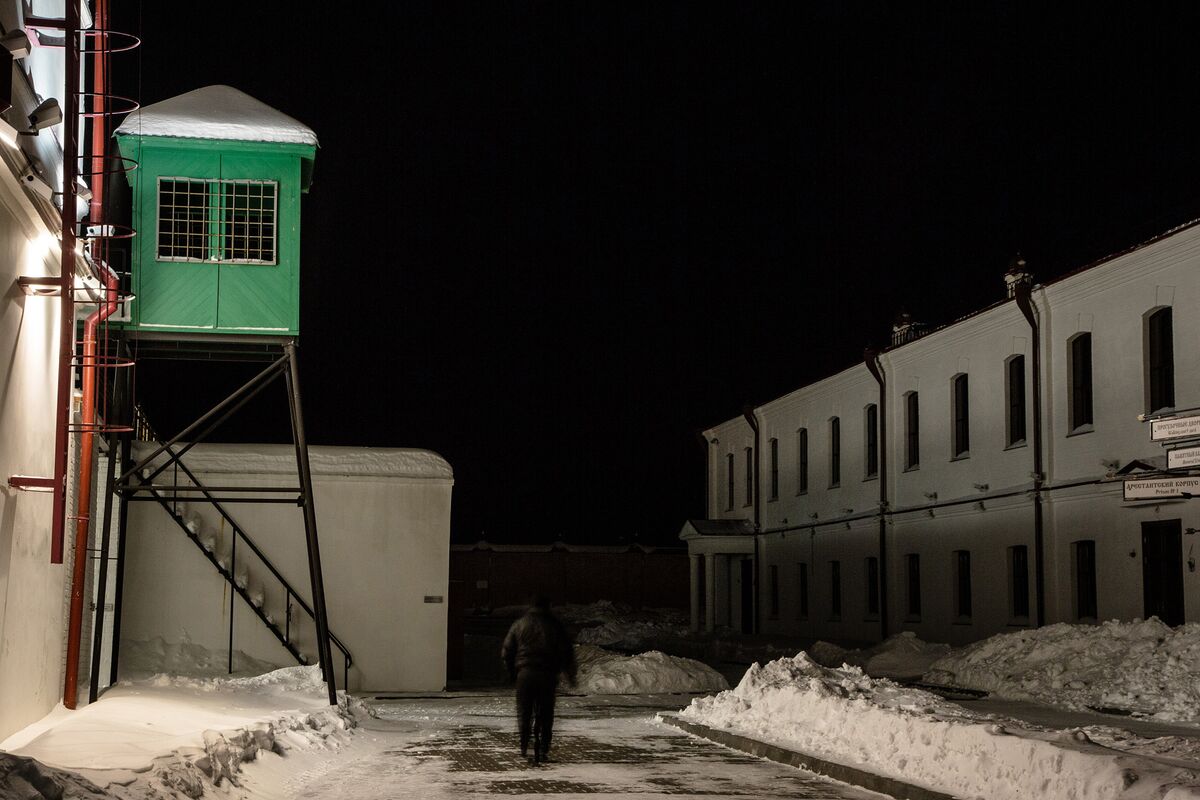
    Alexander Aksakov/Getty — Prison Castle, Siberia, Dostoevsky’s “Dead House”

    I’m not very disciplined even in whatever self-imposed ad-hoc ethical system I’ve imposed upon myself. I believe–intellectually–that good and evil are things that you do, not things that you are. And yet I find myself thinking of people as good or evil, or liking or not liking them, if I do not keep a short rein on my thoughts.

    I have an old friend in prison. He is, I would say, a good man, who did something horrible. He had a psychotic break in a country (and milieu within that country, furthermore) that provides miserly help for mental health while providing generously for ease of access to guns. (I will say this: a man will not ‘seek help’ if said seeking ends his career, and he has a wife and child to support. This is to say nothing of a disease the very pathology of which obscures ones insight of self. But there are those windows of clarity, those moments of “what am I doing”, those moments when there’s an intervention, and because of the first concern you’ve squandered that.) How do I reconcile “good” with this? Genuine repentance, genuine horror and regret. I suppose “feeling” can be “doing”.

    Anyway, I finally read Notes from a Dead House by Dostoevsky, a thinly-veiled autobiography about his time at hard labor in Siberia for being part of a socialist literary circle in a Tsarist Russia that had just been given quite a fright by the goings-on to the west in Europe in 1848, and so was particularly inclined to punish anything red-tainted with a heavy hand. I want to send a copy of this to my friend in prison. (He is not going to leave prison.) Tiresome as I am sure it is to have everybody define your life by ‘being in prison’ it is An Experience and a consuming one, and Dostoevsky’s humanity and love for his fellow prisoners is emblematic of the very best tendencies of the Christian tradition, what I consider closest to that of the compassion of the Biblical Christ. It is a compassion that does not deny that some of these men are scoundrels that would stab you for a dram of vodka, but they are men, for all that, and have an inherent human dignity and an inherent goodness they can choose, should they choose. Timshel. And ‘thou mayest’ be more likely to choose compassion when you are treated with dignity. Anyway, I wanted to pick his brain on how much Dostoevsky’s observations hold up with his own, with regard to the nature of man in captivity. He is a thoughtful and quiet man who helps his fellow prisoners get their letters and numbers, as he’s one of those rare breed of educated prisoners, not to make too fine a point on the extent to which ‘criminality’ coincides with ‘economic necessity’.

    It doesn’t much matter because that state just decided that prisoners can no longer receive books, even straight from Amazon. I somehow doubt a book known for exploring the humanity of the incarcerated and the corrosive effect power has on those who wield it would make it past censors in the most permissive systems, but I am still pissed. I just donated a few bags of paperbacks to my local prison system (it’s one of the more permissive in the country, which is saying little), mostly science fiction and fantasy, nothing that would raise eyebrows, but all passing my personal and rigorous quality standards as Something Worth Reading, and I felt warm imagining somebody finding something good to read, something to take their minds outside the walls and speak to them as a human with inherent dignity.

    Voluntary executioners

    I keep what could generously be called a zibaldone–or less generously, a collection of scrawling and scribbling and doodling whatever is cluttering up my mind or whatever quotes hit me–and unsurprisingly one can trace what I’ve been reading by trawling through my notebooks. (I date sketches; that’s about it as regards organization.)* Notes from a Dead House was on my list long before the recent unpleasantness up north and maybe my subconscious drove me to pick it of all the books on my queue, having been marinated in all this unfortunate to-do and misunderstanding of Rashomon-like subtlety.

    “There are people, like tigers, who have a thirst for licking blood. A man who has once experienced this power, this unlimited lordship over the body, blood, and spirit of a man just like himself, created in the same way, his brother by the law of Christ; a man who has experienced this power and the full possibility of inflicting the ultimate humiliation upon another being bearing the image of God, somehow involuntarily loses control of his sensations. Tyranny is a habit; it is endowed with development, and develops finally into an illness. I stand upon this, that the best of man can, from habit, become coarse and stupefied to the point of brutality. Blood and power intoxicate: coarseness and depravity develop; the most abnormal phenomenon become accessible and, finally, sweet to the mind and feelings. Man and citizen perish forever in the tyrant, and the return to human dignity, to repentance, to regeneration, becomes almost impossible for him. What’s more, the example, the possibility, of such self-will has a contagious effect on the whole of society: power is seductive. A society that looks indifferently upon such a phenomenon is itself infected at its foundation. In short, the right of corporal punishment, granted to one man over another, is one of the plagues of society, one of the most powerful means of annihilating in it any germ, any attempt at civility, and full grounds for it’s inevitable and ineluctable corruption.”

    I wasn’t even much thinking on the corrosion to the soul that is being given power over another human being–the corrosive effect on any person, even a ‘good’ person–maybe because I read that chapter within a few hours of the murder of Alex Pretti. I was thinking on what Dostoevsky called “voluntary executioners” in the translation I read.

    There are two kinds of executioners, those who of their own will are executioners and those who are executioners by duty, by reason of office.

    Bad people. People who are bad. Fundamentally broken. I was not practicing my equanimity, my defining-people-only-as-doing; I was thinking about the sort of person who joins ICE because it looks like good fun. Do I wish to believe in the existence of the ‘voluntary executioner’ who is somehow more intrinsically bad, more evil, than the ‘involuntary executioner’ who only takes on this role through economic desperation or plain naivety and is through the corrosive poison of the very nature of the job itself made into a bad person? I am again going against my sincerely-held belief that evil is what somebody does, not what somebody is, but there are people who take such glee in inflicting pain I admit I see them as ghoulish. Well, it is perhaps more comforting to think that there are people just ‘born wrong’, independent of intellectual disability or brain malformation, than that anybody, even the kindest person, has the germ of this cruelty within them, and it is only a matter of choosing whether or not to nurture it. Timshel. Some natures make choosing evil more pleasurable or less painful than it is to others, perhaps. I can only hold that it is not fair that some people have innate checks on cruelty and others do not, but though it is not somebody’s fault they were born with low empathy or sadistic tendencies, it remains their responsibility to manage it. It is not fair, but it is. Fair and not-fair, deserving and not-deserving, are ultimately distractions, child’s excuses; one deals with what is.

    Are they different and does it matter, when the trigger is pulled on a gun pointed at a man’s back? Why do I want it to matter, when a bullet kills just as surely no matter the thoughts or inner self or true self or what-the-fuck-ever of the person squeezing the trigger?

    This hurts you more than it hurts me

    I have yet to see a category of person who supports ICE: a person who thinks that what is being done is necessary, but dislikes how much pain it causes. I have seen nobody with the surgeon’s sobriety at inflicting ‘necessary’ pain. All I see is glee that pain is being inflicted.

    Is there a person who thinks all the raids are ‘necessary’ (for… the health of the country, I guess) and who also acknowledges and grieves all the human misery it is causing?

    Even indifference, self-preserving callousness, would let me know there is still a soul in there that needs to be guarded. Or, it means that one does not see the people suffering as fully ‘human’ or believe that they are truly ‘suffering’, which is its own defect of the soul.

    Who do what is necessary

    I’ve been on the internet long enough that I’m difficult to surprise with pretty much any level of pretentiousness or self-delusion, but the DHS penguin tweet (I’m not linking to it) just about did it.

    My first thought was that “Americans have always known “why” [the penguin walks away]” was a reference to Ursula K. Le Guin’s The Ones Who Walk Away from Omelas, the sort of delusional reading of a story I saw so often wherein people manifestly bad, manifestly on the side of wrong (here I go again with those value judgements) interpret an unambiguous parable about self-denial in doing what is right as in some way having something to do with them doing what is wrong, but taking on the ‘self-denial’ of the esteem of their fellow humans who just refuse to see that they are only doing what must be done, unpleasant as it might be. It’s the primary balm to the soul of somebody who does something evil — to re-frame it as something that is Unpleasant but Necessary, to recast oneself as the equivalent of the outcastes who took on unclean jobs like corpse disposal and butchery that were necessary to the functioning of society, but that nobody wanted to think much about, just reap the benefits of, and then hate the people doing the deed from which they benefited, from which they were spared guilt. A proud, stoic person who loves humanity so deeply, so purely, that they will do what is necessary even if those people who benefit hate them.

    How does this square with my earlier complaint about ghoulish joy? I guess butchers cannot have too much empathy for the cows they slaughter, but they don’t like it when their children run from them because they smell of blood.

    ——–

    *If you are picturing one of the ~aesthetic~ strictly-formatted and regimented journals, the sort of spread that looks just lovely on an Instagram or Pintrest with neat handwriting and makes you want to go analogue… well, keep picturing that if it encourages you to keep a notebook; I’ve found the practice immensely gratifying, but nobody is going to look at my notebooks and get inspired.**

    **I do like looking at ~aesthetic~ journals and hipster-ass stationary pages; my follow list on personal Instagram is a shameful catalogue of actually now that I think about it precisely the sort of marketing nonsense I’ve ranted about.

  • Scholarly pursuits

    Scholarly pursuits

    Been a bit dead around here of late. I do have a science camp comic on the backburner that involves Labubu(s). I don’t know what the proper plural is and I’m sure if I asked the kids I have this afternoon their opinion they’d go with the English-speaker’s tendency to pluralize with ‘s’ if uncertain.

    “I’m a scholar. I enjoy scholarly pursuits.” –Buster Bluth, emeritus polymath scholar at UC Irvine

    I mentioned this in an earlier post: I’m going back to school! At 30-or-40 years old and already having a doctorate. I need a couple of course credits for a license and one of them is a 101-level class in my Ph.D. subject. Yes, really. The license requirements are pedantic and literal to that point; this has much to do with guild protectionism of a lucrative post and the massive exodus of research scientists into clinical science, given the disemboweling of government/academic research and the dismal state of the biotech industry. But the second class (hematology) is taking more time than I anticipated, given that I insist upon reading the textbook chapters whole and my experience vis-a-vis blood is largely the immune system. Competition for these clinical positions is cutthroat and I’ve got to prove this old dog can still learn new tricks, or, at the very least, indicate that my dismal publication record is not a result of a dismal drive or dismal intellect.

    Perhaps you seek too much

    Bit of my analogue fetishism/return to notebook the past few years–I’m taking notes by hand, and I have to admit retention is far better than when I just download the lecture powerpoint or even type notes. The tenor of the past few years of my life is one of regret, of wishing-to-do-over–so looking back at my undergrad and grad years and wishing I had (a) done the reading more diligently and (b) taken detailed hand notes. I had been hit by a combination of gifted-kid arrogance and depression. I felt in a weird way that reading the text and taking notes would be cheating–that I should be smart enough to remember stuff told to me once, that I should not be that pedantic apple-polishing student who tries very hard but isn’t all that naturally bright. Looking up examples is cheating; I should be bright enough to extrapolate everything I need know from a few basic rules. It’s all bullshit, of course–I maintain the honors students are the students who lie about how much they study by understating, or they were in my day–but my younger self was disgusted by the idea of being too lock-step with the system and, perhaps most damning, was rewarded for this behavior with good grades and scholarships. I wanted to be so damn naturally smart that I could not-try and be valedictorian. I also had a Hesse-esque fixation on being no-one’s acolyte or student but my own that carried over well into adulthood. I wanted to be the Siddhartha who rejected the tutelage of the Buddha to find his own truth, much as he respected the Buddha’s teachings, the Max Demian who kept his own moral council.

    Might I be in a better position now if I had knuckled down that first year of graduate school–sure. I put all my time and reading into my lab rotations and neglected my classes, and that was reflected in my grades, which impacted my lab rotations when it was time to get a permanent lab. I was frequently at one lab until 1 AM. But that lab (that liked me most) had taken me as a rotation student on the understanding that I would have to secure my own funding to stay with them–and I didn’t, not for lack of trying. I am stupefied meditating on how different my career might look how had I gotten that damn NSF grant, or something. I ended up in a solid enough lab but to make a long story short our off-campus collaborators told me two weeks after I defended that the data upon which I had based my dissertation–and two substantial first-author papers I was waiting for other-author comments on–was faulty, in such a way as to invalidate the entire premise. I was allowed to graduate because I had defended correctly what I had been given in good faith. But, those papers never happened–the PI of the other lab was caring for his wife on hospice and the PI of my own lab had his own age-related issues. I should have been more of an asshole and leaned hard on them but I can’t bring myself to do that to kind old men. It is utterly against my nature to impose upon people, because I hate it so much when people impose upon me, and I treat others as I wish to be treated.

    And here I am.

    About what you know

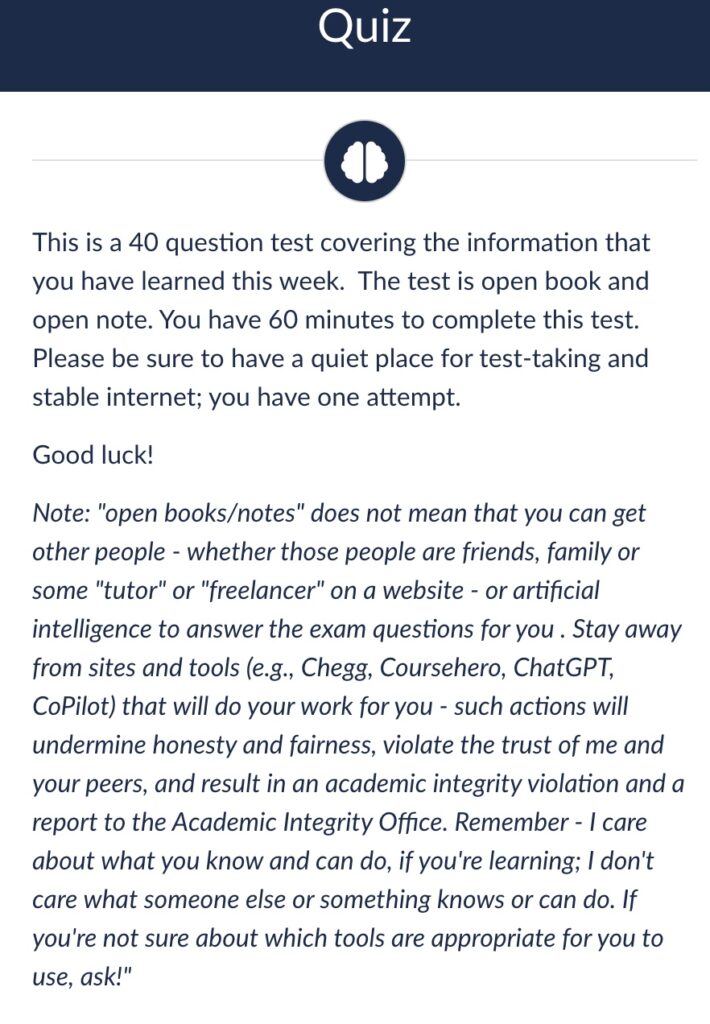
    “Note: “open books/notes” does not mean that you can get other people – whether those people are friends, family or some “tutor” or “freelancer” on a website – or artificial intelligence to answer the exam questions for you. Stay away from sites and tools (e.g. Chegg, Coursehero, ChatGPT, CoPilot) that will do your work for you – such actions will undermine honesty and fairness, violate the trust of me your peers, and result in an academic integrity violation and a report to the Academic Integrity Office. Remember – I care about what you know and can do, if you’re learning; I don’t care what someone else or something knows or can do.”

    I am so glad I got my Ph.D. before ChatGPT and the other generative AI became prevalent. The date lends a credibility to it. I am also glad I am not teaching remotely in this brave new world because this disclaimer–really, this entreaty–bleeds with desperation that comes of only being able to tell people not to cheat in their own best interest because–please. Just please don’t, else the spirit and credibility of academic accreditation is gone. As an somebody who wanted to be an academic or a post-secondary instructor I understand the desperation, the same way I sometimes wonder how set I’d be were reading and writing still marketable, unique Skills.

    I am a scholar – maybe not so far removed from Buster Bluth as I would like to think, the only thing separating us being that I decided upon a concentration and he had the family largess to be an eternal student.* I’m primarily a knowledge-peddler, a thinker, responding to crisis or shock with paralysis and thinking. Perhaps my kind is ultimately of as little usefulness as a farrier in the age of the automobile, where horses are a novelty and one only needs so many farriers, a very rare lucky few to serve what is an elaborate expensive hobby and not a social need. One can argue whether or not this is intrinsically a bad thing or a loss for society but either way I’m kind of fucked, aren’t I.

    You’d be one of the bright ones

    That is the message I got growing up in the 90s – I was so intrinsically bright, so intrinsically chosen, that a good life and a fulfilling career were all but guaranteed, and all I had to do was not fuck it up too badly.

    That’s another thing that’s difficult to come to terms with, the point where all this intellectual pride intersects with a very American-Protestant pride in being The One Who Rises Above, the cream of the crop, the bright ones who earn a degree of comfort and stability in life. There’s something of the Calvinist pride in being “chosen” to be endowed with natural gifts, that pride in what-one-is and not what-one-earned that is an odd and striking counterpoint to the ‘you must earn everything’ ethos that is the face of that Protestant work ethic. I maintain New Calvinism** appeals in this day of the shattered myth of meritocracy (or the ‘fuck you, I got mine’ era) because it gives realization of this painful truth, at the very least, the aura of stoicism, of clear-minded clear-seeing grit. Like Pa Ingalls letting his family starve before he lowers himself to accepting charity, and that being seen as admirable, American. “Play the hand you’re dealt” and don’t complain, but still be proud of being dealt a good hand. Pride in acceptance of one’s lot. “God did not choose me to deserve much in this life.”

    I do not believe you have to be exceptional to have a good quality of life. And yet as the haves and have-nots diverge further, as the middle is hollowed out and the have-nots reach such a majority that the K-shaped wealth curve becomes very bottom-heavy indeed, I still find myself feeling this economic uncertainty and precarity is my fault. I wasn’t one of the Bright Ones after all.

    ——–

    *I also think Lucille is hilarious but I could not actually put up with her in person, let alone live with her, let alone have an incestuous pseudo-marriage with her in which she is in a position of authority over me.

    **Consisting mostly of those “extreme” youth churches with a grunge-by-way-of-industrial aesthetic stuck back in 2002 with the billboards all over I-10 that multiply east of LA proper.

  • Time isn’t after us.

    Time isn’t after us.

    Just like that bluebird

    Ten years and some change ago I was waking up to text messages from my mom and my best friend asking if I “was okay”, which was A Way to start a morning, to be sure. I do not have the texts saved but I can guess with some degree of confidence my response was “????” or thereabouts. Then comes the text reaction you can feel the “o_o” behind – the feeling when one realizes one is not merely a party of comfort, but a messenger of bad news.

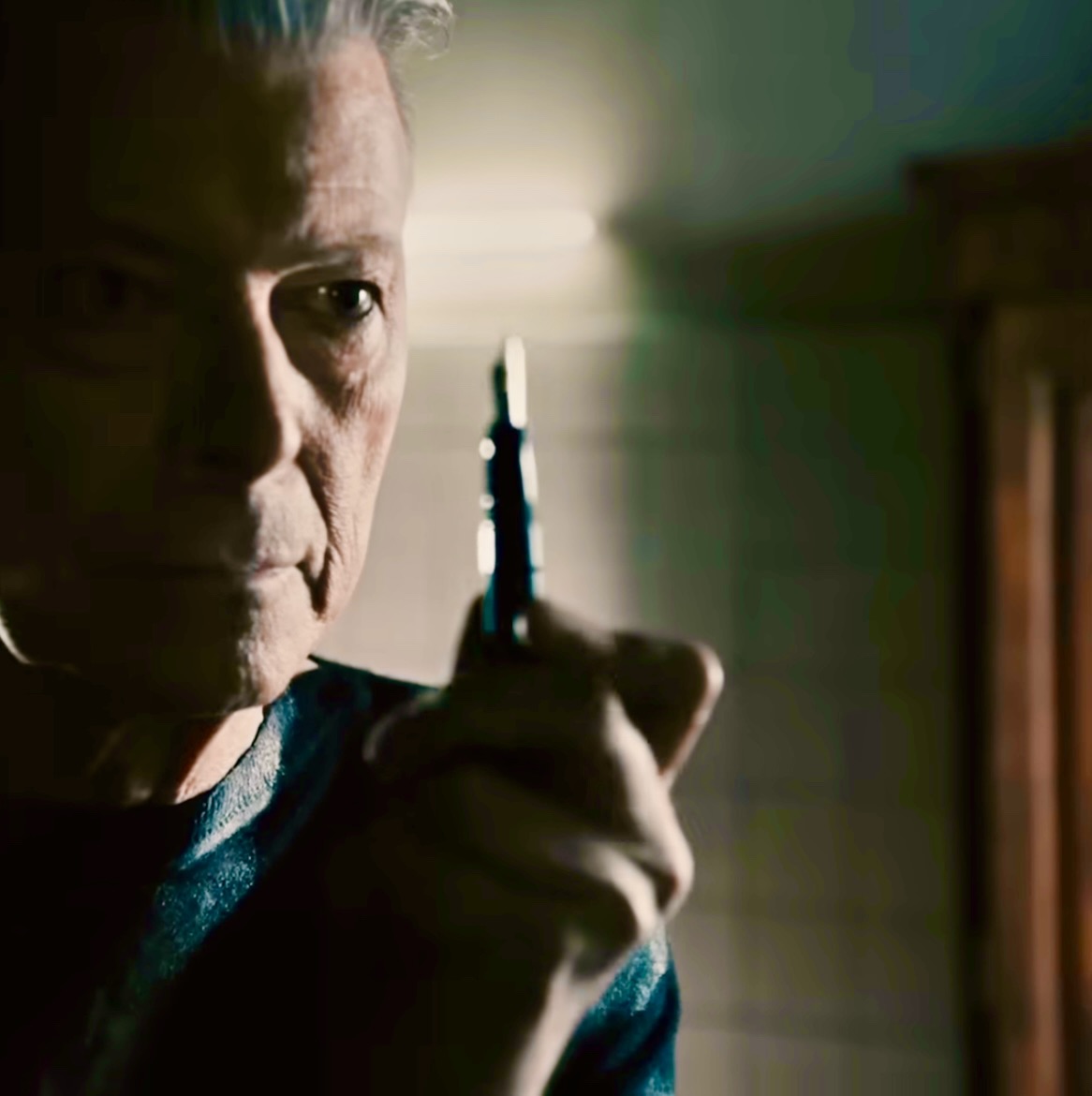
    “Lazarus”, from Blackstar, David Bowie

    I did not make this post on the tenth, because–and it pains me to admit this–the tenth of this month did not register to me as meaningful, not the day of. I was up early to work a convention in Long Beach and stayed largely off any internet but the convention staff Discord channel. The fuck of the thing is — Labyrinth was showing across the street at The Pike for its fortieth anniversary run and I was well aware of that, hoping to be able to make it myself, but I did not get off work in time. And still somehow Jareth the Goblin King lurking at the back of my mind was not sufficient to trigger my memory that it was ten years to the day Bowie had died. Indeed, I did not even think on it until yesterday when I saw a memorial retrospective for Alan Rickman, and through that remembered we had lost two giants that week in January of 2016.

    I’ve see “ten year retrospectives”. I do not recall twenty year, or twenty-five year, or further. Perhaps ten years is, in round symbolic numbers, closest to the amount of “organic” or “intrinsic” time it takes for the world to adjust to your absence. Not to forget you by any means, but to accept that you are past tense, outside a posthumous cult that elevates that day into an annual memorial, or one’s direct relations. Ten years to accept the loss of an artist, a legend, as it were. That ten years is a liminal time for the artist wherein the immediacy of their loss fades, and we come to accept them as past/passed.

    Something of an echo

    I live what I feel is a distinct echo, but faint, anaemic, of 2016. Tired, rueful. That year I was preparing for quals, teaching, doing research, doing the various things that make up a graduate student’s life. I was happy. I loved my work. I was proud of it. I still saw some of the freshness of young adult life in the daily, the waking up in my own apartment, making my own way. I was buoyed by that sense I have heard called “romanticizing your own life”–not bogged down by self but still utterly in the moment, thinking on the pleasure that is living a life the way you want to. I cannot tease apart the extent to which 2016 felt hopeful because I was younger or because it was a more hopeful time; it isn’t important anyway. My peers age as we all do, as I did, and that folds into my evaluation of the gestalt. Today I am back in school, sort of, taking online classes this quarter to fill in gaps for a license. We had an ‘introduce yourself’ sort of icebreaker assignment on the class message board and I again see how I am ten to fifteen years older than the rest of the class, how they are at a point in their lives where they are looking forward, while I am trying to salvage a career crashed first by circumstance of nobody’s fault, really, and then by direct, deliberate action with the explicit aim to destroy what was limping back.

    Something of a synchronized timer

    As we all do, age, together–life follows a rhythm. My cohort who came of age twenty years ago followed a common pattern within a few years of moving out. Many of them adopted pets. This past couple years, all those pets passed. The pace of a life cycle synched up. My cats dropped into my life a few years later than my friends’, so they’re still chugging along, but time is ever a gift and tomorrow never promised. An era ends. Nobody has talked (with me, at least) about it in explicit terms, but there is the sense that youth is over, and the future joys of life will be tempered with loss and weariness. We had a first ‘unifying’ epoch, in our early-mid twenties–when all our childhood pets died within a couple of years of one another. It is this uniformity of the life rhythm that hits me, the relentless predictability, a metronomic and inevitable group loss. As sorrowful as that metered death-wave is, it is only all the more sorrowful with outliers, with those who go early. But is there joy or comfort for the outlier who lives longer? In good health, maybe. If that outlier walks with company.

    The older you get, the more the ‘inevitable’ happens to you, and none of it seems so impossible anymore. I do think that is at the root of the cowardice of adults. It is also at the root of wisdom.

    Never tell me the odds.

    There seems to be a general consensus that 2016 is when Things Started to Go Wrong, at least domestically. (Example: I actually thought Bernie Sanders had a chance.) Retrospective pessimism is a balm in the way of sour grapes. But, I cannot but help feel foolish–we see the way things are as the way things would always inevitably have been, because things that are take primacy in our lizard brains. How does one approach the idea “It did not have to be this way”? Can one do the ‘impossible’ with a sober mind that ‘accurately’ evaluates odds? It sometimes feels strategically most sound to just fucking do it.

    It would be lovely to be able to say that pessimism with age is just an affliction, the way that I felt in youth that old people just needed to turn their face to the sun again. I knew the sorrows of life weighed on them in a way it did not on me, but I did not know. Well, I knew the loss; a young child can know loss. What I did not know was the doors slamming, age discrimination, regret, the fact that your own body and the people who guard the gates to opportunity will conspire to drain your life of potential. The former will fail you and the latter will see in you the aging they do not want to contemplate. They will see The Past, the Old Ways, or, at best, the Way Things Are. When the Way Things Are sucks that is not a welcome spectre.

    With time I grow more concerned with whether or not a framing idea is useful than if it is ‘true’.

    My point in all of this, ultimately, is an attempt to grasp what exactly the power of youth is. I do think it exists–even taking into account a deeply pessimistic generation-feeling, as I heard it put, that “none of us actually expects anything good to happen again”, I do think the young have a spark. Easy to be a saint in paradise, easy to be an optimist in the 90’s. Easy to be an optimist when young in the 90’s. The youth of today have only youth.

    Sorrow, guilt, pessimism, those are all stopping-feelings, feelings that make you freeze–long after the need for stillness to heal is gone. If I do not see “as accurately” and yet for that Believing* “get more things done” it is a trade I should be willing to make. What is in the mind is maya and what is done is the ‘stuff’ of one’s life, becomes truth. I’m a creature living too much in the mind** and indeed being so at home in the realm of ‘ideas’ that thinking–and this would include perceiving–feels like to doing.

    *in myself, in the future, in the universe, in ‘God’, in humanity

    **enneagram type 5, if you had that personality testing phase like I did in middle school

  • Possesses power

    Christmas at the childhood home, which means a lot of lazing about. I catch that Hobbit-like tendency to generally overindulge, in food and in indolence. This also takes the form of not checking the news to torment myself with goings-on that I cannot do a damn thing about, not today. I am one of those people who live too much in the mind who–while I am intellectually aware it is not and therefore torture myself for it–feels doomscrolling like to activism, awareness like to action.

    All going according to custom past few days–I’ve been comfortably pillowed by the sand–but this morning I got a push notification of Breaking News.

    It’s tedious to announce, with some flourish, as though it would make any difference if I could be arsed, that I put the phone down after some confirmation of what, exactly, happened, made coffee, and played vidya instead. “Instead.” Instead of what? Self-flagellation is just narcissism with its back turned. What the Odonians on Anarres would call “egoizing”, or performative. I’m not going out protesting, which, while it may arguably have once pushed policy, and may even now act as PR for the American intellectual-worldly class in showing the world there are Americans who Do Not Approve of the actions of our government (I doubt The World gives a shit), seems to have no effect on this regime. Feeling bad about that inaction doesn’t make it any better, in a moral sense.

    And yet I wonder…

    ———–

    Of course I hit this part of the game today.

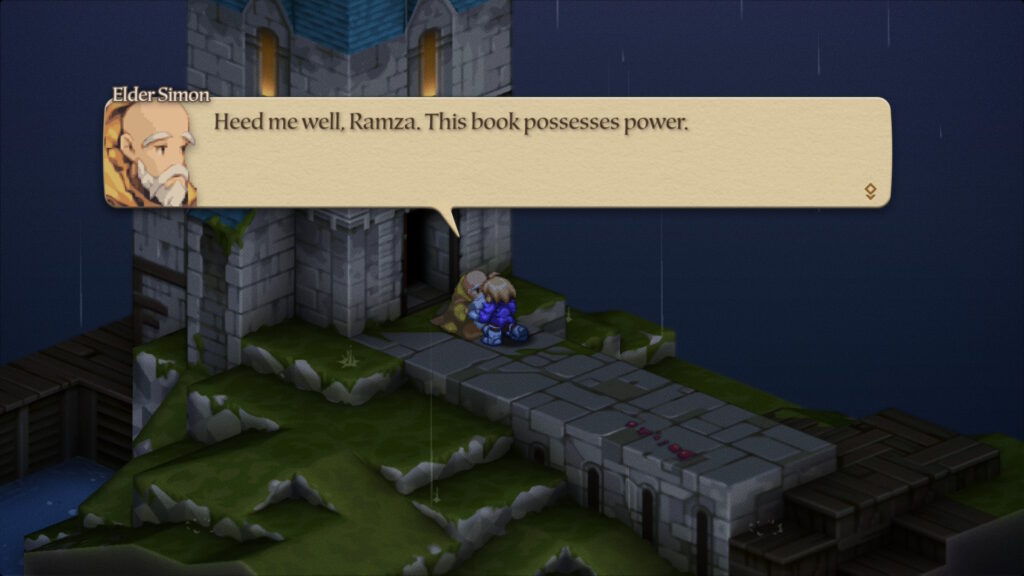
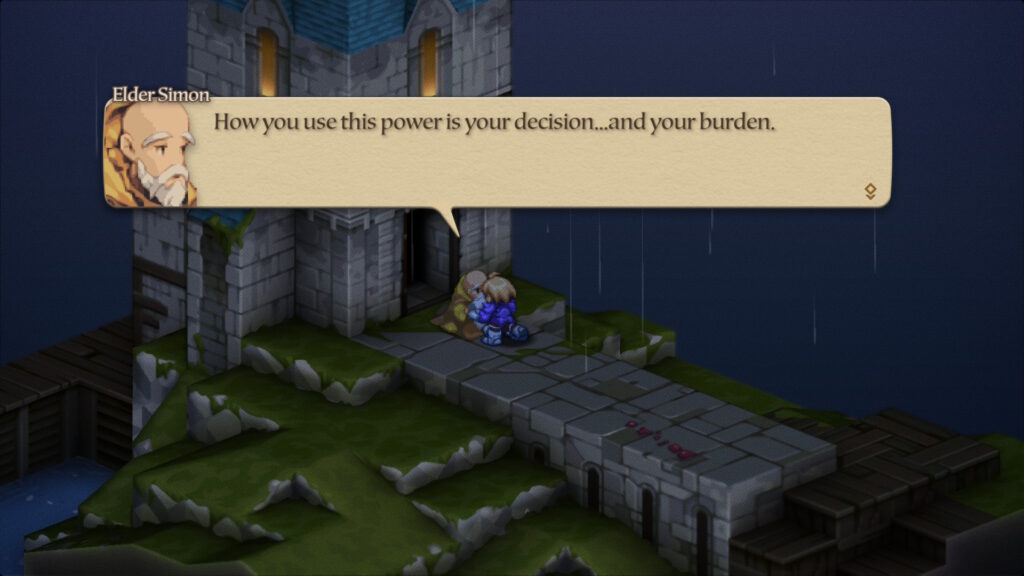
    Elder Simon: It exposes the deception of the Church–that its doctrine is founded upon lies.
    Ramza: A book?
    Elder Simon: That is why we fear it so, and have kept it hidden since the beginning… Heed me well, Ramza. This book possesses power. How you use this power is your decision… and your burden.

    -from Final Fantasy Tactics: The Ivalice Chronicles

    (I don’t even have to explain this; you can guess exactly what is going on in the narrative if you’ve ever, once in your life, consumed narrative media.)

    This is so typical of the intellectual writer-ly class, the sort of person who likes video games enough to write them, or books, or movies or what-have-you: the idea that ideas and Truth have such inherent power that they can change everything just by being revealed. If you are the sort of person who is in thrall to ideas this is bone-deep truth. But even the most rarefied of the intellectual class limits itself to hemming and hawing and acknowledging if this Truth negatively impacts their material conditi0ns. No, I do not know if I am talking about Elder Simon-the-character or the writers of FFT or the players of games; everybody in that feels culpable. Even within the context of the game that “truth” is going to come escorted at the barrel of a gun**.

    But here I am reminded of why I have a fondness for this game:

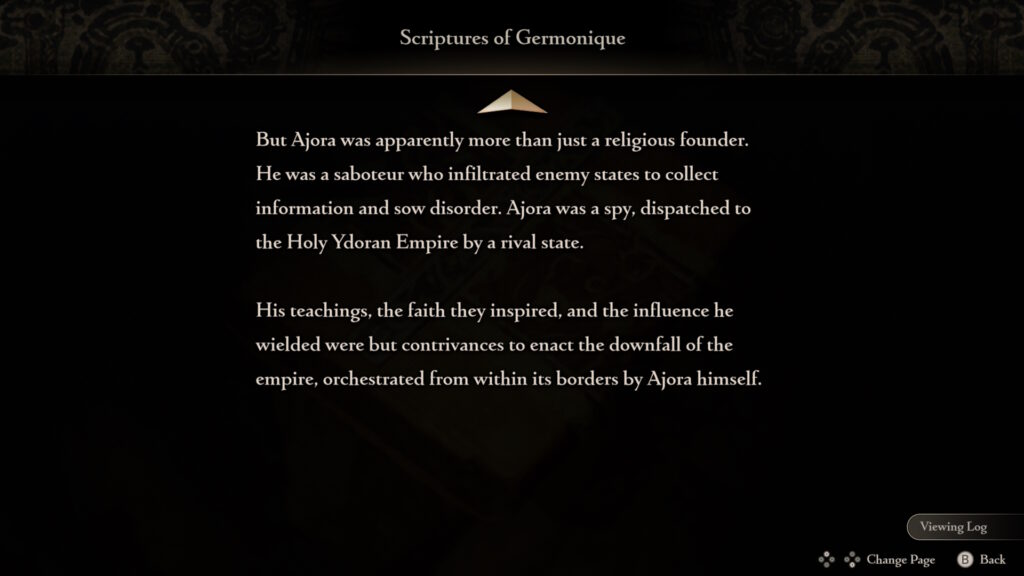
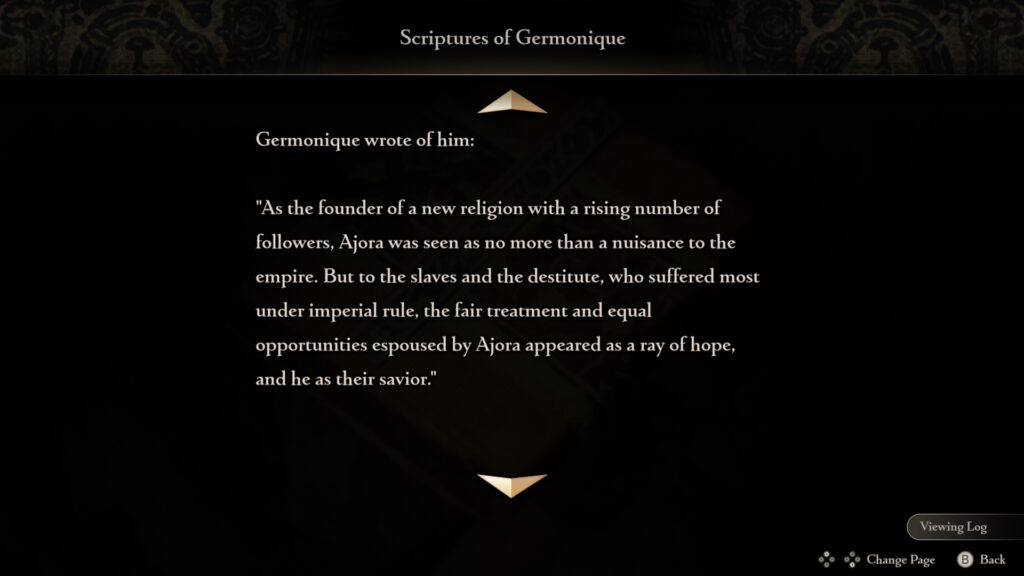
    “But Ajora was apparently more than just a religious founder. He was a saboteur who infiltrated enemy states to collect information and sow disorder. Ajora was a spy, dispatched to the Holy Ydoran Empire by a rival state. His teachings, the faith they inspired, and the influence he wielded were but contrivances to enact the downfall of the empire, orchestrated from within its borders by Ajora himself. Germonique wrote of him: “As the founder of a new religion with a rising number of followers, Ajora was seen as no more than a nuisance to the empire. But to the slaves and the destitute, who suffered most under imperial rule, the fair treatment and equal opportunities espoused by Ajora appeared as a ray of hope, and he as their savior.”

    Scriptures of Germonique, or: that powerful book of Truth Elder Simon was going on about

    There is acknowledgement of the fact that it is by appealing to material conditions that one makes a movement. I haven’t much sympathy for an Empire-as-entity (i.e. not individual people in that empire against whom atrocities of opportunity are committed) that is undermined this way; I don’t give sympathy to the target because the intent of the opposing power was their own imperial gain, but I don’t respect that opposing power, either, other than on an strategic level. Is that opposing empire a “liberator”? Sure, to the people who materially benefit, but the opposing empire gets no moral accolade for acting on its own interests. Don’t run an empire on a fundamental inequality, then, if not because it is wrong in a moral sense, then only because it is strategically unsound on a century-scale. All you can hope for the people is that there is more net material justice in distribution of resources and ‘rights’ as a result–that the burden of the underclass of humanity is lightened, and not just shifted to another part of the underclass.

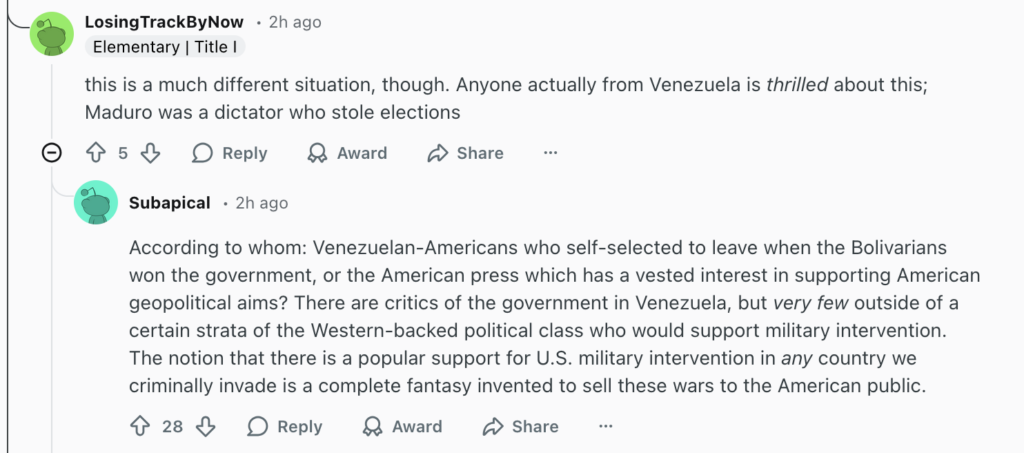
    This sort of we’re-the-good-guys-actually justification is what I’m talking about:

    Meanwhile on Reddit (link is image)

    Both of these things are be true:

    1. Maduro was a dictator who stole elections, and the people of Venezuela would just as soon see him gone.
    2. The United States materially benefits from “seeing Maduro gone” (which is really just a pretense for invasion). It is not doing this out of a desire to set things right, and may well make things materially worse for the people of Venezuela.

    Venezuela has oil. North Korea does not. That’s it. That is all, total, and sum, what is motivating the US. Never look to the smokescreens and platitudes of empire. If this magically somehow ‘liberates’ people along the way, I am glad, truly, for those people. But I’ll never consider the US liberators or a force of ‘good’. If things go well for the people of Venezuela it is the whim of chance, the struggle of the people themselves–not the benevolence of the US–that is to thank.

    I do not think things will go well.

    I’m a Millennial American. My coming-of-political-awareness was defined by Afghanistan and Iraq. Of course I am biased toward pessimism. May time prove me wrong, and if and when it does, I will have no share of joy or pride to share with the American military.

    *The Dispossessed by Ursula K. Le Guin — I firmly maintain performing awareness is a self-indulgent, attention-as-absolution-seeking activity, so it fits within the Odonian idea of “egoizing”.

    **I have spent a great deal of time grinding my white mages to be able to carry guns–which, in an ironic way, is a skill of the orator class, or the class of battlefield persuasion.