My dentist’s offering of stuff-you-watch-on-the-ceiling-TV includes the Bob Ross channel, and as I’m prone to establishing rituals I turn to it when I’m getting work done. Jaw issues that make dental work taxing aside, while I affect calm as an adult deep down I am still That Kid at the dentist who is a crying nightmare the littler kids next rooms down are staring at wondering “WTF is wrong with that kid”. It’s a way of self-soothing*. I also just like watching painting videos.
It is a little surprising, when one thinks on it: there is a streaming channel–replete with sudden commercials, which were immensely grating and near-profane when spliced with a soft-spoken man and soft music–entirely dedicated to episodes of painting tutorials that aired on public access television in the 80’s and 90’s. I’d seen The Joy of Painting some growing up, but I was a little kid when it aired. I can’t pretend I was a diehard fan before the nostalgia-cum-irony-soaked revival of all things sincere and pure in the 2010s, when Bob Ross tat (I can think of no better way to put it–just branded crap) started appearing at art stores and those ‘zany’ gift shops. I do not mean art supplies–I mean things like a Bob Ross chia pet or a Bob Ross waffle maker and other such tat I feel secondhand embarrassment even beholding, stuff that is purely reference and irony and no substance, meme-stuff of the meanest kind.
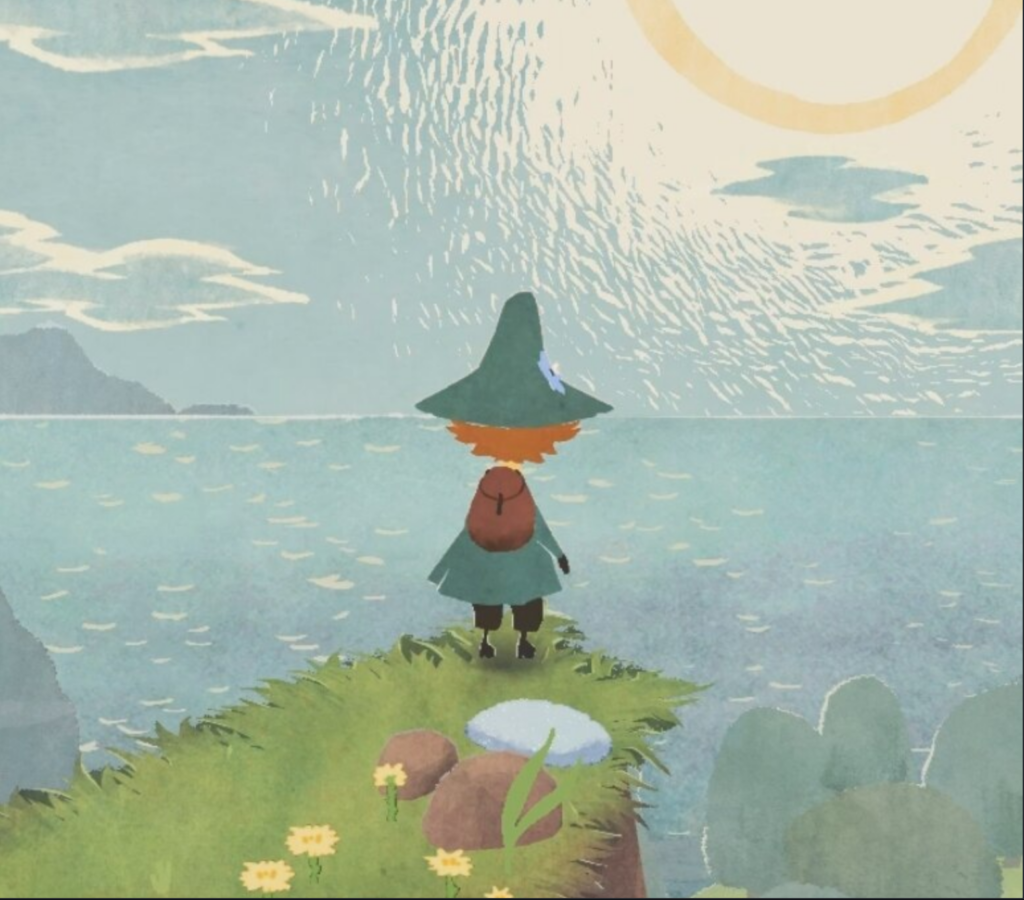
King of all he sees.
I’m working on a Snufkin costume for this Halloween, and I’ve been re-reading the Moomins books–I re-read a lot of children’s books while on the elliptical–so things Moomin have been hovering about just below my waking mind, or infusing it. (Also after the dentist we went to Goodwill where last week my partner saw a Snufkin painting that may-or-may-not (was not, as it turns out) still be there, so his silhouette was at the edges of my mental canvas, so to speak.) So it is not terribly outlandish or offhand that Moomins were brought to mind when watching Bob Ross. Both are un-apologetically genuine and free of the hyper-self-aware irony that has poisoned everything pop culture since the 90s. This is to say, the source material is.
Moomins have also been relentlessly merchandised, especially in Japan, but it’s stuff I admit I find charming–stationary, my bucket hat, the several Traveler’s Notebook-associated tie-ins that sell scalped for an obscene price. It’s pure mercantilism but it’s genuine in its own way; it sparks joy, whereas the Bob Ross stuff sparks revulsion, horror, almost sorrow, a desperate hoping the dead do not see into the world of the living. I may have bought some of the Moomins TN inserts and shitajiki at MSRP had I the opportunity, but I refuse to fall into one of the more corrosive and insidious aspects of Japanese material pop culture that is bleeding into the Western: limited-edition FOMO completionist accumulation.
It’s the same way I feel about gatcha mechanics and blind boxes working their way into Western products; they are immensely profitable and effective, so of course once the popularity of the Japanese model caught on it would be spread. I have bought blind-box figures and gatcha and it’s a little bit of fun, a bit of dopamine, and don’t have a problem with them any more than I do Pokemon cards themselves–it is the scalping and ruthless monetization that turns me off. Leaving the acquisition of some plastic ephemera up to fate makes of the acquisition a moment, a memory touched by the random flow of the universe. I collect memory triggers. And yet this rent-seeking profiteering was predictable given the hyper-financialization of everything in the US; I see desperation in it, the scramble to have a toehold in an economy that is pushing people out and creating more surplus labor each year. It is merely an extension of the idea of mere ownership being a means of revenue, not the creating of a thing itself.
I guess it is sincerity that I see in common in Ross and Snufkin — peddling, themselves, directly, either nothing (Snufkin, who repeatedly says that possessions are a hindrance to him and so much clutter) or the thing itself, the tools of the trade, the art, the lessons (Ross, during his lifetime), and in parallel do I see that essence of sincerity being sold with meta-products, that is, products about Snufkin and Ross, products featuring. Buying the seeming of something, of freedom, of art by one’s own hand, of living in the moment. Selling the essence of simplicity and non-consumption, the courage in living without pretense, in the doing. This is a form of pure vicariousness. I cannot imagine telling Snufkin I spent $500 on a notebook with his visage–the very idea would revolt him, having his image associated with such, used to manipulate people out of money.
I will not pretend Bob Ross’s popularity is purely attributed to his art; his personality absolutely cinched it, but it is a good personality, a genuine one on balance by all accounts, and that is the sort of charisma I don’t begrudge what-are-now-called ‘influencers’. If one is to be famous for being oneself that self should be admirable. Perfect does not exist and looking for it is seeking to get one’s own heart broken, and denying celebrities the dignity of human complexity and interiority, fallibility; expecting perfection is a form of objectification. But if we’re lionizing somebody purely on personality we can look for on-balance good, good enough. It would be a vast improvement over the current influencer archetype, which seems to be defined by impunity and narcissism and disruptiveness.
**I would also like to report everything looks “excellent” and the gum-pocket test was aced.
*I could not hear Mr. Ross’s voice over the scrape scrape scrape whiiiineeeee going up my jaw and into the roots of my eyes, though I am sure it would have been quite soothing. What I DID hear was the sudden jump in volume and “ARE YOU PAYING TOO MUCH FOR YOUR CAR INSURANCE???”
This one’s a real post. Apologies in case anybody has been getting spammed with shitposts. I’m automating crossposting and there’s more debugging (and testing, hence the posts) than anybody ever expects, even though I should damn well know better from script kiddie days back in high school. So that will continue for the near future.
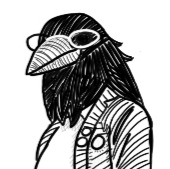
A pilgrim comes seeking fellowship.
Somebody finally said in /r/printSF something I’ve been suspecting–and I do love it when my kneejerk gut takes are proven to be Correct and Wise. There has been a flood of posts fishing for the sort of answer your English teacher would want you to give about a book in AP English, written in AI style. I had not pursued it–my response to my own AI paranoia has been to disengage from everything, which is healthy for somebody who already has a tendency to be a recluse–but of late what were once the last bastions resembling old school message boards on the internet for niche ephemera (the wall-of-text subreddits) are just not engaging me, even though they are trying to start discussions that are in my wheelhouse (Le Guin, Wolfe, old school ‘literary’ scifi, the weeds of theory, etc). The posts have the tenor of a recent convert to the beauty of literature, a pilgrim coming to confess and pray at the altar, seeking the fellowship and validation of the congregation. And, as people generally believe their ‘religions’ are good and should be appreciated more, this is an excellent way to engage them. Yes, including me.
I’m seeing this pilgrim-crawling-to-the-altar and “hello fellow kids” everywhere now even more than I once was; it was bad enough when I suspected people of karma farming and astroturfing, but it was at least a human putting the work in–I could only hope, sometimes, a human who was asking some questions they genuinely wanted to ask as part of their karma-farming, something. Now we are also being triggered into providing some deep, insightful discussions to train an AI algorithm to have deep, insightful discussions. In any case, OP made an astute observation with some concrete evidence of seeding, with more being added down the thread.
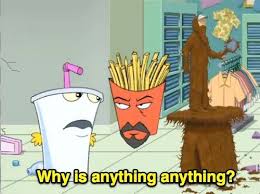
Weighted Blanket of the Absurd
Master Shake’s distracting-from-his-hustle philosophical irrelevances that have the bonus quality of having made me laugh hysterically at 2AM as psychological armor.
Yes, I’m well aware this might be AI-calling-out-AI. Anything might be anything. Fuck it. If I’m going to bother participating on the internet at all I at least need to delude myself that there are some signs of life out there. I’m coping with my aughts-adolescent cynicism and ennui with absurdist nihilist flip. Which, let’s be honest, isn’t the most unhealthy coping mechanism I’ve used, and can be quite fun. There’s that old saw about the funniest people you know being the most depressed people you know and having a lot of practice in defusing psychological agony with humor.
Let’s for the moment focus on the aspect of AI that relieves one of having to do things like pay attention to and think about things that are boring, like books and philosophy and history and Big Ideas, that the gatekeepers of your degree/ license to work a more than subsistence job tend to think are Big, Important things for humans to think about. The sort of person who becomes a teacher tends to be the sort of person who believes in the inherent value of Truth and Thought and cultivating the life of the mind and becoming a well-rounded human-cum-citizen, and that sort of person is the the gatekeeper standing between you and your license to work a bullshit white collar job that pays something more than a subsistence wage. You used to have to indulge them, to some extent, or go to effort and expense to get somebody else to do it for you, but there is now an algorithm that pays granular and close attention to those gatekeepers talking amongst themselves in the brainy tl;dr wall-of-text subs about the things they’re going to ask you to write about and grade you on. That’s a lot of attention-energy somebody else already expended and you don’t want to on things that don’t matter to you.
A bullshitter or conman used to have to be a good listener, and good at guessing what people wanted to hear. That skill, bullshitting, is being de-professionalized, too, now; the algorithm whispers into your ear what to say to bullshit or con. Quality bullshitting and knowing what people want to hear is a skill–another one that is being lost. Again the middle is falling out of an entire profession and the only conmen who make a living will be those exceptional individuals with genius charisma. Workaday mediocre conmen need jobs too–more argument for UBI I guess.
I feel the desperation of realizing every safety valve and escape is being shut off or turned into a honeypot or corrupted–‘escapes’ for ‘intellectuals’ or ‘genuine people’ or however we style ourselves are weirs.
Marketers desperately seeking organic ‘cool’ cred for their product isn’t new; shilling and guerilla marketing are nothing new; influencers are just now up front about it, which I find refreshing. There is a desperate cynicism in capitulating to it all being about the game–we’re far from the gen X obsession with not ‘selling out’. Indeed, to care about ‘selling out’ or ‘authenticity’ is seen as a naive, childish, unsophisticated concern, and while gen Z /alpha may be well on to something, it is part of the pattern of their generation never being raised on ‘hope’ or optimism for the future like Millennials-and-older. When I was in middle school ‘poseur’ was a deadly fucking insult if you were in any sort of ‘scene’ with pretensions to authenticity–skating, music, art, fashion. I remember rumors about who had used a butter knife to scuff up the underside of their skateboard to make it look broken in with the sort of wear pattern you would get with ‘hardcore’ use. That was a fighting accusation. And these so-accused were not attempting to be influencers or anything with a monetary reward; they just desperately wanted to be cool and authentic. Authenticity had enough intrinsic value to be something to lose, something precious. It was, in the minds of these middle schoolers, a very real and deadly serious thing. I wonder if younger generations see that sort of totemic belief as naive in the way that believing in ‘capitalism’ (as an ideology of ‘freedom’ or something) seems now, or ‘free enterprise’, or ‘the American dream’.
Considerations of ‘specialness’ aside, this is why people in subcultures condemn ‘selling out’–you make something profitable and the vultures come in and shit all over it. I’ve watched it happen. Anti-gatekeeping rhetoric is being co-opted to stifle conversations about this.
I realize it’s not just getting people to buy shit, monetarily, in a material sense. It’s also political astroturfing, and the everything-sucks-fuck-you pissed off adolescent nihilist philosopher* inside me firmly maintains it’s all the same thing anyway. It is and it isn’t. A healthy criticism of all parties so often just becomes this nihilistic centrism that, functionally, is no different from political neutralization. Trying to sell me mediocre terrycloth hoodies on Instagram is obnoxious but I’m not going to pull the galaxy brain take that it is equivalent to influencing elections. Same tactics, yes–a ‘sale’ is a sale, of ideology or terrycloth hoodies–but equally urgent a threat it is not. The corrosive effect on mutual trust that comes of suspecting either in every interaction is a social enshittification agent, all linked, ultimately, in the big cosmic sense, on big time frames, but in the immediate sense one makes you regret buying bad clothes and the other effectively legalized suspension of due process.
It was mentioned in the original post that many of these suspect accounts also posted in job hunting subreddits, which are utterly lousy with recommendations for resume editors and other magic bullet solutions for desperate over-educated under-employed professionals DOGEd or AIed out of an already shit market**. Maybe this is my naive Millennial belief in the concept of ‘earnestness’ or ‘validity’ but this seems particularly scummy, preying on a need instead of a desire. Doing so is not new but it seems to be one of the few hustle avenues still (or even increasingly) profitable in a collapsing postindustrial economy.
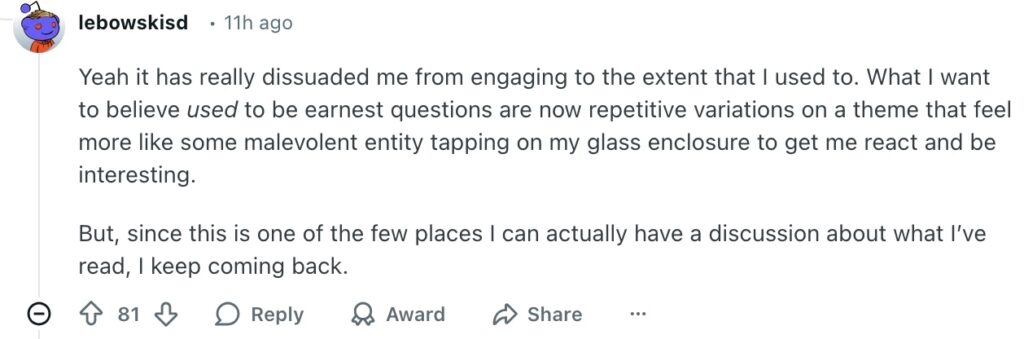
Reddit user lebowskisd: “Yeah, it has really dissuaded me from engaging to the extent that I used to. What I want to believe used to be some earnest questions are now repetitive variations on a theme that feel more like some malevolent entity tapping on my glass enclosure to get me [to] react and be interesting. But, since this is one of the few places I can actually have a discussion about what I’ve read, I keep coming back.”
The Dude(‘s D?) puts it well. Some entity listening in to the place where the eggheads go to escape and trying to prompt discussion to harvest.
Reddit user Beneficial-Neat-6200: “Agreed. Over on r/wallstreetbets the prevailing theory is that the value of rddt more related to monetization of user content for Ai training than from advertising”
This is probably correct. I still see a market for vendors of niche products to hobbyists, many of whom, if they are on Reddit, have disposable income and tend to limit Google searches of product reviews to Reddit or other websites where ‘real people’ used to hang out. They’ve always been lousy with shills, and everybody knows it, but it was also one of the few places to get an honest opinion mixed in there.
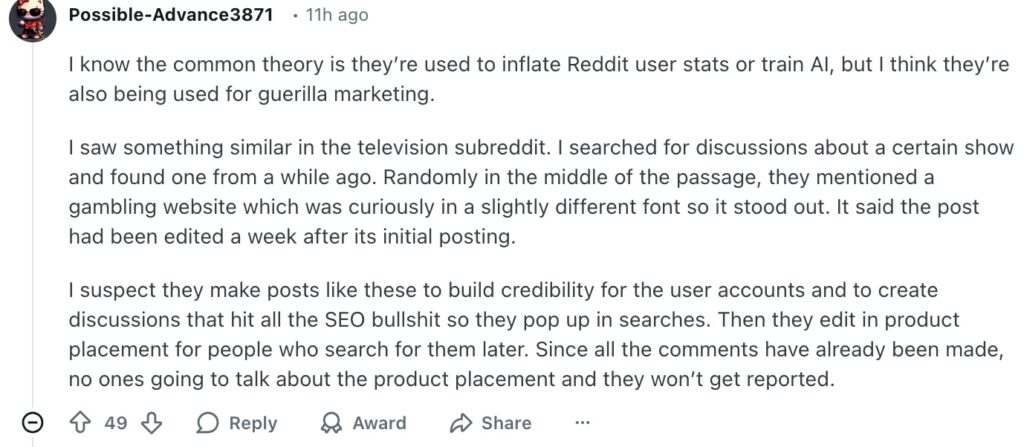
Reddit user Possible-Advance3871: “I know the common theory is they’re used to inflate Reddit user stats or train AI, but I think they’re also being used for guerilla marketing. I saw something similar in the television subreddit. I searched for discussions about a certain show and found one from a while ago. Randomly in the middle of the passage, they mentioned a gambling website which was curiously in a slightly different font so it stood out. It said the post had been edited a week after its initial posting. I suspect they make posts like these to build credibility for the user accounts and to create discussions that hit all the SEO bullshit so they pop up in searches. Then they edit in product placement for people who search for them later. Since all the comments have already been made, no ones going to talk about the product placement and they won’t get reported.”
I admit I had never noticed this pattern before, even though I’ve been trawling through ‘old’ threads looking for info my entire internet life. Such product placements probably just got caught in my bullshit filter and immediately disregarded as brand shit, but I never bothered to look up the editing timestamp because I did not care. But this is critical–it is a piece of what, exactly, bolsters the monetary value of a ‘trusted source’.
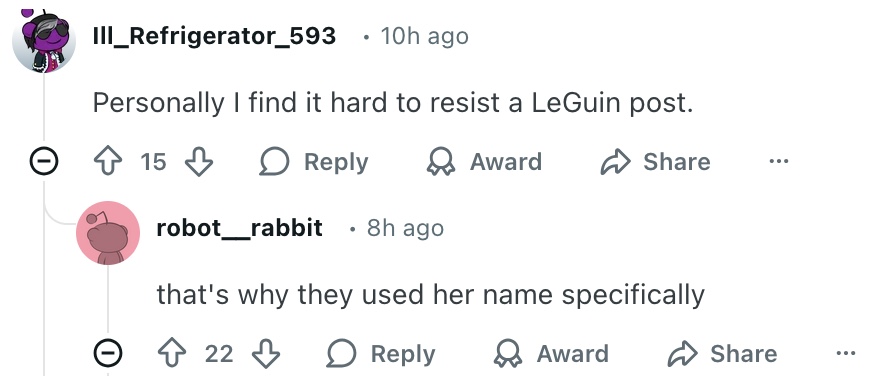
Reddit user Ill_Refrigerator_593: “Personally I find it hard to resist a Le Guin post.” User robot_rabbit: “that’s why they used her name specifically”
Me too, Ill_Refrigerator-san. The authors being featured in these suspect posts seems to be a who’s-who gallery of what I have heard referred to as “your favorite author’s favorite author” – highly-praised literary luminaries who may (Le Guin) or may not (most of the rest of them) be popular. Also likely to be the favorite authors of the sort of person who is going to put themselves into the position of gatekeeping your degree or interview vis-à-vis going into teaching, or the authors people list as ‘favorites’ if they want to seem intellectual and deep and from that trustworthy, above petty considerations such as money and popularity, genuine.
Reddit user chrooooo: “A movie based on a Le Guin will be announced soon.”
Fucking hell, you may be right. Now I’ll be suspicious and surly instead of mildly, reservedly interested. While I never had much hope for adaptations from other sources, Ghibli Earthsea burned me too badly. I’ll be bitter about that one until the earth falls into the sun.
Daily I am more convinced of the existential need to retreat to a shack in the woods.
Fine. Those online spaces are all compromised. So now what? Limit ourselves to the people within easy physical meeting distance? That’s lonely work if you have niche interests. The internet was the first time, for better or worse, all these niche weirdos found a welcoming lounge-cum-echo chamber, and it was the most high quality social interaction many of us had for years, especially if we lived in a small town in what is now MAGA country. Part of how those spy camera/microphone ‘glasses’ are going to pay for themselves in data harvesting is through eavesdropping on these conversations we take offline, if we can, when we can. When might somebody get paid hourly to hang out in a bookstore or coffee shop wearing those***? Your employment manual will recommend very obviously ‘reading’ a book that may start the conversations your client wants, or painting, or wearing a shirt with an unfortunate opinion. If there is a hierarchy in pay based on how pleased clients are with the information you get there will be an incentive for the best bullshitters do this work–a resurgence of the ‘peer influencer’, who influences people who do not like influencers. AI paranoia is going to creep into IRL conversations–not just in the sense of AI being fed as answers through an earbud or lens so you can get laid or get a job or sell something, but also in the sense of being harvested, used to train skinwalkers to seem more human. ‘Authenticity’ will always be the most coveted thing a marketer will seek, no matter what the product being sold.
Paranoia is isolating and exhausting. I keep seeing reasons it is an accurate response to one’s environment, not an individual pathology, necessarily. The same issue with depression or anxiety being an appropriate response to life circumstances.
——-
*This is the same entity that thought Trent Reznor’s rendition of Closer at Coachella was fucking sick as fuck.
**Hi.
***Even if like one out of a thousand of those conversations yield anything interesting it is still of value to information brokers. Also if you’re hiring I have two elderly cats with high needs and could use the scratch.
I justify to myself being spendy at the gift shops of museums, national parks, other nonprofits, etc, as providing ‘support’. Either way both of us benefit and from a utilitarian perspective that is a good thing, questions about ‘true altruism’ or other abstractions aside. So I don’t sweat it too much.
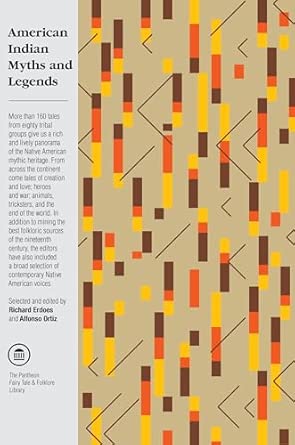
I picked up American Indian Myths and Legends (editor/compilers Erdoes and Ortiz, Pantheon Fairy Tale and Folklore Library) book at the Joshua Tree NP gift shop. This is a book seemingly tailored to my interests–sociology, mythology, anthropology, a generous helping of annotations from scholars, a clean minimalist book cover that would pair in a lovely way with other volumes of the same series on my bookshelf, sturdy paperback. I do like the use of large blocks of pattern and the sidebar summary in this Pantheon printing; the entire effect is charming, gives a clean ‘universal’ impression, free from proprietary this or that or over-reliance on one person’s interpretation based on their illustration. Anyway, I’ve been picking through it between other books and I last night got to the portion on war-and-valor-related myths, the introduction of which mentions the coup stick, which triggered a memory that has not been unearthed for probably thirty years. Proust’s madeleines and involuntary memory again. I was familiar with this concept. I had heard about it, a time buried in the distant past. I had not since read about it, so I was inundated with that-timeness; I was for that moment a schoolchild in awe of the ways of others, so different from my own that they seemed inherently mystical.
The untouched memories
These are my memories before I taint them with further research, using the terms my memory uses (i.e. what I would have learned as a Texas schoolchild in the 90s):
A notion of a special “coo stick”. I visualize something like Sokka-from-Avatar’s war club, an embedded jewel the stick cups like a wave. A sense of an Indian warrior sitting straight and proud, very proper, on a horse, riding up to a white invader, tapping them gently on the head, and bolting. No sense of hurry or danger from the Indian. Serenity and poise, making a game of something the White man treats as deadly serious. A child’s budding sense of ‘are we the baddies?’ I am in a classroom. Classroom walls, the bright primary colors, construction-paper cutout headings on bulletin boards. When I visualize-read the term “coo stick” so Anglicized it further triggers the memory–this must be phrase I had only ever heard, specifically.
Rarity of experience
I grapple with involuntary memory quite a bit. That, in itself, is not infrequent for me. It is however unusual for me to access a bit of intellectual trivia that has not been touched, as far as I can sense, in decades, especially when it resides within the realm of things I regularly explore (in this case sociology/mythology/history etc), so I want to sit with it a while, turn it over in my hands, before I go off on a reading spree to update my knowledge.
NOTE: This was originally my preamble to my review of The Algebraist, but it went off the rails enough to be in blog territory.
My patience for reading things that start a bit of a slog but pay off ‘in the end’ is high. I admire any artist or writer who in this day of dopamine hyper-addiction and micro entertainments is willing to ask the reader to have faith and take the long slog, as it will pay off in the end. (Or, probably more to the point, the publishing house willing to publish it.) This wasn’t as much of an Ask in 2004, when The Algebraist was published, but in 2024, when Orbit started republishing Banks’ works with a new minimalist Windows screen saver aesthetic cover design, it was.
This is a constant of Banks’ works—hyper-detailed, unexplained jargon, blow-by-blow decontextualized action that only on looking back completely makes sense. Use of Weapons is possibly most exemplary of this of his works, with the most famous payoff. Tor is putting out new versions of The Book of the New Sun, which asks faith that moves mountains–in the face of four books of what might as well be post-apocalypse Jabberwocky for all the sense it makes in the first read-through—that it all ties together, eventually, so perhaps there is an appetite for this sort of slow investment again. I wonder how much of that ‘demand’ is fueled by self-disgust in people whose attention spans are utterly shot, who want to force themselves to appreciate something ‘slow’—the anxiety of intellectuals who are, unfortunately, caught in the same damn trap as the rest of society, but have the burden of being aware and ashamed of it. I cheer on anybody who is trying to undo the dopamine addiction, the scattershot three-screens-at-once attention span. I’ve fallen into it myself and had to claw myself back out of it.
Well, Banks and Wolfe are both decorated authors, multiple-winners of prestigious awards, the favorite-author-of-your-favorite-author as I once heard it put, and that reputation itself does a lot of lifting of the marketing. A “classic”—an accomplishment to have read, a victory for the struggling dopamine addict intellectual. Perhaps that designation is carrying a lot of the decision to re-print. Kind of a moot point, perhaps, to ask if these books ‘could have been published today’ because the weight of the designation of “classic” and the endorsement of popular contemporary authors primes the reader with far more fortitude and patience than they would bring to opening a new book from an unknown author. I admit I am no different—I trust Banks, so I give him more grace when I’m not jiving with the work immediately, and the payoff comes in the last twenty or so pages.
The ones who tell our stories
The old advice to ‘grab the reader immediately’ only seems more urgent, now—the adage that you have a page to grab the reader/editor seems almost quaint and naively generous. You have a catchphrase, a list of tropes. What works are we losing because publishers are too aware of this taste of the market? And what brilliant writers with asocial souls are not getting published? Leaning into questions of identity-as-shaping-narrative, what narratives do we necessarily lose when that sort of person is locked out of publishing? Does the soul of the BookTokker have within it The Brothers Karamazov or Always Coming Home? That aspect of the human experience simply is not being printed. It is not ‘better’ or more ‘valid’ than the modern social media socialite soul, but I lament that there is no place for it.
This begs questions about the emperor’s new clothes, and our ability to accurately evaluate a work ‘of its own merits’ (implied: decontextualized, which is impossible). I’ve thought a great deal about meta-narratives readers impose upon authors’ works, something that seems only to have gotten more prevalent with hyperfocus on identity in interpreting one’s words. Indeed, to do this—to ‘think about who is saying this, and why’—is now a stated imperative in leftish circles, and while it does have a materialist bent (we are shaped by our circumstances) it is the sort of belief that leads to the Isabell Fall tragedy: the “attack helicopter” story in Clarkesworld that was condemned as ‘dangerous’ outright and the only possible mitigation being Fall’s identity: that only a trans voice could be trusted to parody anti-trans speech in good faith. She was pushed to out herself as a trans woman. She did not want to out herself, originally; she just wanted to publish a story and have it stand of its own merits, for the tongue-in-cheek to be evident to any reader with a brain. Anonymity as condemnation—part of a larger trend online of finding pseudonyms suspect because they might obscure that a person is out of their lane, so to speak.
(Note: I wrote the bulk of this a month ago, when the murder of Alex Pretti was still fresh news. It’s been years since a month ago.)
Alexander Aksakov/Getty — Prison Castle, Siberia, Dostoevsky’s “Dead House”
I’m not very disciplined even in whatever self-imposed ad-hoc ethical system I’ve imposed upon myself. I believe–intellectually–that good and evil are things that you do, not things that you are. And yet I find myself thinking of people as good or evil, or liking or not liking them, if I do not keep a short rein on my thoughts.
I have an old friend in prison. He is, I would say, a good man, who did something horrible. He had a psychotic break in a country (and milieu within that country, furthermore) that provides miserly help for mental health while providing generously for ease of access to guns. (I will say this: a man will not ‘seek help’ if said seeking ends his career, and he has a wife and child to support. This is to say nothing of a disease the very pathology of which obscures ones insight of self. But there are those windows of clarity, those moments of “what am I doing”, those moments when there’s an intervention, and because of the first concern you’ve squandered that.) How do I reconcile “good” with this? Genuine repentance, genuine horror and regret. I suppose “feeling” can be “doing”.
Anyway, I finally read Notes from a Dead House by Dostoevsky, a thinly-veiled autobiography about his time at hard labor in Siberia for being part of a socialist literary circle in a Tsarist Russia that had just been given quite a fright by the goings-on to the west in Europe in 1848, and so was particularly inclined to punish anything red-tainted with a heavy hand. I want to send a copy of this to my friend in prison. (He is not going to leave prison.) Tiresome as I am sure it is to have everybody define your life by ‘being in prison’ it is An Experience and a consuming one, and Dostoevsky’s humanity and love for his fellow prisoners is emblematic of the very best tendencies of the Christian tradition, what I consider closest to that of the compassion of the Biblical Christ. It is a compassion that does not deny that some of these men are scoundrels that would stab you for a dram of vodka, but they are men, for all that, and have an inherent human dignity and an inherent goodness they can choose, should they choose. Timshel. And ‘thou mayest’ be more likely to choose compassion when you are treated with dignity. Anyway, I wanted to pick his brain on how much Dostoevsky’s observations hold up with his own, with regard to the nature of man in captivity. He is a thoughtful and quiet man who helps his fellow prisoners get their letters and numbers, as he’s one of those rare breed of educated prisoners, not to make too fine a point on the extent to which ‘criminality’ coincides with ‘economic necessity’.
It doesn’t much matter because that state just decided that prisoners can no longer receive books, even straight from Amazon. I somehow doubt a book known for exploring the humanity of the incarcerated and the corrosive effect power has on those who wield it would make it past censors in the most permissive systems, but I am still pissed. I just donated a few bags of paperbacks to my local prison system (it’s one of the more permissive in the country, which is saying little), mostly science fiction and fantasy, nothing that would raise eyebrows, but all passing my personal and rigorous quality standards as Something Worth Reading, and I felt warm imagining somebody finding something good to read, something to take their minds outside the walls and speak to them as a human with inherent dignity.
Voluntary executioners
I keep what could generously be called a zibaldone–or less generously, a collection of scrawling and scribbling and doodling whatever is cluttering up my mind or whatever quotes hit me–and unsurprisingly one can trace what I’ve been reading by trawling through my notebooks. (I date sketches; that’s about it as regards organization.)* Notes from a Dead House was on my list long before the recentunpleasantnessup north and maybe my subconscious drove me to pick it of all the books on my queue, having been marinated in all this unfortunate to-do and misunderstanding of Rashomon-like subtlety.
“There are people, like tigers, who have a thirst for licking blood. A man who has once experienced this power, this unlimited lordship over the body, blood, and spirit of a man just like himself, created in the same way, his brother by the law of Christ; a man who has experienced this power and the full possibility of inflicting the ultimate humiliation upon another being bearing the image of God, somehow involuntarily loses control of his sensations. Tyranny is a habit; it is endowed with development, and develops finally into an illness. I stand upon this, that the best of man can, from habit, become coarse and stupefied to the point of brutality. Blood and power intoxicate: coarseness and depravity develop; the most abnormal phenomenon become accessible and, finally, sweet to the mind and feelings. Man and citizen perish forever in the tyrant, and the return to human dignity, to repentance, to regeneration, becomes almost impossible for him. What’s more, the example, the possibility, of such self-will has a contagious effect on the whole of society: power is seductive. A society that looks indifferently upon such a phenomenon is itself infected at its foundation. In short, the right of corporal punishment, granted to one man over another, is one of the plagues of society, one of the most powerful means of annihilating in it any germ, any attempt at civility, and full grounds for it’s inevitable and ineluctable corruption.”
I wasn’t even much thinking on the corrosion to the soul that is being given power over another human being–the corrosive effect on any person, even a ‘good’ person–maybe because I read that chapter within a few hours of the murder of Alex Pretti. I was thinking on what Dostoevsky called “voluntary executioners” in the translation I read.
There are two kinds of executioners, those who of their own will are executioners and those who are executioners by duty, by reason of office.
Bad people. People who are bad. Fundamentally broken. I was not practicing my equanimity, my defining-people-only-as-doing; I was thinking about the sort of person who joins ICE because it looks like good fun. Do I wish to believe in the existence of the ‘voluntary executioner’ who is somehow more intrinsically bad, more evil, than the ‘involuntary executioner’ who only takes on this role through economic desperation or plain naivety and is through the corrosive poison of the very nature of the job itself made into a bad person? I am again going against my sincerely-held belief that evil is what somebody does, not what somebody is, but there are people who take such glee in inflicting pain I admit I see them as ghoulish. Well, it is perhaps more comforting to think that there are people just ‘born wrong’, independent of intellectual disability or brain malformation, than that anybody, even the kindest person, has the germ of this cruelty within them, and it is only a matter of choosing whether or not to nurture it. Timshel. Some natures make choosing evil more pleasurable or less painful than it is to others, perhaps. I can only hold that it is not fair that some people have innate checks on cruelty and others do not, but though it is not somebody’s fault they were born with low empathy or sadistic tendencies, it remains their responsibility to manage it. It is not fair, but it is. Fair and not-fair, deserving and not-deserving, are ultimately distractions, child’s excuses; one deals with what is.
Are they different and does it matter, when the trigger is pulled on a gun pointed at a man’s back? Why do I want it to matter, when a bullet kills just as surely no matter the thoughts or inner self or true self or what-the-fuck-ever of the person squeezing the trigger?
This hurts you more than it hurts me
I have yet to see a category of person who supports ICE: a person who thinks that what is being done is necessary, but dislikes how much pain it causes. I have seen nobody with the surgeon’s sobriety at inflicting ‘necessary’ pain. All I see is glee that pain is being inflicted.
Is there a person who thinks all the raids are ‘necessary’ (for… the health of the country, I guess) and who also acknowledges and grieves all the human misery it is causing?
Even indifference, self-preserving callousness, would let me know there is still a soul in there that needs to be guarded. Or, it means that one does not see the people suffering as fully ‘human’ or believe that they are truly ‘suffering’, which is its own defect of the soul.
Who do what is necessary
I’ve been on the internet long enough that I’m difficult to surprise with pretty much any level of pretentiousness or self-delusion, but the DHS penguin tweet (I’m not linking to it) just about did it.
My first thought was that “Americans have always known “why” [the penguin walks away]” was a reference to Ursula K. Le Guin’s The Ones Who Walk Away from Omelas, the sort of delusional reading of a story I saw so often wherein people manifestly bad, manifestly on the side of wrong (here I go again with those value judgements) interpret an unambiguous parable about self-denial in doing what is right as in some way having something to do with them doing what is wrong, but taking on the ‘self-denial’ of the esteem of their fellow humans who just refuse to see that they are only doing what must be done, unpleasant as it might be. It’s the primary balm to the soul of somebody who does something evil — to re-frame it as something that is Unpleasant but Necessary, to recast oneself as the equivalent of the outcastes who took on unclean jobs like corpse disposal and butchery that were necessary to the functioning of society, but that nobody wanted to think much about, just reap the benefits of, and then hate the people doing the deed from which they benefited, from which they were spared guilt. A proud, stoic person who loves humanity so deeply, so purely, that they will do what is necessary even if those people who benefit hate them.
How does this square with my earlier complaint about ghoulish joy? I guess butchers cannot have too much empathy for the cows they slaughter, but they don’t like it when their children run from them because they smell of blood.
——–
*If you are picturing one of the ~aesthetic~ strictly-formatted and regimented journals, the sort of spread that looks just lovely on an Instagram or Pintrest with neat handwriting and makes you want to go analogue… well, keep picturing that if it encourages you to keep a notebook; I’ve found the practice immensely gratifying, but nobody is going to look at my notebooks and get inspired.**
**I do like looking at ~aesthetic~ journals and hipster-ass stationary pages; my follow list on personal Instagram is a shameful catalogue of actually now that I think about it precisely the sort of marketing nonsense I’ve ranted about.
Been a bit dead around here of late. I do have a science camp comic on the backburner that involves Labubu(s). I don’t know what the proper plural is and I’m sure if I asked the kids I have this afternoon their opinion they’d go with the English-speaker’s tendency to pluralize with ‘s’ if uncertain.
“I’m a scholar. I enjoy scholarly pursuits.” –Buster Bluth, emeritus polymath scholar at UC Irvine
I mentioned this in an earlier post: I’m going back to school! At 30-or-40 years old and already having a doctorate. I need a couple of course credits for a license and one of them is a 101-level class in my Ph.D. subject. Yes, really. The license requirements are pedantic and literal to that point; this has much to do with guild protectionism of a lucrative post and the massive exodus of research scientists into clinical science, given the disemboweling of government/academic research and the dismal state of the biotech industry. But the second class (hematology) is taking more time than I anticipated, given that I insist upon reading the textbook chapters whole and my experience vis-a-vis blood is largely the immune system. Competition for these clinical positions is cutthroat and I’ve got to prove this old dog can still learn new tricks, or, at the very least, indicate that my dismal publication record is not a result of a dismal drive or dismal intellect.
Perhaps you seek too much
Bit of my analogue fetishism/return to notebook the past few years–I’m taking notes by hand, and I have to admit retention is far better than when I just download the lecture powerpoint or even type notes. The tenor of the past few years of my life is one of regret, of wishing-to-do-over–so looking back at my undergrad and grad years and wishing I had (a) done the reading more diligently and (b) taken detailed hand notes. I had been hit by a combination of gifted-kid arrogance and depression. I felt in a weird way that reading the text and taking notes would be cheating–that I should be smart enough to remember stuff told to me once, that I should not be that pedantic apple-polishing student who tries very hard but isn’t all that naturally bright. Looking up examples is cheating; I should be bright enough to extrapolate everything I need know from a few basic rules. It’s all bullshit, of course–I maintain the honors students are the students who lie about how much they study by understating, or they were in my day–but my younger self was disgusted by the idea of being too lock-step with the system and, perhaps most damning, was rewarded for this behavior with good grades and scholarships. I wanted to be so damn naturally smart that I could not-try and be valedictorian. I also had a Hesse-esque fixation on being no-one’s acolyte or student but my own that carried over well into adulthood. I wanted to be the Siddhartha who rejected the tutelage of the Buddha to find his own truth, much as he respected the Buddha’s teachings, the Max Demian who kept his own moral council.
Might I be in a better position now if I had knuckled down that first year of graduate school–sure. I put all my time and reading into my lab rotations and neglected my classes, and that was reflected in my grades, which impacted my lab rotations when it was time to get a permanent lab. I was frequently at one lab until 1 AM. But that lab (that liked me most) had taken me as a rotation student on the understanding that I would have to secure my own funding to stay with them–and I didn’t, not for lack of trying. I am stupefied meditating on how different my career might look how had I gotten that damn NSF grant, or something. I ended up in a solid enough lab but to make a long story short our off-campus collaborators told me two weeks after I defended that the data upon which I had based my dissertation–and two substantial first-author papers I was waiting for other-author comments on–was faulty, in such a way as to invalidate the entire premise. I was allowed to graduate because I had defended correctly what I had been given in good faith. But, those papers never happened–the PI of the other lab was caring for his wife on hospice and the PI of my own lab had his own age-related issues. I should have been more of an asshole and leaned hard on them but I can’t bring myself to do that to kind old men. It is utterly against my nature to impose upon people, because I hate it so much when people impose upon me, and I treat others as I wish to be treated.
And here I am.
About what you know
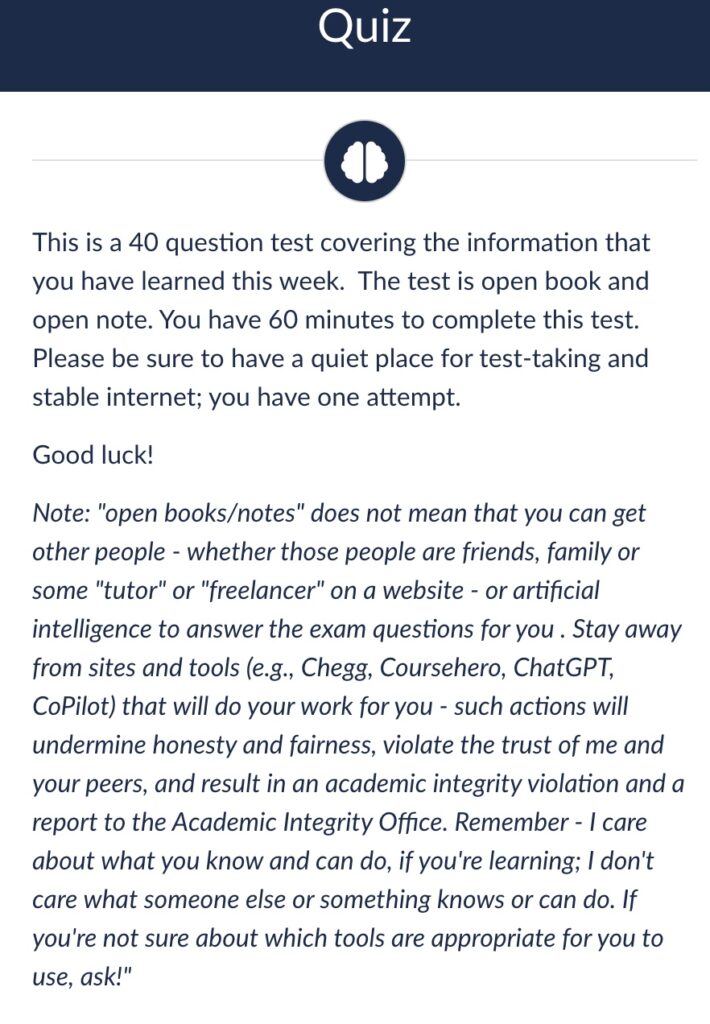
“Note: “open books/notes” does not mean that you can get other people – whether those people are friends, family or some “tutor” or “freelancer” on a website – or artificial intelligence to answer the exam questions for you. Stay away from sites and tools (e.g. Chegg, Coursehero, ChatGPT, CoPilot) that will do your work for you – such actions will undermine honesty and fairness, violate the trust of me your peers, and result in an academic integrity violation and a report to the Academic Integrity Office. Remember – I care about what you know and can do, if you’re learning; I don’t care what someone else or something knows or can do.”
I am so glad I got my Ph.D. before ChatGPT and the other generative AI became prevalent. The date lends a credibility to it. I am also glad I am not teaching remotely in this brave new world because this disclaimer–really, this entreaty–bleeds with desperation that comes of only being able to tell people not to cheat in their own best interest because–please. Just please don’t, else the spirit and credibility of academic accreditation is gone. As an somebody who wanted to be an academic or a post-secondary instructor I understand the desperation, the same way I sometimes wonder how set I’d be were reading and writing still marketable, unique Skills.
I am a scholar – maybe not so far removed from Buster Bluth as I would like to think, the only thing separating us being that I decided upon a concentration and he had the family largess to be an eternal student.* I’m primarily a knowledge-peddler, a thinker, responding to crisis or shock with paralysis and thinking. Perhaps my kind is ultimately of as little usefulness as a farrier in the age of the automobile, where horses are a novelty and one only needs so many farriers, a very rare lucky few to serve what is an elaborate expensive hobby and not a social need. One can argue whether or not this is intrinsically a bad thing or a loss for society but either way I’m kind of fucked, aren’t I.
You’d be one of the bright ones
That is the message I got growing up in the 90s – I was so intrinsically bright, so intrinsically chosen, that a good life and a fulfilling career were all but guaranteed, and all I had to do was not fuck it up too badly.
That’s another thing that’s difficult to come to terms with, the point where all this intellectual pride intersects with a very American-Protestant pride in being The One Who Rises Above, the cream of the crop, the bright ones who earn a degree of comfort and stability in life. There’s something of the Calvinist pride in being “chosen” to be endowed with natural gifts, that pride in what-one-is and not what-one-earned that is an odd and striking counterpoint to the ‘you must earn everything’ ethos that is the face of that Protestant work ethic. I maintain New Calvinism** appeals in this day of the shattered myth of meritocracy (or the ‘fuck you, I got mine’ era) because it gives realization of this painful truth, at the very least, the aura of stoicism, of clear-minded clear-seeing grit. Like Pa Ingalls letting his family starve before he lowers himself to accepting charity, and that being seen as admirable, American. “Play the hand you’re dealt” and don’t complain, but still be proud of being dealt a good hand. Pride in acceptance of one’s lot. “God did not choose me to deserve much in this life.”
I do not believe you have to be exceptional to have a good quality of life. And yet as the haves and have-nots diverge further, as the middle is hollowed out and the have-nots reach such a majority that the K-shaped wealth curve becomes very bottom-heavy indeed, I still find myself feeling this economic uncertainty and precarity is my fault. I wasn’t one of the Bright Ones after all.
——–
*I also think Lucille is hilarious but I could not actually put up with her in person, let alone live with her, let alone have an incestuous pseudo-marriage with her in which she is in a position of authority over me.
**Consisting mostly of those “extreme” youth churches with a grunge-by-way-of-industrial aesthetic stuck back in 2002 with the billboards all over I-10 that multiply east of LA proper.
I am reading Translation State by Ann Leckie (sequel to the Imperial Radch trilogy 123 I favorably reviewed, fucking hell, ten years ago).
It is a far-flung high-tech space opera published in 2024, near-Culture levels of tech, or at the very least, well beyond Star Trek with warp capability etc. It’s a lovely book and I am thrilled the author chose to revisit this universe, but that is not really here or there.
There is, in short, a bloody, shocking, historical event the aftermath of which is well documented on some sort of audiovisual media, and a group of people who think the event was completely made up. They have a motive, granted, and that is the best negation of proof. But the POV character at the time seems to think having seen the footage is proof enough. And my immediate thought is — why are you not considering that it is AI? Of course post-disaster footage can have any narrative attached to it, but I was more interested in the POV character’s immediate faith in the footage itself being real. And I have read a lot of science fiction over the past a lot of years– I am trying to recall what my initial reaction was to like statements (i.e. what is seen is what is) in older novels with a similar level of far-future tech quantum leaps beyond our own. Of course in the narrative structure of science fiction is inherent a lot of technological gotchas and revelations, and generative AI has been a staple of science fiction since its inception, but what I thought was — why does this character, specifically, not consider AI? Not me the genre-savvy reader, but this character who in-universe is not unusually adept in tech or science.
When did generative AI move, in my mind, from the category of esoteric and theoretical to a given like electricity? When did I assume it was common enough to be first thought for any person of any tech background?
When would I have begun to wonder if the very fact this character of this high-tech epoch did not immediately draw it to mind might be a clue, an anomaly, some key to a backwater upbringing?
It isn’t, and wasn’t. It’s beside the point as far as the novel itself is concerned. But I have been wondering about my reaction, me-in-2025, and the-author-in-2024.
Considerations:
The AI concerns were already addressed in the “backstage” of the novel, temporally or narrative-wise, and there was no narrative point to bringing it up as part of the character’s thought process. I am reminded of Hermann Hesse’s characterization of brevity as respect for the reader in Steppenwolf.* Leckie’s style is also spare and to-the-point. It is good to let some what-ifs breathe.
Advanced AI is at the forefront of this series — consciousness of collectives and machines is a key theme of the original series.
Why would I assume generative AI would precede cognitive AI?
As a law of nature?
As a necessary “upstream” technology of that more advanced AI?
There is clearly an ‘order’ to scientific discoveries, a sequence — science builds upon itself and many discoveries depend on previous knowledge. So it is not itself a silly thing to believe, that there are forms of tech necessarily upstream of other forms.
With the advance of time, this disconnect is written off as aesthetic. That is the essence of ‘retro-futuristic’. The aesthetic is intentional in works written after the advent of that tech and merely charming in works written before. The difference in intentionality between original Star Trek as written in the 60s with that tech or lack thereof and the exact same show were it produced today is a question of aesthetic. Or, even more Millennial**, irony.
My question is — when would non-acknowledgement of generative AI begin to qualify as part of this aesthetic?
And, are there examples of science fiction that consciously buck this trend for reasons other than aesthetic or irony? That explore the link with more than a gut feeling akin to “well, if they can go warp speed they sure as hell figured out cell phones” arising from the feasibility disconnect between cell phones (where we are now, so very possible) and warp speed (a distant theoretical) in our own reality? Fan works have cleverly messed with the mismatch in tech levels as an intellectual exercise — how would we have become warp-capable when we’re still using 5.25″ floppies — but I’m struggling to think of one where that is the premise from the jump.
I want to say that the lack of evidence for practical use of the wheel by the highly-architecturally-advanced Maya is the closest I can come to a real-life example, or would be if lack-of-evidence actually had any positive significance, beyond potentially pointing to something so commonplace it is not depicted or clarified. (Will people reading our recipes a thousand years hence know ‘eggs’ means ‘chicken eggs’?)
A continuation, I reckon, of a re-read of Stephen Fry’s Greek myths, certainly not because Hades II had a recent full release or anything so puerile as that, though this time I’m all the way at the Odyssey.
Telemachus, son-of-Odysseus, looks just like his old man–a “chip off the old block” as Helen-via-the relentlessly-English-Fry puts it. That is the reaction he gets when meeting anybody who knew his father — immediate, reflexive, almost awe. Telemachus at this point in the story does not remember his father, as the latter was summoned to the Trojan campaign when the former was but an infant. But, from birth, in his mother’s eyes, the ghost of his father hovers over him and everything he does.
I was struck by how familiar this was–this was a motif in my own life.
That was common enough when I was growing up close to the small town where he grew up, visiting often. This is a small town in a “small state”, in the sense that it is a rural state and everybody seems to know or have connection to each other who has lived there long enough. It was not a recognition I anticipated I would get ever again once I had moved out of that temporal and geographical sphere. Yet, as fate had it, one of the administrators in my department at a world-class school in a world-class city knew my father in childhood. One Christmas party I was chatting with her and my mentor when she said, seemingly out of nowhere, “You look so much like your father.” (My mentor, who knew my roots were deeply rural, was shocked–I had not told him happenstance had placed an old family friend from another world in our little department in our massive school.) It was unbidden, a burst that comes of no longer being able to hold something back, from being overwhelmed by a thought. I have spent a lot of time thinking about that encounter. I was an anachronism, a powerful anchor for nostalgia, well out of time. I wish I recall what I had been saying, or what my facial expression had been, or what I had been wearing. Something to clue me in to what, precisely, was the last straw.
I was an adult when I first saw a photograph of my father in his youth, in his high school yearbook. Time had not yet masculinized him as much as it had when I knew him, or even saw photographs in college, and I felt I was looking at a photograph of myself. Me, a bit broader in jaw in shoulder, a bit more heavy of bone, but even dressed the same was I was for my senior photographs in black suit and tie.
Those gasping reactions I used to get from people who knew my dad — “You look exactly like your father” — are a time-limited state of being-understood. People who see me through the lens of him will die out and should the fates favor me to live that long there will come a time when no-one on earth will see me by my resemblance to my father; or, rather, the people who knew my father before they knew me–who see me in the context of him as the primary relation–will die off. This does not feel like losing “myself” but it is a loss of a link. A loss of a function as a mirror, which can reveal things about oneself by comparison. Not all it reveals will be flattering, but it will be worth thinking about, if I have the courage to do it with an honest mind. The resemblances are not merely physical. I’ll leave it at that.
Not all are familiar with the dynamics of rural areas — large geographical swaths with small populations, small state capitals, small universities, the same institutions in huge populated states but writ small where everyone seems to know everyone else. The offices that require geographical distribution — doctors, professors, lawyers, the sort of office where you need a baseline of X practitioners per X unit land regardless of population density–that create a small pond for some large fish. The setting of the Odyssey, a collection of city-states we now think of as “Greek” largely, would have been similar — there is room for each large personality to become well-known. I am reminded of Dunbar’s number here — that each person can remember maybe 150 people intimately, regardless of the population density in which they live, and at lower densities the odds favor somebody-knowing-somebody-who-knows-you.
I had thought in coming to California I had forfeited any likelihood I would be evaluated through the prism of family. It is liberating. Alienation often is. But alienation is decontextualizing, and I have an inordinate respect for context, for understanding a person through their place in the matrix of relationships that created them. Maybe that is why I so like multi-generational epics.
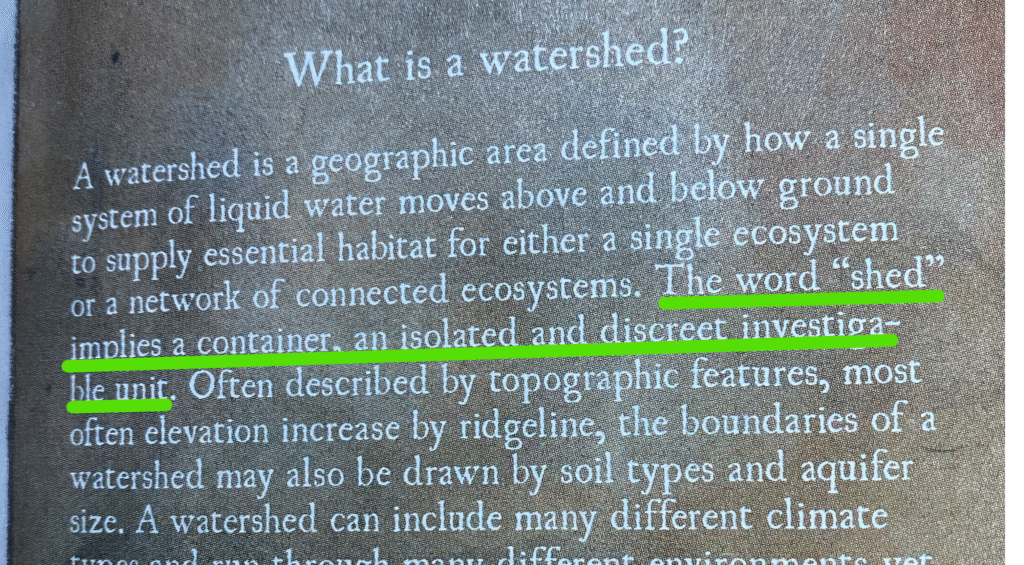
“From “”The State of Water” by Obi Kaufmann, pg 23: “The word [water]’shed’ implies a container, an isolated and discreet investigable unit.”
I always associated ‘shed’, in the context of ‘watershed’, with sloughing something off, shedding it like a skin. So, when I saw ‘watershed’ on a map I pictured the going-to place for water, where water sheds off mountains and hills and the like. But I always wondered why the word focused on the “shedding” aspect rather than the “holding” aspect. Because of this, I associated the term “watershed” with movement-toward, coming-together, flux–and maybe that is more accurate than the stable stagnant ‘pool’ I admit I picture when I think of a water shed. The only water I’ve seen in ‘sheds’ (as in a freestanding rough storage structure) is standing mosquito-hosting muck. Maybe my mistaken etymology was actually an insight? I think I’ll go with that.
I am sure I (a) noticed this the first time I read it, (b) felt like I had a revelation, and (c) forgot, obviously.
Anyway Mr. Kaufmann is one of my favorite watercolorists and naturalists and his books on California ecology are a delight. I keep them over my desk in place-of-privilege granted to books I pick up to noodle through most often.
“The one I liked best was the one where Mr. Spock had to go home because he was in heat,” I said to her.
“Except he never, you know,” she said. “They just had a fight over the girl, him and Captain Kirk, and then they left.”
“That’s his pride,” I said, obscurely. I was thinking how Mr. Spock was never unbuttoned, never lolled, kept himself shadowy, unfulfilled; and so we loved him. And poor Captain Kirk, going from blonde to blonde, would never understand true love, would never even understand that he himself loved Mr. Spock truly, hopelessly, forever.
Ursula K. Le Guin, Searoad: Chronicles of Klatsand, “True Love”
Searoad: Chronicles of Klatsand was just reprinted and contained several short stories I had not yet read, including this one, with a quote I have seen before online but have now encountered in context.