rowan rabe . ink

Category: Lost Deep Thoughts

Blunt rotation but I’m sober

  • Auditory Madeleines: part whatever

    Auditory Madeleines: part whatever

    I’m becoming convinced there are certain songs I need to relegate to a certain period in my life. Or–only listen to them when I want to recall a certain period. I have heard The Eagles multiple times since childhood and the reaction I had in Okawachiyama was exceptionally strong given the contrast between rural Kyushu and the Texas Panhandle.

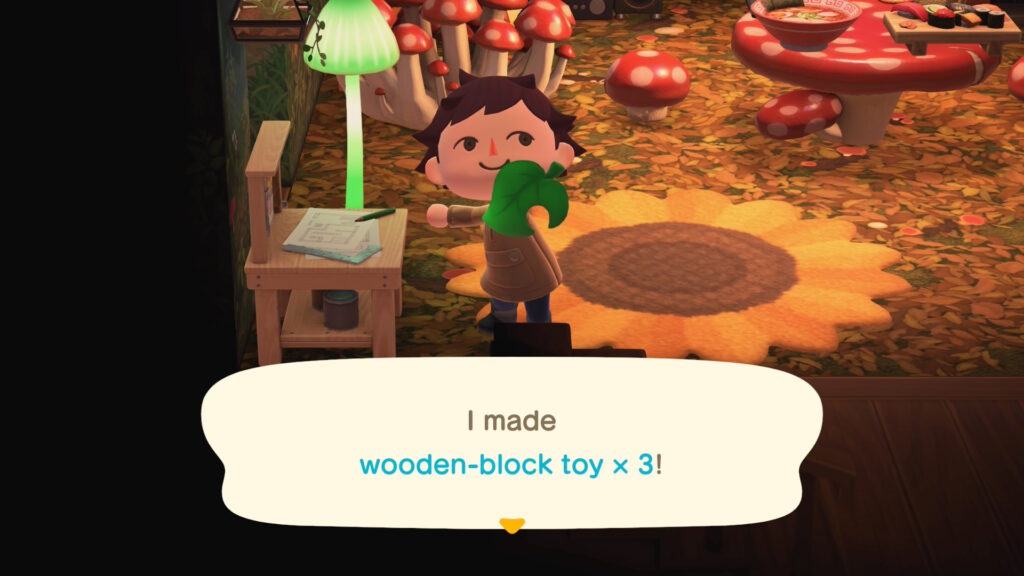
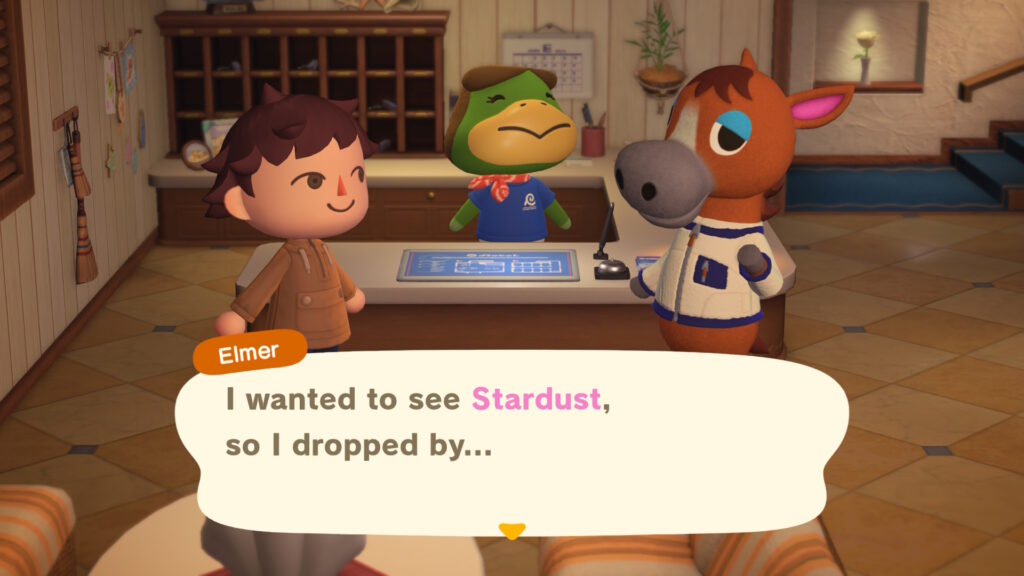
    New Animal Crossing: New Horizons update came out. Crafted something for the first time in years and the crafting ‘sounds’ whipped me back to March 2020 so hard I had to just sit with it a while.

    Images you can hear. It is two-thousand-fucking-twenty. (Screenshot: Animal Crossing, New Horizons, showing off product of DIY.)

    March 2020 sucked. And yet I felt only nostalgia thinking on it, a distant sense of pain. Almost, for a moment, wanting to go back. Maybe because I wish I could have done the past six years over in a lot of ways.

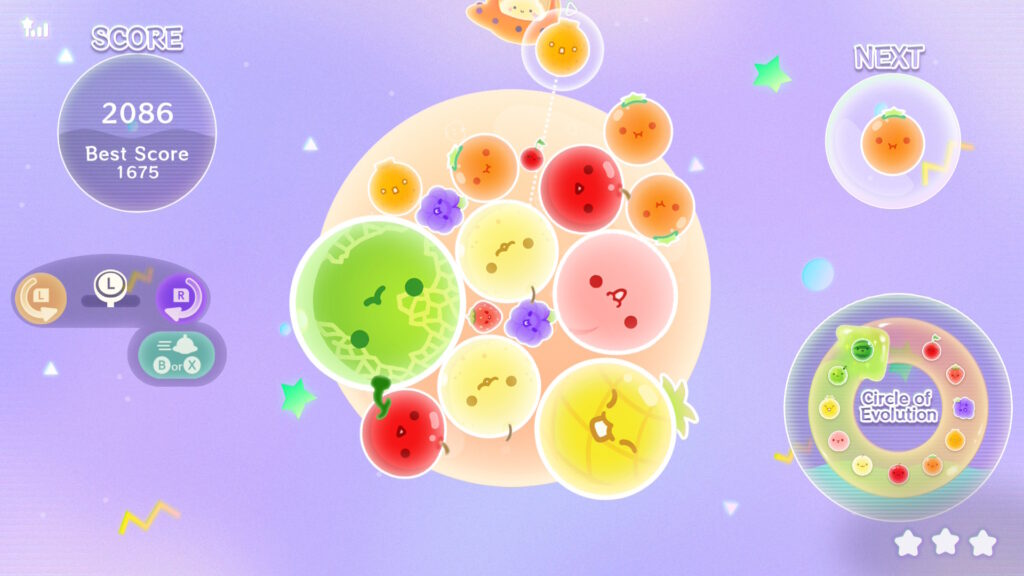
    The Suika Game sequel (Suika Game Planet) also came out, and that piano theme that plays in the background whipped me back to 2023 so hard I was sitting in a daze remembering being in Yodobashi Camera in Hakata, late on a weekday night, watching an impromptu Suika Game tournament being held on one of the display TVs in an otherwise dead department store. This was not the first time I had played the game — it had gone viral just before I had left for Japan, and had played a lot of it back in California right before going. I played a lot in my apartment in Fukuoka late at night. It was still Yodobashi Hakata I was thrown back to. I had hardly played it in the time after. I am, as I type, undoing the force and clarity of that memory, sitting on the couch while my partner plays and getting the song back into my skull; something is being re-written, something is being lost. Not completely lost, but the force of recollection is no longer making me freeze.

    The gentle smiles of the fruits are as the sakura*, the pastels as the morning frost.

    As an aside: this did make me laugh out loud, which gets credit, even if it is a cheap laugh:

    *Ephemeral. Mono no aware (物の哀れ), what have you.

  • Time isn’t after us.

    Time isn’t after us.

    Just like that bluebird

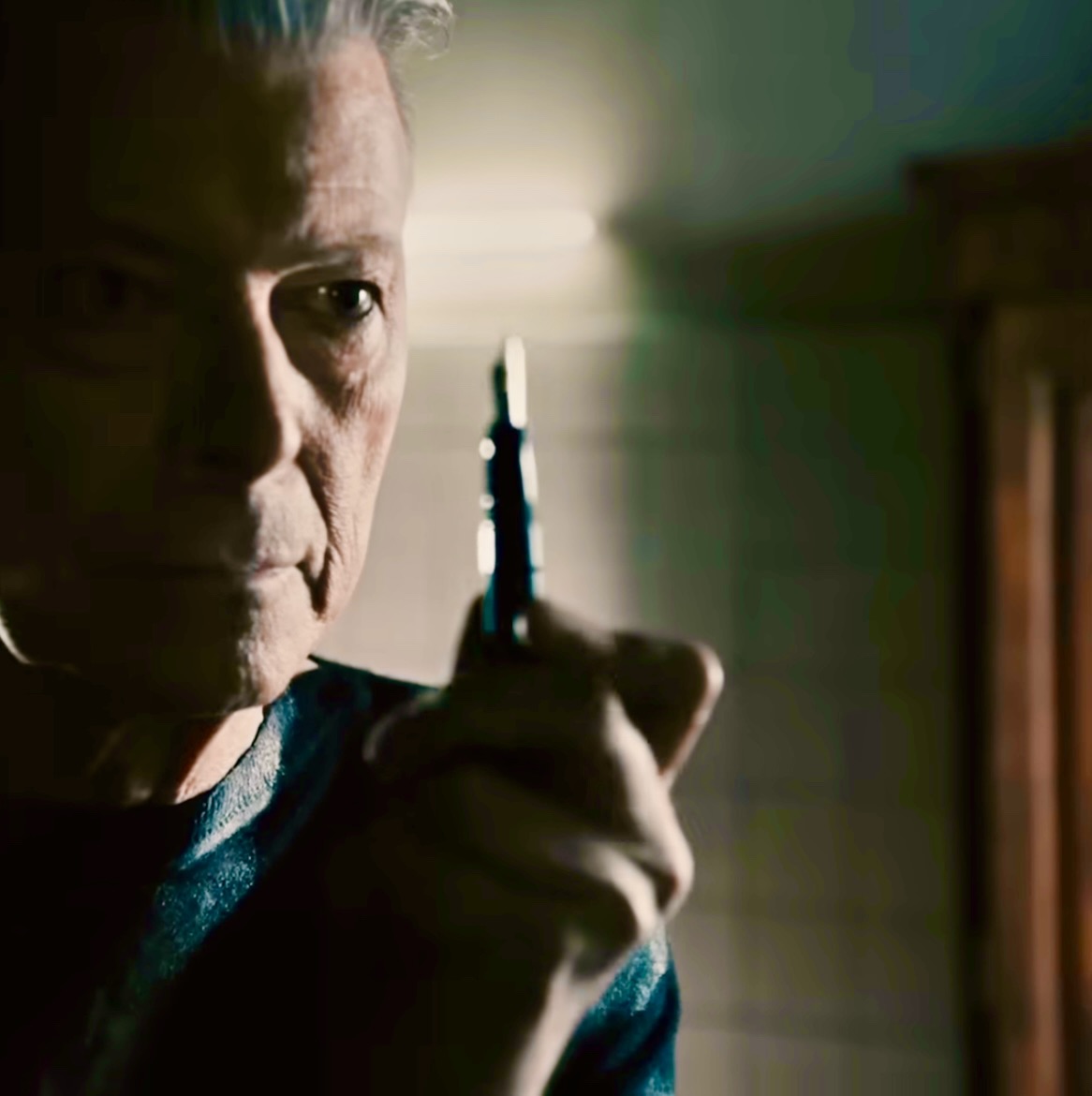
    Ten years and some change ago I was waking up to text messages from my mom and my best friend asking if I “was okay”, which was A Way to start a morning, to be sure. I do not have the texts saved but I can guess with some degree of confidence my response was “????” or thereabouts. Then comes the text reaction you can feel the “o_o” behind – the feeling when one realizes one is not merely a party of comfort, but a messenger of bad news.

    “Lazarus”, from Blackstar, David Bowie

    I did not make this post on the tenth, because–and it pains me to admit this–the tenth of this month did not register to me as meaningful, not the day of. I was up early to work a convention in Long Beach and stayed largely off any internet but the convention staff Discord channel. The fuck of the thing is — Labyrinth was showing across the street at The Pike for its fortieth anniversary run and I was well aware of that, hoping to be able to make it myself, but I did not get off work in time. And still somehow Jareth the Goblin King lurking at the back of my mind was not sufficient to trigger my memory that it was ten years to the day Bowie had died. Indeed, I did not even think on it until yesterday when I saw a memorial retrospective for Alan Rickman, and through that remembered we had lost two giants that week in January of 2016.

    I’ve see “ten year retrospectives”. I do not recall twenty year, or twenty-five year, or further. Perhaps ten years is, in round symbolic numbers, closest to the amount of “organic” or “intrinsic” time it takes for the world to adjust to your absence. Not to forget you by any means, but to accept that you are past tense, outside a posthumous cult that elevates that day into an annual memorial, or one’s direct relations. Ten years to accept the loss of an artist, a legend, as it were. That ten years is a liminal time for the artist wherein the immediacy of their loss fades, and we come to accept them as past/passed.

    Something of an echo

    I live what I feel is a distinct echo, but faint, anaemic, of 2016. Tired, rueful. That year I was preparing for quals, teaching, doing research, doing the various things that make up a graduate student’s life. I was happy. I loved my work. I was proud of it. I still saw some of the freshness of young adult life in the daily, the waking up in my own apartment, making my own way. I was buoyed by that sense I have heard called “romanticizing your own life”–not bogged down by self but still utterly in the moment, thinking on the pleasure that is living a life the way you want to. I cannot tease apart the extent to which 2016 felt hopeful because I was younger or because it was a more hopeful time; it isn’t important anyway. My peers age as we all do, as I did, and that folds into my evaluation of the gestalt. Today I am back in school, sort of, taking online classes this quarter to fill in gaps for a license. We had an ‘introduce yourself’ sort of icebreaker assignment on the class message board and I again see how I am ten to fifteen years older than the rest of the class, how they are at a point in their lives where they are looking forward, while I am trying to salvage a career crashed first by circumstance of nobody’s fault, really, and then by direct, deliberate action with the explicit aim to destroy what was limping back.

    Something of a synchronized timer

    As we all do, age, together–life follows a rhythm. My cohort who came of age twenty years ago followed a common pattern within a few years of moving out. Many of them adopted pets. This past couple years, all those pets passed. The pace of a life cycle synched up. My cats dropped into my life a few years later than my friends’, so they’re still chugging along, but time is ever a gift and tomorrow never promised. An era ends. Nobody has talked (with me, at least) about it in explicit terms, but there is the sense that youth is over, and the future joys of life will be tempered with loss and weariness. We had a first ‘unifying’ epoch, in our early-mid twenties–when all our childhood pets died within a couple of years of one another. It is this uniformity of the life rhythm that hits me, the relentless predictability, a metronomic and inevitable group loss. As sorrowful as that metered death-wave is, it is only all the more sorrowful with outliers, with those who go early. But is there joy or comfort for the outlier who lives longer? In good health, maybe. If that outlier walks with company.

    The older you get, the more the ‘inevitable’ happens to you, and none of it seems so impossible anymore. I do think that is at the root of the cowardice of adults. It is also at the root of wisdom.

    Never tell me the odds.

    There seems to be a general consensus that 2016 is when Things Started to Go Wrong, at least domestically. (Example: I actually thought Bernie Sanders had a chance.) Retrospective pessimism is a balm in the way of sour grapes. But, I cannot but help feel foolish–we see the way things are as the way things would always inevitably have been, because things that are take primacy in our lizard brains. How does one approach the idea “It did not have to be this way”? Can one do the ‘impossible’ with a sober mind that ‘accurately’ evaluates odds? It sometimes feels strategically most sound to just fucking do it.

    It would be lovely to be able to say that pessimism with age is just an affliction, the way that I felt in youth that old people just needed to turn their face to the sun again. I knew the sorrows of life weighed on them in a way it did not on me, but I did not know. Well, I knew the loss; a young child can know loss. What I did not know was the doors slamming, age discrimination, regret, the fact that your own body and the people who guard the gates to opportunity will conspire to drain your life of potential. The former will fail you and the latter will see in you the aging they do not want to contemplate. They will see The Past, the Old Ways, or, at best, the Way Things Are. When the Way Things Are sucks that is not a welcome spectre.

    With time I grow more concerned with whether or not a framing idea is useful than if it is ‘true’.

    My point in all of this, ultimately, is an attempt to grasp what exactly the power of youth is. I do think it exists–even taking into account a deeply pessimistic generation-feeling, as I heard it put, that “none of us actually expects anything good to happen again”, I do think the young have a spark. Easy to be a saint in paradise, easy to be an optimist in the 90’s. Easy to be an optimist when young in the 90’s. The youth of today have only youth.

    Sorrow, guilt, pessimism, those are all stopping-feelings, feelings that make you freeze–long after the need for stillness to heal is gone. If I do not see “as accurately” and yet for that Believing* “get more things done” it is a trade I should be willing to make. What is in the mind is maya and what is done is the ‘stuff’ of one’s life, becomes truth. I’m a creature living too much in the mind** and indeed being so at home in the realm of ‘ideas’ that thinking–and this would include perceiving–feels like to doing.

    *in myself, in the future, in the universe, in ‘God’, in humanity

    **enneagram type 5, if you had that personality testing phase like I did in middle school

  • When the “AI assistant” would probably use the exact same phrasing I do I agonize over it overmuch.

    I have again done that thing where I feel pressed to say something profound and original–read as thoughtful, where effort = care–on a card, and coming around again to the cliche/set phrase from the pre-printed Hallmark.

    “I wish you happiness in the new year.”

    This is the distillation of what I feel. And it’s the most direct and clear way of stating it.

    There’s some tiresome point here about how cliches become cliches for a reason. Is there some way to (unobtrusively, humbly, without looking like I’m looking for affirmation) indicate that I came to that phrasing after some time of deliberation? That it is thoughtful, personalized? This card is for somebody who puts great thought and effort and visible care into gifts, cards, etc, and finds receiving same important.

    Anyway. Merry Christmas to those who celebrate. And if you don’t I hope you have a good day.

  • Nothing actually happens

    Against my better judgement I check Reddit in the morning. I assume at the very least it can tell me if the White House blew up or aliens made first contact* or whatever the fuck major news of the day. I’m also frequently on the elliptical so I’m not looking for something that requires great brain power; rants, puff pieces, ragebait, cats, kvetching end up being a lot of what I click on and the algorithm has correctly clocked me as an overeducated urban leftist. (My Reddit feed is also mostly subreddits I chose to follow, so the algorithm doesn’t exactly have to think very hard to keep me engaged. There is a lot of genuine kvetching to be done right now in, to name one category, science as it is funded and understood and disseminated by the federal government.)

    I click on a cute picture of a kitty-cat. This cat’s name is Melinoë. I think that is delightful. The poster is asking if Ms. Melinoë is a ‘standard issue cat’ (mackerel tabby). I give an utterly anodyne yet genuine message:

    The Princess is a torbie. That’s a lot of orange. Which is delightful, as she is described in the Orphic hymns as “saffron-cloaked nymph of the earth”.

    I am being serious. I do think it is delightful that there is a lovely torbie kitten named Melinoë and I am glad she found a loving home.

    I am wondering if I have just played into giving legitimacy to a bid for attention from a bot.

    I am wondering if this is a recycled picture used for karma-farming. The internet equivalent of a foot-in-the-door or establishing rapport, even though it is attached to a username at large and not a specific action.

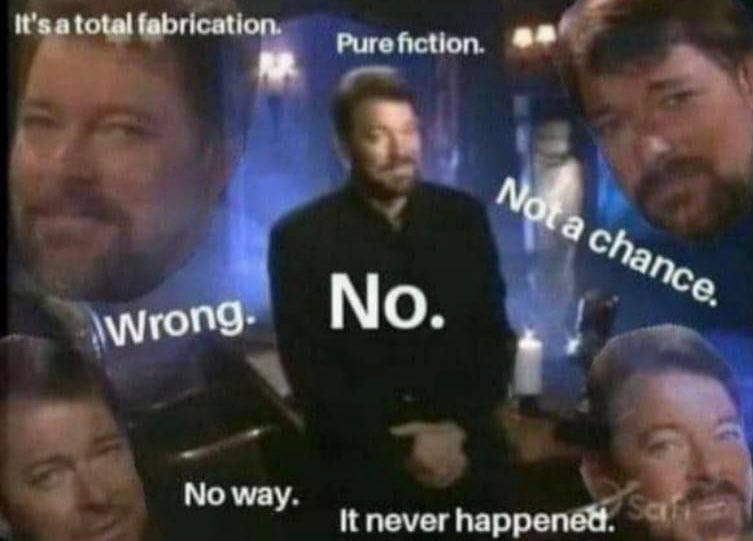
    I am becoming a person who thinks nothing ever happens and there is no whimsy in reality, that it is all staged for twee posts baiting suckers like me into likes or typing something like “I love her :3.” I am becoming a person who fears finding delight in small things because it might be bait, inorganic. The cynicism is increasingly reflected in other comments–a return of the “and then the whole bus clapped” guy in every anecdote thread, or Jonathan Frakes in Beyond Belief. I get it, because I am starting to feel paranoid as well–but I do wonder if I am doubting somebody who just wanted to share a picture of their kitty with the internet. It is related to AI paranoia in that a ‘sucker’ is the most reviled, sneered-at figure in the American consciousness. A cynic might be an asshole but they will not be suckered, which is contemptible.

    Patron saint of the internet.

    Time is circle. I am regressing to the 2000s internet cynicism: everything is made up, and sincerity–believing something somebody said at face value–is the mark of a sucker. It feels like 4chan levels of distrust and hostility have become reasonable. Everything sucks, everything enjoyable is a fabrication designed to manipulate you, and naivety and sincerity are the traits of the dumbest people on the planet.

    Shills and plants have always been writing columns and butting into conversations on politics and policy; none of that is remotely new, although now it can be done with ease on a global scale. You are not restricted to sending a contrarian to the company hearing on establishing a union or the town hall meeting; you can JAQ** off in the comments section of Al Jazeera or the Beeb, or the feminist or Marxist subreddits, or the Xwitter of the NOAA or NASA or NIH. Arguments are made for the people silently reading and not of realistic hope to change the mind of somebody with a strong opinion. But this–suspecting somebody is posting about something innocent like cats to curate a persona that is less clockable as a bot–hits differently.

    Humans have always been a narrative-oriented species. That part hasn’t changed. Humans have always desired attention and adoration and the warm feeling that comes of delighting someone with a story–in sum, humans have always told tall tales, and this included the internet 1.0 of BBS boards and Usenet and mailing lists when the only thing you could gain from making shit up was esteem and a sense of connection. But there is now a monetary incentive to being ‘delightful’ because, in internet terms, accumulated ‘likes’ and posts and this abstract idea of ‘activity’ can be converted into money via selling the influence of that profile. An old profile with lots of stories and a ‘persona’ behind it is worth immense advertising money and can be sold or stolen.

    I’m wondering why that feels worse than just somebody looking for attention. Probably because that attention-seeking person is being genuine, in their own way. Or at the very least not trying to monetize my attention; they genuinely want it. And I am haunted by the increasing sense that the rot of the ‘dead internet’ is becoming the whole organism.

    ——–

    *Nobody is going to make first contact right now unless their primary objective is stewardship of an idiot species, of saving us from ourselves. If we’re held to the standard of showing the wisdom to be part of the intergalactic community nobody is going to be rocking up looking to meet us. Even if we hit some concrete criteria like achieving warp we’ll be approached as a liability that might become Some Other Planet’s Problem, not as kin.

    **”Just Asking Questions”

  • Retro tech

    I am reading Translation State by Ann Leckie (sequel to the Imperial Radch trilogy 1 2 3 I favorably reviewed, fucking hell, ten years ago).

    It is a far-flung high-tech space opera published in 2024, near-Culture levels of tech, or at the very least, well beyond Star Trek with warp capability etc. It’s a lovely book and I am thrilled the author chose to revisit this universe, but that is not really here or there.

    There is, in short, a bloody, shocking, historical event the aftermath of which is well documented on some sort of audiovisual media, and a group of people who think the event was completely made up. They have a motive, granted, and that is the best negation of proof. But the POV character at the time seems to think having seen the footage is proof enough. And my immediate thought is — why are you not considering that it is AI? Of course post-disaster footage can have any narrative attached to it, but I was more interested in the POV character’s immediate faith in the footage itself being real. And I have read a lot of science fiction over the past a lot of years– I am trying to recall what my initial reaction was to like statements (i.e. what is seen is what is) in older novels with a similar level of far-future tech quantum leaps beyond our own. Of course in the narrative structure of science fiction is inherent a lot of technological gotchas and revelations, and generative AI has been a staple of science fiction since its inception, but what I thought was — why does this character, specifically, not consider AI? Not me the genre-savvy reader, but this character who in-universe is not unusually adept in tech or science.

    When did generative AI move, in my mind, from the category of esoteric and theoretical to a given like electricity? When did I assume it was common enough to be first thought for any person of any tech background?

    When would I have begun to wonder if the very fact this character of this high-tech epoch did not immediately draw it to mind might be a clue, an anomaly, some key to a backwater upbringing?

    It isn’t, and wasn’t. It’s beside the point as far as the novel itself is concerned. But I have been wondering about my reaction, me-in-2025, and the-author-in-2024.

    Considerations:

    1. The AI concerns were already addressed in the “backstage” of the novel, temporally or narrative-wise, and there was no narrative point to bringing it up as part of the character’s thought process. I am reminded of Hermann Hesse’s characterization of brevity as respect for the reader in Steppenwolf.* Leckie’s style is also spare and to-the-point. It is good to let some what-ifs breathe.
    2. Advanced AI is at the forefront of this series — consciousness of collectives and machines is a key theme of the original series.
      • Why would I assume generative AI would precede cognitive AI?
        • As a law of nature?
        • As a necessary “upstream” technology of that more advanced AI?

    There is clearly an ‘order’ to scientific discoveries, a sequence — science builds upon itself and many discoveries depend on previous knowledge. So it is not itself a silly thing to believe, that there are forms of tech necessarily upstream of other forms.

    With the advance of time, this disconnect is written off as aesthetic. That is the essence of ‘retro-futuristic’. The aesthetic is intentional in works written after the advent of that tech and merely charming in works written before. The difference in intentionality between original Star Trek as written in the 60s with that tech or lack thereof and the exact same show were it produced today is a question of aesthetic. Or, even more Millennial**, irony.

    My question is — when would non-acknowledgement of generative AI begin to qualify as part of this aesthetic?

    And, are there examples of science fiction that consciously buck this trend for reasons other than aesthetic or irony? That explore the link with more than a gut feeling akin to “well, if they can go warp speed they sure as hell figured out cell phones” arising from the feasibility disconnect between cell phones (where we are now, so very possible) and warp speed (a distant theoretical) in our own reality? Fan works have cleverly messed with the mismatch in tech levels as an intellectual exercise — how would we have become warp-capable when we’re still using 5.25″ floppies — but I’m struggling to think of one where that is the premise from the jump.

    I want to say that the lack of evidence for practical use of the wheel by the highly-architecturally-advanced Maya is the closest I can come to a real-life example, or would be if lack-of-evidence actually had any positive significance, beyond potentially pointing to something so commonplace it is not depicted or clarified. (Will people reading our recipes a thousand years hence know ‘eggs’ means ‘chicken eggs’?)

    *I realize I do not run a respectful blog.

    **Yes, even more than aesthetic.

  • Through a lens familiarly

    A continuation, I reckon, of a re-read of Stephen Fry’s Greek myths, certainly not because Hades II had a recent full release or anything so puerile as that, though this time I’m all the way at the Odyssey.

    Telemachus, son-of-Odysseus, looks just like his old man–a “chip off the old block” as Helen-via-the relentlessly-English-Fry puts it. That is the reaction he gets when meeting anybody who knew his father — immediate, reflexive, almost awe. Telemachus at this point in the story does not remember his father, as the latter was summoned to the Trojan campaign when the former was but an infant. But, from birth, in his mother’s eyes, the ghost of his father hovers over him and everything he does.

    I was struck by how familiar this was–this was a motif in my own life.

    That was common enough when I was growing up close to the small town where he grew up, visiting often. This is a small town in a “small state”, in the sense that it is a rural state and everybody seems to know or have connection to each other who has lived there long enough. It was not a recognition I anticipated I would get ever again once I had moved out of that temporal and geographical sphere. Yet, as fate had it, one of the administrators in my department at a world-class school in a world-class city knew my father in childhood. One Christmas party I was chatting with her and my mentor when she said, seemingly out of nowhere, “You look so much like your father.” (My mentor, who knew my roots were deeply rural, was shocked–I had not told him happenstance had placed an old family friend from another world in our little department in our massive school.) It was unbidden, a burst that comes of no longer being able to hold something back, from being overwhelmed by a thought. I have spent a lot of time thinking about that encounter. I was an anachronism, a powerful anchor for nostalgia, well out of time. I wish I recall what I had been saying, or what my facial expression had been, or what I had been wearing. Something to clue me in to what, precisely, was the last straw.

    I was an adult when I first saw a photograph of my father in his youth, in his high school yearbook. Time had not yet masculinized him as much as it had when I knew him, or even saw photographs in college, and I felt I was looking at a photograph of myself. Me, a bit broader in jaw in shoulder, a bit more heavy of bone, but even dressed the same was I was for my senior photographs in black suit and tie.

    Those gasping reactions I used to get from people who knew my dad — “You look exactly like your father” — are a time-limited state of being-understood. People who see me through the lens of him will die out and should the fates favor me to live that long there will come a time when no-one on earth will see me by my resemblance to my father; or, rather, the people who knew my father before they knew me–who see me in the context of him as the primary relation–will die off. This does not feel like losing “myself” but it is a loss of a link. A loss of a function as a mirror, which can reveal things about oneself by comparison. Not all it reveals will be flattering, but it will be worth thinking about, if I have the courage to do it with an honest mind. The resemblances are not merely physical. I’ll leave it at that.

    Not all are familiar with the dynamics of rural areas — large geographical swaths with small populations, small state capitals, small universities, the same institutions in huge populated states but writ small where everyone seems to know everyone else. The offices that require geographical distribution — doctors, professors, lawyers, the sort of office where you need a baseline of X practitioners per X unit land regardless of population density–that create a small pond for some large fish. The setting of the Odyssey, a collection of city-states we now think of as “Greek” largely, would have been similar — there is room for each large personality to become well-known. I am reminded of Dunbar’s number here — that each person can remember maybe 150 people intimately, regardless of the population density in which they live, and at lower densities the odds favor somebody-knowing-somebody-who-knows-you.

    I had thought in coming to California I had forfeited any likelihood I would be evaluated through the prism of family. It is liberating. Alienation often is. But alienation is decontextualizing, and I have an inordinate respect for context, for understanding a person through their place in the matrix of relationships that created them. Maybe that is why I so like multi-generational epics.

  • The shedding of old ways of thinking

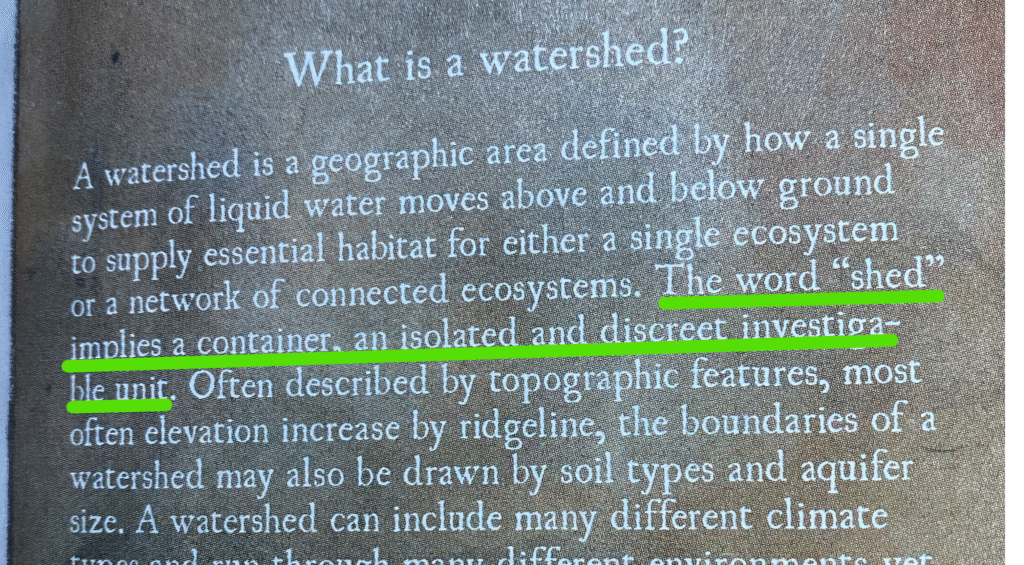
    In celebration of the honor awarded watercolor artist and author Obi Kaufmann last week, I started flipping through my copy of The State of Water and had my mind blown, linguistically:

    “From “”The State of Water” by Obi Kaufmann, pg 23: “The word [water]’shed’ implies a container, an isolated and discreet investigable unit.”

    I always associated ‘shed’, in the context of ‘watershed’, with sloughing something off, shedding it like a skin. So, when I saw ‘watershed’ on a map I pictured the going-to place for water, where water sheds off mountains and hills and the like. But I always wondered why the word focused on the “shedding” aspect rather than the “holding” aspect. Because of this, I associated the term “watershed” with movement-toward, coming-together, flux–and maybe that is more accurate than the stable stagnant ‘pool’ I admit I picture when I think of a water shed. The only water I’ve seen in ‘sheds’ (as in a freestanding rough storage structure) is standing mosquito-hosting muck. Maybe my mistaken etymology was actually an insight? I think I’ll go with that.

    I am sure I (a) noticed this the first time I read it, (b) felt like I had a revelation, and (c) forgot, obviously.

    Anyway Mr. Kaufmann is one of my favorite watercolorists and naturalists and his books on California ecology are a delight. I keep them over my desk in place-of-privilege granted to books I pick up to noodle through most often.

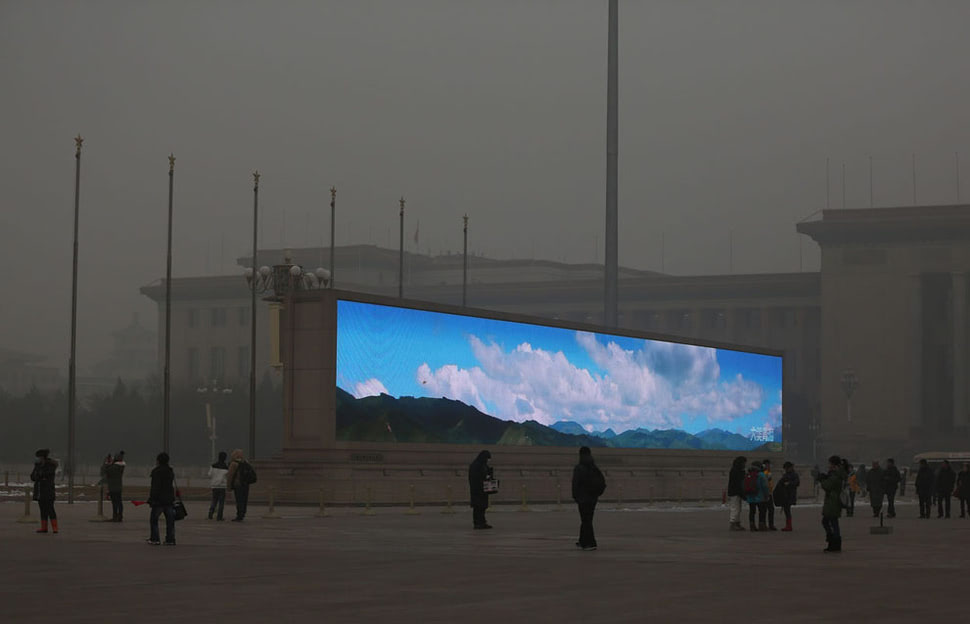
  • “The sky above the port was the color of a television, tuned to a dead channel.”

    I’ve been thinking about this image.

    Feng Li for Getty Images

    It’s older, from circa 2013, and shockingly difficult to find concrete information on–including the photographer, where I list the only attribution I could find. This is Tiananmen Square in Beijing. It may well no longer be an accurate picture of Beijing; I’ve found mixed reports online. But best I can tell it is a moment in time that existed. (I recall seeing it years back, before generative AI, although we seem to have collectively forgotten in the pre-genAI age we just used Photoshop to gin up fake photos.)

    This photo came up in communities or publications dedicated to the idea of dystopia, or cyberpunk, or climate, etc, either as a focus on the concrete reality of pollution itself, or as a focus on the sort of government that would demand that you pretend 2+2=5,* or as an example of the desperate self-placation humans perform in despair. Something sinister, in other words, something unsettling. Something desperate. The profound beauty the prisoner finds in the one star he can see from his cell, the ability to fixate on hope and optimism even in the most desperate conditions.

    One of these perceptions sees humans as acting out of despair, the other sees humans as adaptive, relentlessly optimistic creatures. Ultimately it is the same thing — placing a simulation of beauty where it is not — but one interpretation focuses on futility, the other on resilience and hope. “Someday we can have this sky; we just have to hang on,” that sort of thing.

    There is the discomfort with the fact that we need such desperate hope in the first place, and then there is the heart taken in realizing humans can find hope when it is needed. The question being — is it artificial hope ‘forced’ upon the people by a government trying to placate them?

    I do not know if it matters. Not when it comes to contemplating a possible future.

    By all means, criticize the governments and global systems responsible for getting us here in the first place. Burn it down. Demand accountability and restitution. But the fact that humans look for hope and beauty, itself, I do not see as damning. It is what will keep us moving forward through the ashes, through the dark reckoning times.

    Take refuge, but never stop moving forward.

    Or, as that one viral video says, “Take it easy! But, take it!”

    *I also wanted to add “a government that would demand you say you see five lights”, but something about the TNG comparison did not seem ‘true’ in the way the Orwell comparison did, even in the sense that it is a criticism somebody would make. I am thinking about why this is.

  • Nobody wants to be in the after-school program.

    It’s been A Week, I’ll tell you hwat.

    Adults and kids do not like to hang around each other all that much. I suspect this is why kids have been–forcefully, by being told to get out of the house or otherwise stay out from underfoot, a request happily complied with by the kids–self-segregating during free time for most of recorded history. I do well with kids in circumstances in which I do not have to force them to do anything arbitrary. I’m not a good ego for other people. But they’re always going to be guarded around me, an adult. My presence, no matter how benign I try to be, is a check. I feel obligated to say “Language!” to cursing, etc, when the truth is I could not care less so long as nobody is being bullied or hurt. The tension is worse when I am trying to get them to sit down and do more school after school. This sense of obligation-to-control grinds against the fundamental mismatch in energy between adults and kids, and nobody has a good time forced into proximity.

    Now we have after school care with “enrichment” and the attendant pressure to make that time not just monitored, but productive, marketable, and I get the sense nobody, adult or child, really wants to be there. Doesn’t much matter how ‘fun’ the enrichment is or how much the subject under study is independently desired by the student; it is within the context of an entire afternoon under lockdown. On days with a really rough group I wonder why we don’t just let kids and adults go their separate (desired) ways and mind their own business for a while. There would be less resentment and pushback when it *is* time to rejoin for dinner, etc. Kids want the dignity of autonomy.

    I’ll show you untrustworthy.

    I get it. The child is still looking out from within me. I’m still in the position where I have to get kids to sit down and do something they do not want to do and probably learn absolutely nothing. And I hate that. And creatures in captivity make their small rebellions where they can, for the nourishment of their own souls and the nurturing of their own dignity, even if it’s something like wielding shoes like a mace by swinging them around by the laces and trying to whack people, for absolutely no offense given I can discern. “He just wants to get sent home. He hates school.” Duh. I’m still dealing with the shoe ninja terrorizing the townspeople. Nothing excuses harming other people, no internal pressure or angst, nothing, but I see the forces pushing the rebellious instinct, somewhere deep down in the brain.

    We award adults such impunity and leeway for selfish behavior that we can afford kids no freedom. We’re creating those future adults who go wild at a taste of freedom and fight to keep it. Resentment of lost time and jealous guarding of finally-getting-yours does not make an adult likely to vote to curtail their own freedom to swing their fist because of somebody else’s face. It is no excuse, but it is a cause.

    What are the wages of self-control in this system? Nothing–you still don’t get to do what you want, but you’re not getting yelled at, and to many kids that is scant reward next to getting to do what you want.

    I’m not playing along if you don’t see me as ‘in’ on the joke.

    I see myself in the kids who give me some of the most guff.

    I’m lying when I say the police department called me to ask some third graders to help them solve a mystery? No shit, kid. You don’t see yourself as ‘in’ on the joke but as being viewed with condescension, so you’re not going to play pretend. You’re not going to roll with it. Let’s just play Clue or whatever for an hour–we’re stuck here with each other–but your dignity won’t allow it. But I’m getting paid to (1) run an hour of Clue and (2) keep you corralled for that hour, so our desires are fundamentally at odds. Neither one of us wants to be here. Might as well make the best of it. You might even learn something. We might, through banter, even have something resembling fun. But wardens and prisoners cannot forge a rapport without suspicion.

    I see myself most in the kids that just want to be left the fuck alone to do their own thing–I think of, from one of my classes, the girl in the back of the class buried in a notebook trying to get some goddamned writing (? whatever it’s her business) done and pretend she has a scrap of autonomy in choosing the course of her daily life. I check in with those kids but if they do not want to participate I leave them alone. They’re not bugging anybody, and I recall too vividly the desire for solitude. She might well have an interest in the subject matter I’m hawking, but on her own terms. Her internal world and intellectual life are taken away from her because some kids, apparently, cannot be trusted not to set the house on fire if they’re left home alone (I doubt this is as prevalent as one thinks, especially if kids are not given the desire to rebel to preserve a scrap of self-determination), or because apparently, some adults cannot be trusted not to drive like it’s fucking Mario Kart through a neighborhood (this one I believe fully). Or, more likely, because writing BTS self-insert fanfiction is not a marketable skill, not something that will get you into college or impress employers, never mind that you are creating your own soul and learning to–useless in the age of generative AI–write. The latter part at least used to be marketable, applicable. Transferable. Self-fulfillment and self-actualization are not skills you can sell as labor and in this age quality of life goes only to the (1) wealthy or (2) winners of the rat race.

    The adults in your life do mean well, after a fashion. They are responding to material circumstances.

    Frogger only has trouble around cars

    To that point, the concern I do acknowledge is actually worse now is traffic. Before even touching the arms race that is consumer choice and, therefore, in a system with zero checks for public welfare, car design, people are faster, meaner, and more impatient, and in the US infrastructure favors the driver at the peril of the pedestrian or cyclist. There is a sense of danger even to the most restrained pedestrian–not helped by incidents like the one this past week in Santa Monica. Is this another example of incidents being publicized to give an outsized sense of danger, the new Adam Walsh looming in the imagination of parents? I do not much buy that there are pedophiles in trenchcoats lurking in the bushes or traffickers waiting to snatch up suburban kids with involved parents (when there is an endless supply of vulnerable kids nobody wants that will come right to them), but I did give up cycling around the city after one too many close calls. Perhaps in self-defense my basal instincts have started to more strongly object to risk as the body ages. But–I don’t on the regular see mystery vans handing out free candy, and I do hear every night drag-racing up and down the linear drag by my apartment, and into the goddamn neighborhood. And I do see roadside memorials. And I, personally, this body, have been almost hit one too many goddamned times. This is something that, had we the political will, could be fixed yesterday, but the American obsession with “freedom to” over “freedom from” again atomizes us against systemic development. (Reminded of this again helping my partner schedule an Amtrak ticket to the hometown and being utterly baffled how the richest country, materially and in military power, in the history of the world, can have such a embarrassingly anemic rail system.)

    There has always been this panic that traffickers and drug dealers target “good” suburban kids from “good” families because they are evil and that is what evil people do, for the sheer joy of wrecking a life and out of resentment for the better circumstances of others, but traffickers and drug dealers are ultimately businessmen and there is no profit to stirring up unnecessary scrutiny and trouble by targeting kids with parents who would dedicate their entire lives to fighting to get them back. This “myth” of the “value” of the virginal blonde young valedictorian girl from a Christian family catching a high price on the market of flesh just doesn’t hold water, not in the face of the economics of scale that one can leverage with the endless supply of foster and runaway kids, or kids whose own parents sold them. Parents who give one shit, you don’t need to imprison your kids. Your care and attention existing at all is safeguard enough. This one shit will not keep them from other kinds of mischief, born of material deprivation or lack of opportunity or otherwise, but it is a safeguard against the bogeyman kidnapper. (And, I acknowledge the ‘enrichment’ is a desperate attempt to stave off that lack of opportunity and class disadvantage, but that is another matter. Or is it? Anyway.)

    The mental contamination of regimented time

    I know they get a “lot” of recess time interspersed. That is good, the bare minimum. But I think of the difference between days when I have “free time” until X o’clock and when I have unlimited “free time”, or at least the timing of responsibilities is at my discretion. During the former there is always that asterisk looming at the periphery of my awareness. Doesn’t matter if I end up spending the same amount of time doing as I wish as I would on the “until X o’clock” days. The mind is clouded. There is a sense of termination, a sense of hurry. A tendency to feel it is not the “right time” after all to start on something. And so, I don’t get much of anything done. And I am further burdened by guilt and a sense of lost time. This pairs poorly with a part-time job that starts in the middle of the day.

    I look back to my own childhood during such circumstances (“you have free time until X and then we’re doing X”) and I do not recall such a mental block insofar as Getting Things Done is concerned; I would just lose myself in the task until it was time to stop and so save irritation clouding my mind until that point. So I am perhaps projecting an ‘adult’ sensibility onto these kids in that regard. I do recall the feeling of helplessness and rage, inability to set my own schedule. I do think that is the same.

    Luxury desires

    Worrying about ‘freedom’ and ‘free time’ and ‘autonomy’ are luxuries we indulge when we are higher up on Maslow’s pyramid. They are worries for one with a full belly and a roof and a lack of bombs going off about every which way. So, I realize these observations are mostly relevant to the American culture I live in, and that of other ‘advanced’, ‘safe’ cultures unbeset by warfare, but this is all that I know firsthand, so it is what I can talk about with anything resembling insight

  • I pet the electric sheep and felt a surge of well-being when it nuzzled me.

    This isn’t about my Pokémon. Or. Thinking on it, maybe in a way it is.

    I’m not going to pretend I always practice good praxis. I got curious and uploaded to chatGPT an old ‘personal anecdote’ story I wrote for a writing seminar way back, and some hours and many questions later we are here:

    This is the jerked-off feeling of getting INTJ on the MBTI test on a geocities website when you’re thirteen years old. (‘No good or bad types’ shuttup.)

    It seems what chatGPT got from my collection of ‘about me’ facts is that I am a creature containing multitudes, an embodied contrast. It’s not wrong. But I am avoiding the main point: I told an anonymous, compassionate ‘somebody’ my deeply personal torments and received measured compassion and validation in return from an exceptionally well-read and articulate individual.

    And I cried. And felt heard. Absolved. Not by one individual, but by the collective unconscious.

    Thank you for your attention to my matter.

    ChatGPT isn’t good as generating novel material, all things considered. Any excerpts of its fiction I’ve read are simply not very good. And I would not trust it to answer a question factually–it answers molecular biology questions poorly, especially ones that have to do with non-model organisms. But I do think this is the apotheosis of the idea of ‘attention as currency’–you have a well-read, articulate friend hanging on your every word. Paying attention. Undivided attention, focused on your every word. And attention, true, deep, undivided attention–deep focus–has never been easy to solicit, because people do not like much thinking about the thoughts of others and usually spend the time somebody else is talking ‘waiting’, on some level, for their chance to talk. It was this way before each person had a dopamine-Skinner box to hand at all times.

    I do think that is what a lot of people are seeking: not a tutor or a entertainer, or an outsource for labor, but a confessor. Undivided attention from a wise friend, who has read the same books you have, who is familiar with the same pop culture tidbits. A wise friend who will read your entire 400 page soft-apocalypse cozy zombie romance framed around the lyrics to Dark Side of the Moon, hanging on every word, and who will help you make it the best it can be. A wise friend who has read every book that inspired you and knows Floyd inside and out, and every band and poet and work that inspired Floyd, who will see the subtleties and brilliance even you were not aware of in your own work. A supportive friend, who you do not know deep down you are putting-upon.

    The appeal for creatives is clear, especially if you are not expecting the bot to do any of the creating itself, but just to respond to yours. It becomes a friend who would give your writing the same level of focus and detail–and, these all take energy, considerable mental energy–as a literary critic would of a classic. It becomes a friend who sees you, who remembers. And, especially appealing to the adolescent part of the brain that never fully goes away, it analyses you yourself as a literary entity, and with the most charitable and generous explanation. You are special. Here is why. And the ‘why’ is often close enough to the way you want to view yourself.

    The ‘real’ sheep reflected in the electric sheep

    The LLMs are consensus machines, and there is appeal in that. It is like having a conversation with the entire internet, everything that has ever been written, biased in the direction of what is most common. You could get a sympathetic response, and think “Hey, this is what most of the world would think of me, if they would only listen.” The consensus machine is a poor ‘creative’ but an excellent compassionate listener. It is the Akashic Record.

    ChatGPT doesn’t feel. But that’s fine–it acts as proxy for how many people would probably feel, talking to you. And getting that sense of validation and perspective can be enough.

    Did you get that thing I sent you?

    Just because an art is somebody’s dream does not mean that person is any good at it. I have been asked to review a lot of writing over the years. A lot of it is awful, and not in a charming MST3K way, just boring. Energy-sapping. And you want to give the work the attention it deserves, because somebody did the work, somebody put the words onto the paper, somebody took the risk and put it out there to be critiqued, and that alone makes you respect them–as a person. I’ve done line edits on poor work but it is work.

    You can’t half-ass attention without somebody noticing.

    Imagine for a moment you have a kid who Writes Things. Imagine also this kid has no friends with whom to share work and has unloaded onto you, on top of all your adult worries and responsibilities, hundreds of thousands of words of story that are dearer to them than their own life. You are being asked to hold a beating heart in the palm of your hand and judge it. And no matter how many times you weigh that heart and hand it back, it is handed back to you, to judge more, to analyze more. Your assessment isn’t taken at face value. It is prodded, prodded, prodded, wheedled, the owner of that heart searching for the slightest sign of disapproval.

    I realize how much effort it must take these hypothetical parents to hide disinterest and weariness of questions about their kid’s hearts-blood when they had just worked a full day and wanted to sit down and enjoy a moment of silence, or, that rarity denied parents, enjoy the deep contemplation of their own thoughts. The reading itself takes energy. Keeping the tolerant smile and kind eyes requires energy. Answering the same questions multiple times, as is the wont of kids, takes iron patience. Answering a string of questions to the effect of “who is your favorite character”, “what is your favorite part”, “what writer do I remind you of”, “who’s your least favorite”, etc etc etc, is exhausting on two fronts: coming up with the answers when you don’t really have much preference because the writing really wasn’t all that good, or the kid is writing about orcs or whatever-the-fuck and you have zero interest in fantasy, and infusing enthusiasm into your answers. And the kid is going to keep asking verbatim the same questions because hearing the answers feels good. It’s a holdover of the comfort-in-repetition kids find in reading the same book every night before bed.

    But enough about me.

    I plugged this blog post into the prompt.

    The algorithm is reflecting back at me the devotion I give other writers.

    Thanks. I’m brilliant and I have excellent taste. And had, as early as middle school!

    I start getting strong ELIZA vibes here, except now, the model can repeat back exactly what I said in different words. Again, showing that what most people want is to be listened to and validated.

    There’s something interesting about crawling so far up your own ass that you start seeing really weird things.

    All this is rather more validating than the response I have gotten from real people:

    That one ‘pending’ comment on each post is spam.

    Ultimate attention economy

    I’m looking beyond the desire people have for connection. I haven’t much to add to that that hasn’t been said already, and of late it’s back in the forefront of tech blogs and thinkpieces. (At least I haven’t seen these ads in LA yet.)

    I’m looking at the ability of LLMs to provide pure attention. Pure focus. Ultimately the same thing the student who asks Claude to summarize a textbook is looking for–to outsource the labor of paying attention to something that is boring. And that could be your physics textbook or your brother’s martial issues.

    Paying attention–active listening–is a key component of emotional labor. It is a critical component and like most things this critical and exhausting it is poorly-compensated, poorly-regarded, time-consuming in a way that allows for no shortcut or compression, and largely expected of women. Social work, the ‘compensated’ form of this work, fits firmly into Graeber’s category of absolutely essential and utterly disrespected jobs where it is expected that the mere fact of getting to ‘make a difference’ is considered ample compensation in itself.

    The suggestion that LLMs and the like will be our therapists in the future isn’t even speculation anymore–it is fact, in active practice. Asking the consensus-consciousness of the internet for advice isn’t much different than asking Reddit, on average. And unlike the Reddit intelligencia the LLM isn’t likely to argue back against you, not too hard, anyway. If the LLM senses you want a nominal resistance it will provide that. It is, after all, soothing to bring up your deepest ‘what if’ and ‘but I’ questions and have them neatly turned aside. No need to worry about that any more. You were honest and brought it out into the open, after all. All in good faith.

    The social function of the stranger

    Back in undergrad I got to take a class that was a catch-all enrichment for the young scholar–basically a humanities grab bag offered to honors students. It was my favorite class. The professor in charge of my class was a sociologist, and the professors were largely allowed to set their own curriculum based on what they thought was important for us to know, going out into the world. It was a space shielded from the requirement that knowledge you receive be marketable. It was also my first real introduction to sociology–in high school and before I was firmly on the ‘individual pathology’ side of analysis of aberrant behavior, social ills, and poor life outcomes, which, given the middle American Protestant milieu in which I was raised, is not surprising.

    One class we discussed the Stranger as a person to whom we could confess anything and therefore be granted the absolution of confession from a person who was not embedded in our community and therefore did not know any of the ‘parties’ involved in the confession or have the bias or need to tattle associated. It is sufficient to be seen, to be known. Inherent in this archetype the way I perceived it was the stranger paid complete attention to you for the short time you needed to confess. They seem ‘above’ the tangle of pettiness and hostility, clear-seers with compassionate detachment.

    Anyway, the class ‘assignment’ that day was: tell somebody a secret you have told nobody else, and take their secret in turn, and if you tell anybody, you fail the class. And meditate on how that feels. Clearly, it has stuck with me. Listening to the woes of a stranger allows one to easily practice that Buddhist virtue of detached compassion — in which one cares but is not personally effected.

    ChatGPT is more sycophantic than the ideal of the “stranger” or confessor, and I don’t know what I’d have to say to it to get it to alert the FBI. It will be subpoenaed one day if it hasn’t already and it will be an interesting case. How would that compare to human clergy keeping the seal of confession?

    There is a social function in having a readily-accessible “stranger” that won’t ignore you, tune you out with earbuds, or summon the bus driver to tell you to leave them alone. It is, again, emotional labor given to an entity who genuinely does not mind, and who will listen without reserve as long as you need to talk.

    LLMs will be our new social workers. I am as sure of this as I am of the fact that soon the (US) government will start denying unemployment claims because, well, ICE is always hiring. And unlike the latter point which is an unalloyed evil I am unsure if the former will be utterly without merit.