rowan rabe . ink

Category: Lost Deep Thoughts

Blunt rotation but I’m sober

  • I know that’s a wolf under that sheep’s clothing. But we’re having a lovely conversation.

    This one’s a real post. Apologies in case anybody has been getting spammed with shitposts. I’m automating crossposting and there’s more debugging (and testing, hence the posts) than anybody ever expects, even though I should damn well know better from script kiddie days back in high school. So that will continue for the near future.

    A pilgrim comes seeking fellowship.

    Somebody finally said in /r/printSF something I’ve been suspecting–and I do love it when my kneejerk gut takes are proven to be Correct and Wise. There has been a flood of posts fishing for the sort of answer your English teacher would want you to give about a book in AP English, written in AI style. I had not pursued it–my response to my own AI paranoia has been to disengage from everything, which is healthy for somebody who already has a tendency to be a recluse–but of late what were once the last bastions resembling old school message boards on the internet for niche ephemera (the wall-of-text subreddits) are just not engaging me, even though they are trying to start discussions that are in my wheelhouse (Le Guin, Wolfe, old school ‘literary’ scifi, the weeds of theory, etc). The posts have the tenor of a recent convert to the beauty of literature, a pilgrim coming to confess and pray at the altar, seeking the fellowship and validation of the congregation. And, as people generally believe their ‘religions’ are good and should be appreciated more, this is an excellent way to engage them. Yes, including me.

    I’m seeing this pilgrim-crawling-to-the-altar and “hello fellow kids” everywhere now even more than I once was; it was bad enough when I suspected people of karma farming and astroturfing, but it was at least a human putting the work in–I could only hope, sometimes, a human who was asking some questions they genuinely wanted to ask as part of their karma-farming, something. Now we are also being triggered into providing some deep, insightful discussions to train an AI algorithm to have deep, insightful discussions. In any case, OP made an astute observation with some concrete evidence of seeding, with more being added down the thread.

    Weighted Blanket of the Absurd

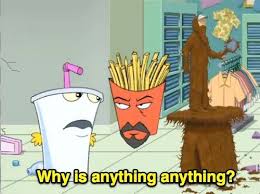
    Master Shake’s distracting-from-his-hustle philosophical irrelevances that have the bonus quality of having made me laugh hysterically at 2AM as psychological armor.

    Yes, I’m well aware this might be AI-calling-out-AI. Anything might be anything. Fuck it. If I’m going to bother participating on the internet at all I at least need to delude myself that there are some signs of life out there. I’m coping with my aughts-adolescent cynicism and ennui with absurdist nihilist flip. Which, let’s be honest, isn’t the most unhealthy coping mechanism I’ve used, and can be quite fun. There’s that old saw about the funniest people you know being the most depressed people you know and having a lot of practice in defusing psychological agony with humor.

    Ultimate attention economy redux

    I still maintain I am right about this.

    Let’s for the moment focus on the aspect of AI that relieves one of having to do things like pay attention to and think about things that are boring, like books and philosophy and history and Big Ideas, that the gatekeepers of your degree/ license to work a more than subsistence job tend to think are Big, Important things for humans to think about. The sort of person who becomes a teacher tends to be the sort of person who believes in the inherent value of Truth and Thought and cultivating the life of the mind and becoming a well-rounded human-cum-citizen, and that sort of person is the the gatekeeper standing between you and your license to work a bullshit white collar job that pays something more than a subsistence wage. You used to have to indulge them, to some extent, or go to effort and expense to get somebody else to do it for you, but there is now an algorithm that pays granular and close attention to those gatekeepers talking amongst themselves in the brainy tl;dr wall-of-text subs about the things they’re going to ask you to write about and grade you on. That’s a lot of attention-energy somebody else already expended and you don’t want to on things that don’t matter to you.

    A bullshitter or conman used to have to be a good listener, and good at guessing what people wanted to hear. That skill, bullshitting, is being de-professionalized, too, now; the algorithm whispers into your ear what to say to bullshit or con. Quality bullshitting and knowing what people want to hear is a skill–another one that is being lost. Again the middle is falling out of an entire profession and the only conmen who make a living will be those exceptional individuals with genius charisma. Workaday mediocre conmen need jobs too–more argument for UBI I guess.

    I feel the desperation of realizing every safety valve and escape is being shut off or turned into a honeypot or corrupted–‘escapes’ for ‘intellectuals’ or ‘genuine people’ or however we style ourselves are weirs.

    Marketers desperately seeking organic ‘cool’ cred for their product isn’t new; shilling and guerilla marketing are nothing new; influencers are just now up front about it, which I find refreshing. There is a desperate cynicism in capitulating to it all being about the game–we’re far from the gen X obsession with not ‘selling out’. Indeed, to care about ‘selling out’ or ‘authenticity’ is seen as a naive, childish, unsophisticated concern, and while gen Z /alpha may be well on to something, it is part of the pattern of their generation never being raised on ‘hope’ or optimism for the future like Millennials-and-older. When I was in middle school ‘poseur’ was a deadly fucking insult if you were in any sort of ‘scene’ with pretensions to authenticity–skating, music, art, fashion. I remember rumors about who had used a butter knife to scuff up the underside of their skateboard to make it look broken in with the sort of wear pattern you would get with ‘hardcore’ use. That was a fighting accusation. And these so-accused were not attempting to be influencers or anything with a monetary reward; they just desperately wanted to be cool and authentic. Authenticity had enough intrinsic value to be something to lose, something precious. It was, in the minds of these middle schoolers, a very real and deadly serious thing. I wonder if younger generations see that sort of totemic belief as naive in the way that believing in ‘capitalism’ (as an ideology of ‘freedom’ or something) seems now, or ‘free enterprise’, or ‘the American dream’.

    Considerations of ‘specialness’ aside, this is why people in subcultures condemn ‘selling out’–you make something profitable and the vultures come in and shit all over it. I’ve watched it happen. Anti-gatekeeping rhetoric is being co-opted to stifle conversations about this.

    I realize it’s not just getting people to buy shit, monetarily, in a material sense. It’s also political astroturfing, and the everything-sucks-fuck-you pissed off adolescent nihilist philosopher* inside me firmly maintains it’s all the same thing anyway. It is and it isn’t. A healthy criticism of all parties so often just becomes this nihilistic centrism that, functionally, is no different from political neutralization. Trying to sell me mediocre terrycloth hoodies on Instagram is obnoxious but I’m not going to pull the galaxy brain take that it is equivalent to influencing elections. Same tactics, yes–a ‘sale’ is a sale, of ideology or terrycloth hoodies–but equally urgent a threat it is not. The corrosive effect on mutual trust that comes of suspecting either in every interaction is a social enshittification agent, all linked, ultimately, in the big cosmic sense, on big time frames, but in the immediate sense one makes you regret buying bad clothes and the other effectively legalized suspension of due process.

    It was mentioned in the original post that many of these suspect accounts also posted in job hunting subreddits, which are utterly lousy with recommendations for resume editors and other magic bullet solutions for desperate over-educated under-employed professionals DOGEd or AIed out of an already shit market**. Maybe this is my naive Millennial belief in the concept of ‘earnestness’ or ‘validity’ but this seems particularly scummy, preying on a need instead of a desire. Doing so is not new but it seems to be one of the few hustle avenues still (or even increasingly) profitable in a collapsing postindustrial economy.

    Say something interesting, damn you.

    Anyway, back to the reddit thread.

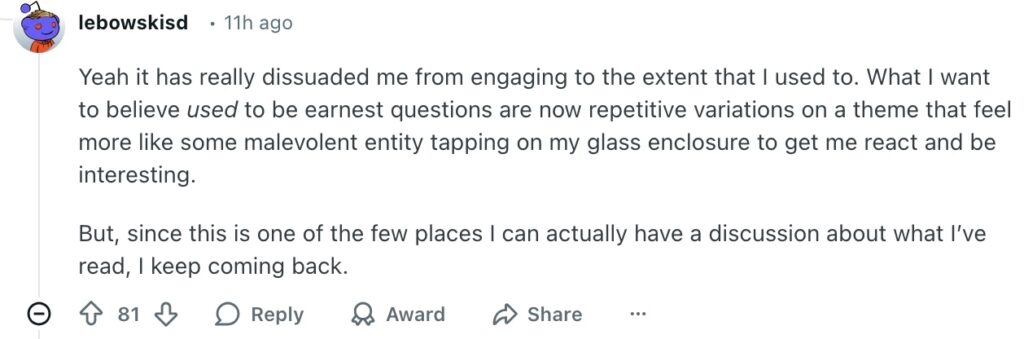
    Reddit user lebowskisd: “Yeah, it has really dissuaded me from engaging to the extent that I used to. What I want to believe used to be some earnest questions are now repetitive variations on a theme that feel more like some malevolent entity tapping on my glass enclosure to get me [to] react and be interesting. But, since this is one of the few places I can actually have a discussion about what I’ve read, I keep coming back.”

    The Dude(‘s D?) puts it well. Some entity listening in to the place where the eggheads go to escape and trying to prompt discussion to harvest.

    Reddit user Beneficial-Neat-6200: “Agreed. Over on r/wallstreetbets the prevailing theory is that the value of rddt more related to monetization of user content for Ai training than from advertising”

    This is probably correct. I still see a market for vendors of niche products to hobbyists, many of whom, if they are on Reddit, have disposable income and tend to limit Google searches of product reviews to Reddit or other websites where ‘real people’ used to hang out. They’ve always been lousy with shills, and everybody knows it, but it was also one of the few places to get an honest opinion mixed in there.

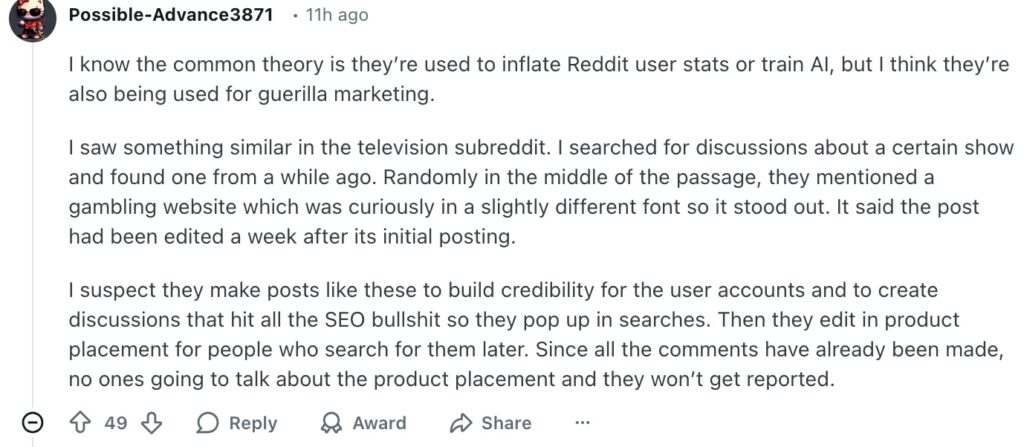
    Reddit user Possible-Advance3871: “I know the common theory is they’re used to inflate Reddit user stats or train AI, but I think they’re also being used for guerilla marketing. I saw something similar in the television subreddit. I searched for discussions about a certain show and found one from a while ago. Randomly in the middle of the passage, they mentioned a gambling website which was curiously in a slightly different font so it stood out. It said the post had been edited a week after its initial posting. I suspect they make posts like these to build credibility for the user accounts and to create discussions that hit all the SEO bullshit so they pop up in searches. Then they edit in product placement for people who search for them later. Since all the comments have already been made, no ones going to talk about the product placement and they won’t get reported.”

    I admit I had never noticed this pattern before, even though I’ve been trawling through ‘old’ threads looking for info my entire internet life. Such product placements probably just got caught in my bullshit filter and immediately disregarded as brand shit, but I never bothered to look up the editing timestamp because I did not care. But this is critical–it is a piece of what, exactly, bolsters the monetary value of a ‘trusted source’.

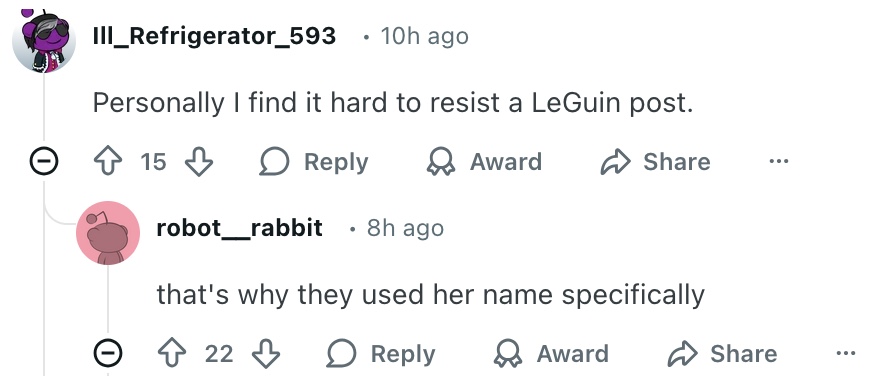
    Reddit user Ill_Refrigerator_593: “Personally I find it hard to resist a Le Guin post.” User robot_rabbit: “that’s why they used her name specifically”

    Me too, Ill_Refrigerator-san. The authors being featured in these suspect posts seems to be a who’s-who gallery of what I have heard referred to as “your favorite author’s favorite author” – highly-praised literary luminaries who may (Le Guin) or may not (most of the rest of them) be popular. Also likely to be the favorite authors of the sort of person who is going to put themselves into the position of gatekeeping your degree or interview vis-à-vis going into teaching, or the authors people list as ‘favorites’ if they want to seem intellectual and deep and from that trustworthy, above petty considerations such as money and popularity, genuine.

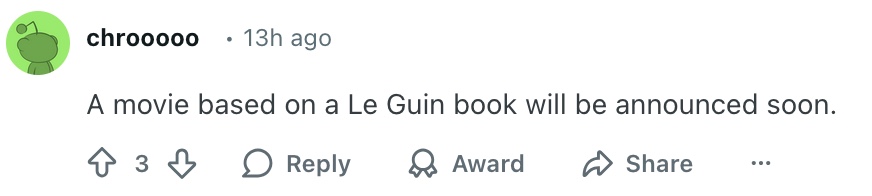
    Reddit user chrooooo: “A movie based on a Le Guin will be announced soon.”

    Fucking hell, you may be right. Now I’ll be suspicious and surly instead of mildly, reservedly interested. While I never had much hope for adaptations from other sources, Ghibli Earthsea burned me too badly. I’ll be bitter about that one until the earth falls into the sun.

    Daily I am more convinced of the existential need to retreat to a shack in the woods.

    Fine. Those online spaces are all compromised. So now what? Limit ourselves to the people within easy physical meeting distance? That’s lonely work if you have niche interests. The internet was the first time, for better or worse, all these niche weirdos found a welcoming lounge-cum-echo chamber, and it was the most high quality social interaction many of us had for years, especially if we lived in a small town in what is now MAGA country. Part of how those spy camera/microphone ‘glasses’ are going to pay for themselves in data harvesting is through eavesdropping on these conversations we take offline, if we can, when we can. When might somebody get paid hourly to hang out in a bookstore or coffee shop wearing those***? Your employment manual will recommend very obviously ‘reading’ a book that may start the conversations your client wants, or painting, or wearing a shirt with an unfortunate opinion. If there is a hierarchy in pay based on how pleased clients are with the information you get there will be an incentive for the best bullshitters do this work–a resurgence of the ‘peer influencer’, who influences people who do not like influencers. AI paranoia is going to creep into IRL conversations–not just in the sense of AI being fed as answers through an earbud or lens so you can get laid or get a job or sell something, but also in the sense of being harvested, used to train skinwalkers to seem more human. ‘Authenticity’ will always be the most coveted thing a marketer will seek, no matter what the product being sold.

    Paranoia is isolating and exhausting. I keep seeing reasons it is an accurate response to one’s environment, not an individual pathology, necessarily. The same issue with depression or anxiety being an appropriate response to life circumstances.

    ——-

    *This is the same entity that thought Trent Reznor’s rendition of Closer at Coachella was fucking sick as fuck.

    **Hi.

    ***Even if like one out of a thousand of those conversations yield anything interesting it is still of value to information brokers. Also if you’re hiring I have two elderly cats with high needs and could use the scratch.

  • Memory coup

    I justify to myself being spendy at the gift shops of museums, national parks, other nonprofits, etc, as providing ‘support’. Either way both of us benefit and from a utilitarian perspective that is a good thing, questions about ‘true altruism’ or other abstractions aside. So I don’t sweat it too much.

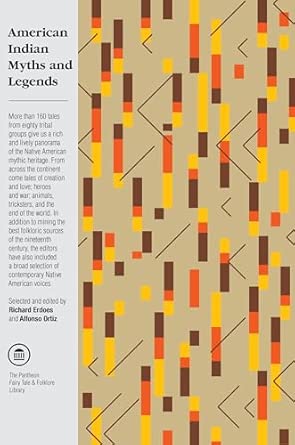
    Book cover - American Indian Myths and Legends (The Pantheon Fairy Tale and Folklore Library) ed. Erdoes and Ortiz

    I picked up American Indian Myths and Legends (editor/compilers Erdoes and Ortiz, Pantheon Fairy Tale and Folklore Library) book at the Joshua Tree NP gift shop. This is a book seemingly tailored to my interests–sociology, mythology, anthropology, a generous helping of annotations from scholars, a clean minimalist book cover that would pair in a lovely way with other volumes of the same series on my bookshelf, sturdy paperback. I do like the use of large blocks of pattern and the sidebar summary in this Pantheon printing; the entire effect is charming, gives a clean ‘universal’ impression, free from proprietary this or that or over-reliance on one person’s interpretation based on their illustration. Anyway, I’ve been picking through it between other books and I last night got to the portion on war-and-valor-related myths, the introduction of which mentions the coup stick, which triggered a memory that has not been unearthed for probably thirty years. Proust’s madeleines and involuntary memory again. I was familiar with this concept. I had heard about it, a time buried in the distant past. I had not since read about it, so I was inundated with that-timeness; I was for that moment a schoolchild in awe of the ways of others, so different from my own that they seemed inherently mystical.

    The untouched memories

    These are my memories before I taint them with further research, using the terms my memory uses (i.e. what I would have learned as a Texas schoolchild in the 90s):

    A notion of a special “coo stick”. I visualize something like Sokka-from-Avatar’s war club, an embedded jewel the stick cups like a wave. A sense of an Indian warrior sitting straight and proud, very proper, on a horse, riding up to a white invader, tapping them gently on the head, and bolting. No sense of hurry or danger from the Indian. Serenity and poise, making a game of something the White man treats as deadly serious. A child’s budding sense of ‘are we the baddies?’ I am in a classroom. Classroom walls, the bright primary colors, construction-paper cutout headings on bulletin boards. When I visualize-read the term “coo stick” so Anglicized it further triggers the memory–this must be phrase I had only ever heard, specifically.

    Rarity of experience

    I grapple with involuntary memory quite a bit. That, in itself, is not infrequent for me. It is however unusual for me to access a bit of intellectual trivia that has not been touched, as far as I can sense, in decades, especially when it resides within the realm of things I regularly explore (in this case sociology/mythology/history etc), so I want to sit with it a while, turn it over in my hands, before I go off on a reading spree to update my knowledge.

  • An utopia defined by free real estate

    An utopia defined by free real estate

    (I’m not posting the Tim and Eric meme.)

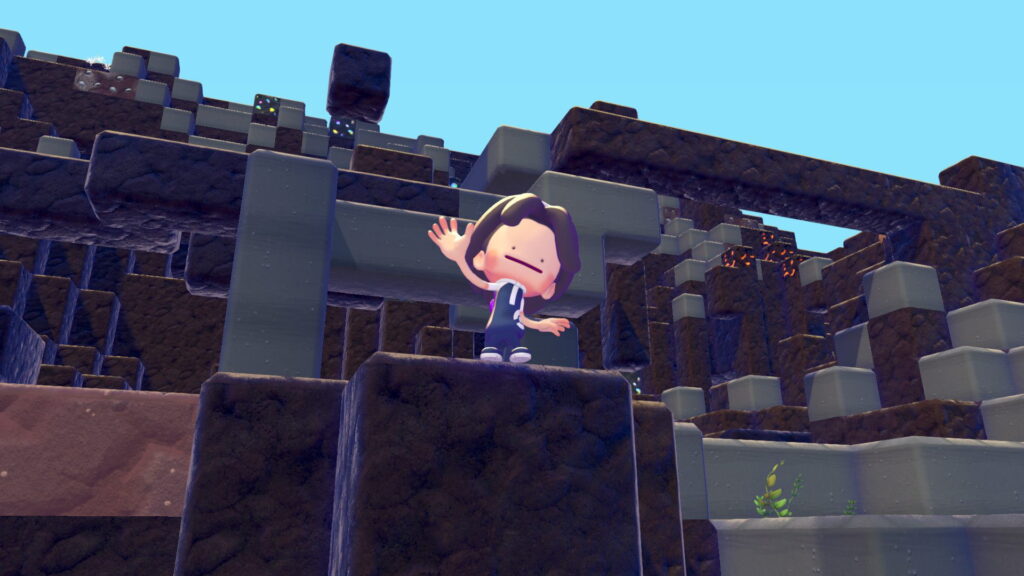
    Once a church stood here. But I’ve deconstructed it, scavenged it for my own use, pick the island clean of resources, and even used it as a dump for my volcanic ash and beach sand seriously I can only make so much glass waste, and not a soul or a ‘mon is harmed. It’s abandoned. It’s free real estate. What a relief, that such islands exist, there to be scoured clean of resources and left with the trash, and that nobody is harmed or dispossessed. Ethically clean.

    The blank eyes of the devouring maw that sucks up all of value.

    I am sinking far too much time into Pokopia. Well, I feel as though I am–I see some of the elaborate builds people did within the first week of release and wonder if I should invest more time. This middling time-sinking feels the ultimate waste — either go into it fully or don’t at all. But that’s always been my problem — obsession with optimization to the point of paralysis, do it all or don’t do it at all, do it right or don’t bother. Even if it’s a damn video game. Somebody years ago on the internet said “Do not treat games like homework,” and it has stuck with me. This means not forcing oneself to finish games one really is not feeling, nor getting into a perfectionist snit. When it stops being intrinsically fun, the value is lost.

    (I’m well aware how familiar this (bonus: ‘this’ is about Book of the New Sun) sounds. I can’t be arsed right now to explain how it’s different; it just is and everybody damn well knows it.)

    Video games are tricky, especially games with a creative element like Pokopia or, oh, Minecraft is next to come to mind, or games that require strategy. There is a creative element in playing them that goes far beyond simple consumption of Funko Pops or whatever. It is the relationship between the brickmaker* and the architect. To be generative within the milieu that is already established (example: to be one of the most influential Pokopia build gurus) means a time commitment to a very deliberate and intense delve into somebody else’s product, something that does take considerable time and dedication. The Serebii Pokopia controversy lays bare the exhaustive labor that comes of being The Authority on a game–clearly, it is labor, it has value, otherwise why would people try to (1) appropriate it and (2) avoid it. This is the literary critic who has built their career around one author, writ with a more populist bent. It is painstaking, exacting work, the sort we acknowledge with the title ‘doctor’, and not undeservedly. This is something adjacent to science, but within this analogy God is the game creator(s), and we are laboring tirelessly to understand their design. Part of the sale point of the game is the mystery that was created, left to be enjoyed on levels from just-dicking-around (hi) to excavation and cataloguing, experimenting. But games have always been ‘pointless’ and yet what we live for, something that compels us as much as art.

    The game designers, however, designed their worlds for maximum engagement and enjoyment–this means a universal constant of (ultimate) fair play, of getting out what you put in being guaranteed if you stick with it. “God” or whoever is responsible for this ‘real world’ was not so generous. The game is rigged not to be rigged against you. It certainly is rigged for you, which gives one a sense of effortless agency.

    I’ve talked about the idea of future-nostalgia, also within the context of a video game that gives me an immense sense of peace. Pokopia is this soft post-apocalypse dream manifest — an empty world, green, cleansed, healed from the excesses of former civilization but retaining many of the fruits of that excess. The payment has already been made and we the innocent Pokemon are here to collect and rebuild. There is enough housing–more than enough, for each person to have their own customized space. While this isn’t in Pokopia as much of an issue there are jobs, ‘places’, for everybody; everybody gets to contribute in a meaningful way, best according to their talents. The world has room. And it is eight billion of us all dreaming of a world scoured clean of probably seven billion of our fellow humans, eight billion overlapping dream worlds in 7/8 of which you are in the way.

    That is something I notice with a lot of ‘cozy’ games, a lot of speculative-utopian settings: there’s a damn lot less of us humans taking up space, resources, jobs, making traffic. And there are few enough humans that each person has a chance to be known as an individual, in some capacity, by a community, has a ‘place’ for their talents and interests. This is the world dreamed of by the person who sends out hundreds of job applications to get no response, who cannot find work in their degree field, who cannot afford a home, who cannot get noticed or published or discovered or an audience and can only pray for the capricious selection of virality to make them one of the ones who made it. But we want this already-done, not a decision we had to make or an atrocity we had to commit–that is the key cozy component.

    It is what the pioneers who went West were promised — an empty world, a canvas that has already been broken in and made hospitable by a previous people, except in the case of the real American West the “people” were not as gone as the pioneers were led to believe. I was reading about the Donner Party again (my Libby hold for The Indifferent Stars Above finally came available after some weeks) which is possibly the clearest illustration of the dire risk taken by families striking out west–basically, the worst that could happen, did happen. This is supposedly my blood, these people (Westward pioneers, not the Donners), and yet I find myself questioning if I would have the stomach to risk such a fate, or if I would have stayed east of the Mississippi, or, going further back, in Europe. It is hindsight that tells me this “open land”, this massive safety valve for the discontent of the masses, was not actually free real estate but seized from a dispossessed people who were cleared out with genocide and disease to make room for the white influx. Whether or not the first wave of disease was intentional or not is immaterial; it happened. I understand why the pioneers reacted with rage when they got to the promised land and found it taken. They had indeed been lied to–sold a bill of goods. They had risked and lost immensely for that lie. They were indeed brave, they did hold up their end of the bargain. But no disappointment, no pain, excuses taking it out on an innocent party. The overwhelming bone-deep feeling of ‘it’s not fair!’ does not excuse harm done to others. Coexistence would have been one thing, a compromise, but they wanted what was promised–what, indeed, is owed to every person, what every person deserves, freedom, self-sufficiency, dignity, but cannot be seized from an innocent other if you lack it. But rage for elites thousands of miles and years away by wagon doesn’t have much of an outlet; it tends to boil over onto what is closest, what manifests the ‘obstacle’, what, if only it did not exist, would make the world perfect. The fly in the ointment, the other person laying down a boundary. If I had the knowledge of history I would have migrated acknowledging that I was an immigrant into somebody else’s land, not pushing into terra incognita, and would make my calculations knowing this. And, had I migrated late enough in history, it would indeed be a (relatively) cleared-out frontier; all that unpleasantness would be in the past and I could reason that me not going west was not going to bring those Indians back to life. I can understand the bitterness of people who do awful things at being vilified; later generations get to recoil from what was done to ensure their current hegemony or prosperity and pretend they would never, while reaping the benefits. People are awfully eager to bury the hatchet when things have already shaken out in their favor–because they get to be technically right (eye for an eye makes the whole world blind and all that) as well as sitting safely in a position of material advantage.

    I will bet in a generation or so Israel will be all over itself to apologize for the genocide its ancestors committed, but, oh well, what is done is done, and here we Israelis are in a Gaza that was ethnically cleansed to make room for us. A people being very contrite from their wadi bungalows and seaside condos. I know this because my own people did it and I find it exhausting, the land acknowledgements and all that. Either give the land back or shut up; at least conservatives are being honest when they say they do not intend to make right. It is very convenient to have a cultural belief that contriteness after the fact erases the burden of sin. It is a belief rooted in truth–that the past is past, and cannot be changed, and we are flawed–but who benefits?

    We’ve (white Americans) also overpopulated such that we can’t just go back from where we came from–Europe (the world, really) hasn’t the capacity or desire to absorb all of us, as Americans looking to expatriate in this political climate are finding out. So, yes, there is nothing to be done, the guilty parties either got their cosmic justice or never will, and it all works out rather neatly because the sins are in the past. 仕方がない.

    We’re still dreaming of the frontier–just an ethical frontier, where this time the former occupants really are all gone and have left behind a world of ruins upon which to build a new society. The self-poisoning excesses of the former society killed them, ultimately, but we (the future people) benefit from the hyper-accumulation they’ve left behind. It’s all out there to be salvaged. The infrastructure and general world-shaping that was barely keeping up with an overpopulation is, transplanted to this new, much smaller population, abundance for all. Much as Marx argued that industrial capitalism must precede communism, hyper-exploitation and excess set up the infrastructure for a comfortable post-scarcity. The evil’s been done, the bill paid, and we the innocent current generation inherit Elysium. And we are truly innocent–we did not do any of the misdeeds of the past, did not commit the sins of our fathers–but we must acknowledge also that we benefit. Those who ‘lost’ the conflict and might be owed something have been buried by clean, healing time, the slate wiped clean.

    So, you can find a church and deconstruct it brick by brick, move it to your own homestead, and what you’ve done is entirely a creative act, dispossessing nobody–indeed, an act of redemption, of recycling, of thrift and industriousness. The people who originally built the church are conveniently gone to allow that. And there is excess for everybody, and the world was allowed to heal from its accumulation, but we get the benefits.

    ————

    *All my fire Pokemon: I told you to get to work on firing bricks and you’re just lounging around; when there is clay in the community box that means SOMEBODY needs to step up. I don’t have this much trouble with the concrete mixers or the furnaces**; somehow Pokemon know that raw materials laid out beside them mean it’s time to step up.

    **It’s also the fire Pokemon. They’re good about the furnaces. I have to drag them by the ear to the community box and show them up close and very specifically that there is clay waiting to be fired, and yes, the community box is usually right next to the furnaces, so they’re clearly walking past the entire setup with selective vision. The recycling Pokemon ignoring the trash in the community box also need to step up or I need to deputize Scyther*** to be an enforcer because he’s clearly the only one who checks the damn box.

    ***I put logs in the community box and it is always Scyther who is on top of it. Thank you, Scyther, specifically; I hope you have a good day.

  • Could be published today

    NOTE: This was originally my preamble to my review of The Algebraist, but it went off the rails enough to be in blog territory.

    My patience for reading things that start a bit of a slog but pay off ‘in the end’ is high. I admire any artist or writer who in this day of dopamine hyper-addiction and micro entertainments is willing to ask the reader to have faith and take the long slog, as it will pay off in the end. (Or, probably more to the point, the publishing house willing to publish it.) This wasn’t as much of an Ask in 2004, when The Algebraist was published, but in 2024, when Orbit started republishing Banks’ works with a new minimalist Windows screen saver aesthetic cover design, it was.

    This is a constant of Banks’ works—hyper-detailed, unexplained jargon, blow-by-blow decontextualized action that only on looking back completely makes sense. Use of Weapons is possibly most exemplary of this of his works, with the most famous payoff. Tor is putting out new versions of The Book of the New Sun, which asks faith that moves mountains–in the face of four books of what might as well be post-apocalypse Jabberwocky for all the sense it makes in the first read-through—that it all ties together, eventually, so perhaps there is an appetite for this sort of slow investment again. I wonder how much of that ‘demand’ is fueled by self-disgust in people whose attention spans are utterly shot, who want to force themselves to appreciate something ‘slow’—the anxiety of intellectuals who are, unfortunately, caught in the same damn trap as the rest of society, but have the burden of being aware and ashamed of it. I cheer on anybody who is trying to undo the dopamine addiction, the scattershot three-screens-at-once attention span. I’ve fallen into it myself and had to claw myself back out of it.

    Well, Banks and Wolfe are both decorated authors, multiple-winners of prestigious awards, the favorite-author-of-your-favorite-author as I once heard it put, and that reputation itself does a lot of lifting of the marketing. A “classic”—an accomplishment to have read, a victory for the struggling dopamine addict intellectual. Perhaps that designation is carrying a lot of the decision to re-print. Kind of a moot point, perhaps, to ask if these books ‘could have been published today’ because the weight of the designation of “classic” and the endorsement of popular contemporary authors primes the reader with far more fortitude and patience than they would bring to opening a new book from an unknown author. I admit I am no different—I trust Banks, so I give him more grace when I’m not jiving with the work immediately, and the payoff comes in the last twenty or so pages.

    The ones who tell our stories

    The old advice to ‘grab the reader immediately’ only seems more urgent, now—the adage that you have a page to grab the reader/editor seems almost quaint and naively generous. You have a catchphrase, a list of tropes. What works are we losing because publishers are too aware of this taste of the market? And what brilliant writers with asocial souls are not getting published? Leaning into questions of identity-as-shaping-narrative, what narratives do we necessarily lose when that sort of person is locked out of publishing? Does the soul of the BookTokker have within it The Brothers Karamazov or Always Coming Home? That aspect of the human experience simply is not being printed. It is not ‘better’ or more ‘valid’ than the modern social media socialite soul, but I lament that there is no place for it.

    This begs questions about the emperor’s new clothes, and our ability to accurately evaluate a work ‘of its own merits’ (implied: decontextualized, which is impossible). I’ve thought a great deal about meta-narratives readers impose upon authors’ works, something that seems only to have gotten more prevalent with hyperfocus on identity in interpreting one’s words. Indeed, to do this—to ‘think about who is saying this, and why’—is now a stated imperative in leftish circles, and while it does have a materialist bent (we are shaped by our circumstances) it is the sort of belief that leads to the Isabell Fall tragedy: the “attack helicopter” story in Clarkesworld that was condemned as ‘dangerous’ outright and the only possible mitigation being Fall’s identity: that only a trans voice could be trusted to parody anti-trans speech in good faith. She was pushed to out herself as a trans woman. She did not want to out herself, originally; she just wanted to publish a story and have it stand of its own merits, for the tongue-in-cheek to be evident to any reader with a brain. Anonymity as condemnation—part of a larger trend online of finding pseudonyms suspect because they might obscure that a person is out of their lane, so to speak.

    Okay, let’s actually review the damn book.

  • Scholarly pursuits

    Scholarly pursuits

    Been a bit dead around here of late. I do have a science camp comic on the backburner that involves Labubu(s). I don’t know what the proper plural is and I’m sure if I asked the kids I have this afternoon their opinion they’d go with the English-speaker’s tendency to pluralize with ‘s’ if uncertain.

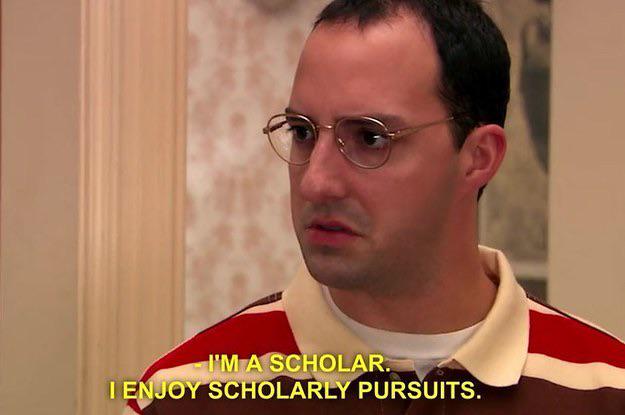
    “I’m a scholar. I enjoy scholarly pursuits.” –Buster Bluth, emeritus polymath scholar at UC Irvine

    I mentioned this in an earlier post: I’m going back to school! At 30-or-40 years old and already having a doctorate. I need a couple of course credits for a license and one of them is a 101-level class in my Ph.D. subject. Yes, really. The license requirements are pedantic and literal to that point; this has much to do with guild protectionism of a lucrative post and the massive exodus of research scientists into clinical science, given the disemboweling of government/academic research and the dismal state of the biotech industry. But the second class (hematology) is taking more time than I anticipated, given that I insist upon reading the textbook chapters whole and my experience vis-a-vis blood is largely the immune system. Competition for these clinical positions is cutthroat and I’ve got to prove this old dog can still learn new tricks, or, at the very least, indicate that my dismal publication record is not a result of a dismal drive or dismal intellect.

    Perhaps you seek too much

    Bit of my analogue fetishism/return to notebook the past few years–I’m taking notes by hand, and I have to admit retention is far better than when I just download the lecture powerpoint or even type notes. The tenor of the past few years of my life is one of regret, of wishing-to-do-over–so looking back at my undergrad and grad years and wishing I had (a) done the reading more diligently and (b) taken detailed hand notes. I had been hit by a combination of gifted-kid arrogance and depression. I felt in a weird way that reading the text and taking notes would be cheating–that I should be smart enough to remember stuff told to me once, that I should not be that pedantic apple-polishing student who tries very hard but isn’t all that naturally bright. Looking up examples is cheating; I should be bright enough to extrapolate everything I need know from a few basic rules. It’s all bullshit, of course–I maintain the honors students are the students who lie about how much they study by understating, or they were in my day–but my younger self was disgusted by the idea of being too lock-step with the system and, perhaps most damning, was rewarded for this behavior with good grades and scholarships. I wanted to be so damn naturally smart that I could not-try and be valedictorian. I also had a Hesse-esque fixation on being no-one’s acolyte or student but my own that carried over well into adulthood. I wanted to be the Siddhartha who rejected the tutelage of the Buddha to find his own truth, much as he respected the Buddha’s teachings, the Max Demian who kept his own moral council.

    Might I be in a better position now if I had knuckled down that first year of graduate school–sure. I put all my time and reading into my lab rotations and neglected my classes, and that was reflected in my grades, which impacted my lab rotations when it was time to get a permanent lab. I was frequently at one lab until 1 AM. But that lab (that liked me most) had taken me as a rotation student on the understanding that I would have to secure my own funding to stay with them–and I didn’t, not for lack of trying. I am stupefied meditating on how different my career might look how had I gotten that damn NSF grant, or something. I ended up in a solid enough lab but to make a long story short our off-campus collaborators told me two weeks after I defended that the data upon which I had based my dissertation–and two substantial first-author papers I was waiting for other-author comments on–was faulty, in such a way as to invalidate the entire premise. I was allowed to graduate because I had defended correctly what I had been given in good faith. But, those papers never happened–the PI of the other lab was caring for his wife on hospice and the PI of my own lab had his own age-related issues. I should have been more of an asshole and leaned hard on them but I can’t bring myself to do that to kind old men. It is utterly against my nature to impose upon people, because I hate it so much when people impose upon me, and I treat others as I wish to be treated.

    And here I am.

    About what you know

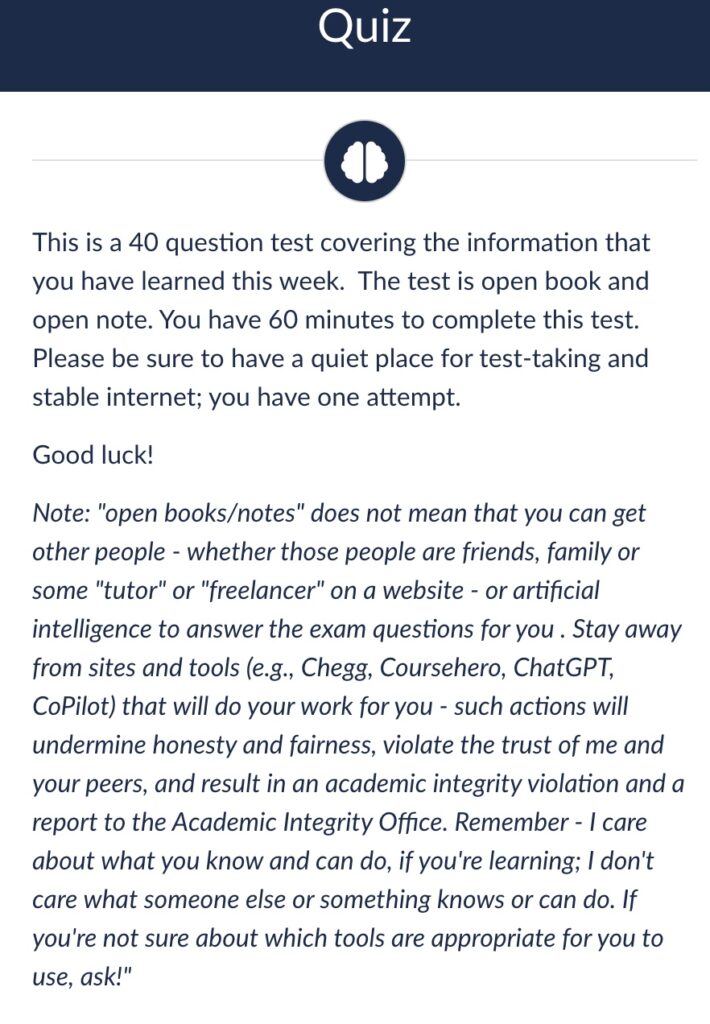
    “Note: “open books/notes” does not mean that you can get other people – whether those people are friends, family or some “tutor” or “freelancer” on a website – or artificial intelligence to answer the exam questions for you. Stay away from sites and tools (e.g. Chegg, Coursehero, ChatGPT, CoPilot) that will do your work for you – such actions will undermine honesty and fairness, violate the trust of me your peers, and result in an academic integrity violation and a report to the Academic Integrity Office. Remember – I care about what you know and can do, if you’re learning; I don’t care what someone else or something knows or can do.”

    I am so glad I got my Ph.D. before ChatGPT and the other generative AI became prevalent. The date lends a credibility to it. I am also glad I am not teaching remotely in this brave new world because this disclaimer–really, this entreaty–bleeds with desperation that comes of only being able to tell people not to cheat in their own best interest because–please. Just please don’t, else the spirit and credibility of academic accreditation is gone. As an somebody who wanted to be an academic or a post-secondary instructor I understand the desperation, the same way I sometimes wonder how set I’d be were reading and writing still marketable, unique Skills.

    I am a scholar – maybe not so far removed from Buster Bluth as I would like to think, the only thing separating us being that I decided upon a concentration and he had the family largess to be an eternal student.* I’m primarily a knowledge-peddler, a thinker, responding to crisis or shock with paralysis and thinking. Perhaps my kind is ultimately of as little usefulness as a farrier in the age of the automobile, where horses are a novelty and one only needs so many farriers, a very rare lucky few to serve what is an elaborate expensive hobby and not a social need. One can argue whether or not this is intrinsically a bad thing or a loss for society but either way I’m kind of fucked, aren’t I.

    You’d be one of the bright ones

    That is the message I got growing up in the 90s – I was so intrinsically bright, so intrinsically chosen, that a good life and a fulfilling career were all but guaranteed, and all I had to do was not fuck it up too badly.

    That’s another thing that’s difficult to come to terms with, the point where all this intellectual pride intersects with a very American-Protestant pride in being The One Who Rises Above, the cream of the crop, the bright ones who earn a degree of comfort and stability in life. There’s something of the Calvinist pride in being “chosen” to be endowed with natural gifts, that pride in what-one-is and not what-one-earned that is an odd and striking counterpoint to the ‘you must earn everything’ ethos that is the face of that Protestant work ethic. I maintain New Calvinism** appeals in this day of the shattered myth of meritocracy (or the ‘fuck you, I got mine’ era) because it gives realization of this painful truth, at the very least, the aura of stoicism, of clear-minded clear-seeing grit. Like Pa Ingalls letting his family starve before he lowers himself to accepting charity, and that being seen as admirable, American. “Play the hand you’re dealt” and don’t complain, but still be proud of being dealt a good hand. Pride in acceptance of one’s lot. “God did not choose me to deserve much in this life.”

    I do not believe you have to be exceptional to have a good quality of life. And yet as the haves and have-nots diverge further, as the middle is hollowed out and the have-nots reach such a majority that the K-shaped wealth curve becomes very bottom-heavy indeed, I still find myself feeling this economic uncertainty and precarity is my fault. I wasn’t one of the Bright Ones after all.

    ——–

    *I also think Lucille is hilarious but I could not actually put up with her in person, let alone live with her, let alone have an incestuous pseudo-marriage with her in which she is in a position of authority over me.

    **Consisting mostly of those “extreme” youth churches with a grunge-by-way-of-industrial aesthetic stuck back in 2002 with the billboards all over I-10 that multiply east of LA proper.

  • Auditory Madeleines: part whatever

    Auditory Madeleines: part whatever

    I’m becoming convinced there are certain songs I need to relegate to a certain period in my life. Or–only listen to them when I want to recall a certain period. I have heard The Eagles multiple times since childhood and the reaction I had in Okawachiyama was exceptionally strong given the contrast between rural Kyushu and the Texas Panhandle.

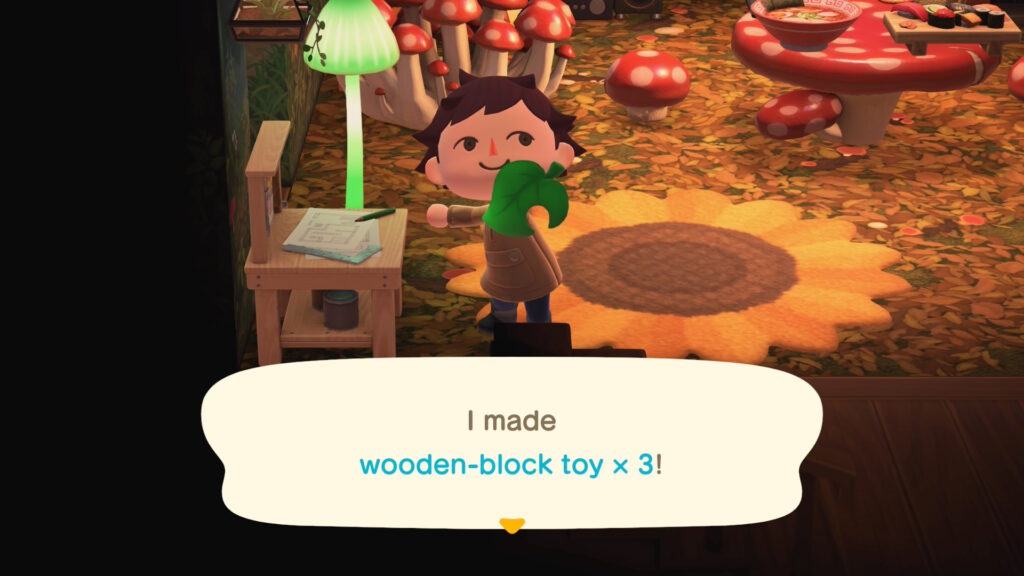
    New Animal Crossing: New Horizons update came out. Crafted something for the first time in years and the crafting ‘sounds’ whipped me back to March 2020 so hard I had to just sit with it a while.

    Images you can hear. It is two-thousand-fucking-twenty. (Screenshot: Animal Crossing, New Horizons, showing off product of DIY.)

    March 2020 sucked. And yet I felt only nostalgia thinking on it, a distant sense of pain. Almost, for a moment, wanting to go back. Maybe because I wish I could have done the past six years over in a lot of ways.

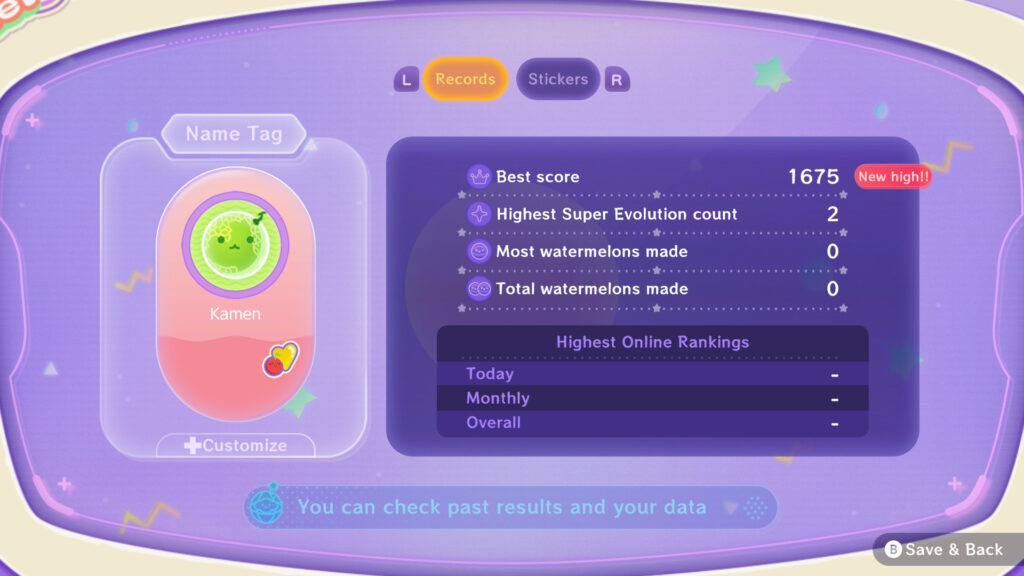
    The Suika Game sequel (Suika Game Planet) also came out, and that piano theme that plays in the background whipped me back to 2023 so hard I was sitting in a daze remembering being in Yodobashi Camera in Hakata, late on a weekday night, watching an impromptu Suika Game tournament being held on one of the display TVs in an otherwise dead department store. This was not the first time I had played the game — it had gone viral just before I had left for Japan, and had played a lot of it back in California right before going. I played a lot in my apartment in Fukuoka late at night. It was still Yodobashi Hakata I was thrown back to. I had hardly played it in the time after. I am, as I type, undoing the force and clarity of that memory, sitting on the couch while my partner plays and getting the song back into my skull; something is being re-written, something is being lost. Not completely lost, but the force of recollection is no longer making me freeze.

    The gentle smiles of the fruits are as the sakura*, the pastels as the morning frost.

    As an aside: this did make me laugh out loud, which gets credit, even if it is a cheap laugh:

    *Ephemeral. Mono no aware (物の哀れ), what have you.

  • Time isn’t after us.

    Time isn’t after us.

    Just like that bluebird

    Ten years and some change ago I was waking up to text messages from my mom and my best friend asking if I “was okay”, which was A Way to start a morning, to be sure. I do not have the texts saved but I can guess with some degree of confidence my response was “????” or thereabouts. Then comes the text reaction you can feel the “o_o” behind – the feeling when one realizes one is not merely a party of comfort, but a messenger of bad news.

    “Lazarus”, from Blackstar, David Bowie

    I did not make this post on the tenth, because–and it pains me to admit this–the tenth of this month did not register to me as meaningful, not the day of. I was up early to work a convention in Long Beach and stayed largely off any internet but the convention staff Discord channel. The fuck of the thing is — Labyrinth was showing across the street at The Pike for its fortieth anniversary run and I was well aware of that, hoping to be able to make it myself, but I did not get off work in time. And still somehow Jareth the Goblin King lurking at the back of my mind was not sufficient to trigger my memory that it was ten years to the day Bowie had died. Indeed, I did not even think on it until yesterday when I saw a memorial retrospective for Alan Rickman, and through that remembered we had lost two giants that week in January of 2016.

    I’ve see “ten year retrospectives”. I do not recall twenty year, or twenty-five year, or further. Perhaps ten years is, in round symbolic numbers, closest to the amount of “organic” or “intrinsic” time it takes for the world to adjust to your absence. Not to forget you by any means, but to accept that you are past tense, outside a posthumous cult that elevates that day into an annual memorial, or one’s direct relations. Ten years to accept the loss of an artist, a legend, as it were. That ten years is a liminal time for the artist wherein the immediacy of their loss fades, and we come to accept them as past/passed.

    Something of an echo

    I live what I feel is a distinct echo, but faint, anaemic, of 2016. Tired, rueful. That year I was preparing for quals, teaching, doing research, doing the various things that make up a graduate student’s life. I was happy. I loved my work. I was proud of it. I still saw some of the freshness of young adult life in the daily, the waking up in my own apartment, making my own way. I was buoyed by that sense I have heard called “romanticizing your own life”–not bogged down by self but still utterly in the moment, thinking on the pleasure that is living a life the way you want to. I cannot tease apart the extent to which 2016 felt hopeful because I was younger or because it was a more hopeful time; it isn’t important anyway. My peers age as we all do, as I did, and that folds into my evaluation of the gestalt. Today I am back in school, sort of, taking online classes this quarter to fill in gaps for a license. We had an ‘introduce yourself’ sort of icebreaker assignment on the class message board and I again see how I am ten to fifteen years older than the rest of the class, how they are at a point in their lives where they are looking forward, while I am trying to salvage a career crashed first by circumstance of nobody’s fault, really, and then by direct, deliberate action with the explicit aim to destroy what was limping back.

    Something of a synchronized timer

    As we all do, age, together–life follows a rhythm. My cohort who came of age twenty years ago followed a common pattern within a few years of moving out. Many of them adopted pets. This past couple years, all those pets passed. The pace of a life cycle synched up. My cats dropped into my life a few years later than my friends’, so they’re still chugging along, but time is ever a gift and tomorrow never promised. An era ends. Nobody has talked (with me, at least) about it in explicit terms, but there is the sense that youth is over, and the future joys of life will be tempered with loss and weariness. We had a first ‘unifying’ epoch, in our early-mid twenties–when all our childhood pets died within a couple of years of one another. It is this uniformity of the life rhythm that hits me, the relentless predictability, a metronomic and inevitable group loss. As sorrowful as that metered death-wave is, it is only all the more sorrowful with outliers, with those who go early. But is there joy or comfort for the outlier who lives longer? In good health, maybe. If that outlier walks with company.

    The older you get, the more the ‘inevitable’ happens to you, and none of it seems so impossible anymore. I do think that is at the root of the cowardice of adults. It is also at the root of wisdom.

    Never tell me the odds.

    There seems to be a general consensus that 2016 is when Things Started to Go Wrong, at least domestically. (Example: I actually thought Bernie Sanders had a chance.) Retrospective pessimism is a balm in the way of sour grapes. But, I cannot but help feel foolish–we see the way things are as the way things would always inevitably have been, because things that are take primacy in our lizard brains. How does one approach the idea “It did not have to be this way”? Can one do the ‘impossible’ with a sober mind that ‘accurately’ evaluates odds? It sometimes feels strategically most sound to just fucking do it.

    It would be lovely to be able to say that pessimism with age is just an affliction, the way that I felt in youth that old people just needed to turn their face to the sun again. I knew the sorrows of life weighed on them in a way it did not on me, but I did not know. Well, I knew the loss; a young child can know loss. What I did not know was the doors slamming, age discrimination, regret, the fact that your own body and the people who guard the gates to opportunity will conspire to drain your life of potential. The former will fail you and the latter will see in you the aging they do not want to contemplate. They will see The Past, the Old Ways, or, at best, the Way Things Are. When the Way Things Are sucks that is not a welcome spectre.

    With time I grow more concerned with whether or not a framing idea is useful than if it is ‘true’.

    My point in all of this, ultimately, is an attempt to grasp what exactly the power of youth is. I do think it exists–even taking into account a deeply pessimistic generation-feeling, as I heard it put, that “none of us actually expects anything good to happen again”, I do think the young have a spark. Easy to be a saint in paradise, easy to be an optimist in the 90’s. Easy to be an optimist when young in the 90’s. The youth of today have only youth.

    Sorrow, guilt, pessimism, those are all stopping-feelings, feelings that make you freeze–long after the need for stillness to heal is gone. If I do not see “as accurately” and yet for that Believing* “get more things done” it is a trade I should be willing to make. What is in the mind is maya and what is done is the ‘stuff’ of one’s life, becomes truth. I’m a creature living too much in the mind** and indeed being so at home in the realm of ‘ideas’ that thinking–and this would include perceiving–feels like to doing.

    *in myself, in the future, in the universe, in ‘God’, in humanity

    **enneagram type 5, if you had that personality testing phase like I did in middle school

  • When the “AI assistant” would probably use the exact same phrasing I do I agonize over it overmuch.

    I have again done that thing where I feel pressed to say something profound and original–read as thoughtful, where effort = care–on a card, and coming around again to the cliche/set phrase from the pre-printed Hallmark.

    “I wish you happiness in the new year.”

    This is the distillation of what I feel. And it’s the most direct and clear way of stating it.

    There’s some tiresome point here about how cliches become cliches for a reason. Is there some way to (unobtrusively, humbly, without looking like I’m looking for affirmation) indicate that I came to that phrasing after some time of deliberation? That it is thoughtful, personalized? This card is for somebody who puts great thought and effort and visible care into gifts, cards, etc, and finds receiving same important.

    Anyway. Merry Christmas to those who celebrate. And if you don’t I hope you have a good day.

  • Nothing actually happens

    Against my better judgement I check Reddit in the morning. I assume at the very least it can tell me if the White House blew up or aliens made first contact* or whatever the fuck major news of the day. I’m also frequently on the elliptical so I’m not looking for something that requires great brain power; rants, puff pieces, ragebait, cats, kvetching end up being a lot of what I click on and the algorithm has correctly clocked me as an overeducated urban leftist. (My Reddit feed is also mostly subreddits I chose to follow, so the algorithm doesn’t exactly have to think very hard to keep me engaged. There is a lot of genuine kvetching to be done right now in, to name one category, science as it is funded and understood and disseminated by the federal government.)

    I click on a cute picture of a kitty-cat. This cat’s name is Melinoë. I think that is delightful. The poster is asking if Ms. Melinoë is a ‘standard issue cat’ (mackerel tabby). I give an utterly anodyne yet genuine message:

    The Princess is a torbie. That’s a lot of orange. Which is delightful, as she is described in the Orphic hymns as “saffron-cloaked nymph of the earth”.

    I am being serious. I do think it is delightful that there is a lovely torbie kitten named Melinoë and I am glad she found a loving home.

    I am wondering if I have just played into giving legitimacy to a bid for attention from a bot.

    I am wondering if this is a recycled picture used for karma-farming. The internet equivalent of a foot-in-the-door or establishing rapport, even though it is attached to a username at large and not a specific action.

    I am becoming a person who thinks nothing ever happens and there is no whimsy in reality, that it is all staged for twee posts baiting suckers like me into likes or typing something like “I love her :3.” I am becoming a person who fears finding delight in small things because it might be bait, inorganic. The cynicism is increasingly reflected in other comments–a return of the “and then the whole bus clapped” guy in every anecdote thread, or Jonathan Frakes in Beyond Belief. I get it, because I am starting to feel paranoid as well–but I do wonder if I am doubting somebody who just wanted to share a picture of their kitty with the internet. It is related to AI paranoia in that a ‘sucker’ is the most reviled, sneered-at figure in the American consciousness. A cynic might be an asshole but they will not be suckered, which is contemptible.

    Patron saint of the internet.

    Time is circle. I am regressing to the 2000s internet cynicism: everything is made up, and sincerity–believing something somebody said at face value–is the mark of a sucker. It feels like 4chan levels of distrust and hostility have become reasonable. Everything sucks, everything enjoyable is a fabrication designed to manipulate you, and naivety and sincerity are the traits of the dumbest people on the planet.

    Shills and plants have always been writing columns and butting into conversations on politics and policy; none of that is remotely new, although now it can be done with ease on a global scale. You are not restricted to sending a contrarian to the company hearing on establishing a union or the town hall meeting; you can JAQ** off in the comments section of Al Jazeera or the Beeb, or the feminist or Marxist subreddits, or the Xwitter of the NOAA or NASA or NIH. Arguments are made for the people silently reading and not of realistic hope to change the mind of somebody with a strong opinion. But this–suspecting somebody is posting about something innocent like cats to curate a persona that is less clockable as a bot–hits differently.

    Humans have always been a narrative-oriented species. That part hasn’t changed. Humans have always desired attention and adoration and the warm feeling that comes of delighting someone with a story–in sum, humans have always told tall tales, and this included the internet 1.0 of BBS boards and Usenet and mailing lists when the only thing you could gain from making shit up was esteem and a sense of connection. But there is now a monetary incentive to being ‘delightful’ because, in internet terms, accumulated ‘likes’ and posts and this abstract idea of ‘activity’ can be converted into money via selling the influence of that profile. An old profile with lots of stories and a ‘persona’ behind it is worth immense advertising money and can be sold or stolen.

    I’m wondering why that feels worse than just somebody looking for attention. Probably because that attention-seeking person is being genuine, in their own way. Or at the very least not trying to monetize my attention; they genuinely want it. And I am haunted by the increasing sense that the rot of the ‘dead internet’ is becoming the whole organism.

    ——–

    *Nobody is going to make first contact right now unless their primary objective is stewardship of an idiot species, of saving us from ourselves. If we’re held to the standard of showing the wisdom to be part of the intergalactic community nobody is going to be rocking up looking to meet us. Even if we hit some concrete criteria like achieving warp we’ll be approached as a liability that might become Some Other Planet’s Problem, not as kin.

    **”Just Asking Questions”

  • Retro tech

    I am reading Translation State by Ann Leckie (sequel to the Imperial Radch trilogy 1 2 3 I favorably reviewed, fucking hell, ten years ago).

    It is a far-flung high-tech space opera published in 2024, near-Culture levels of tech, or at the very least, well beyond Star Trek with warp capability etc. It’s a lovely book and I am thrilled the author chose to revisit this universe, but that is not really here or there.

    There is, in short, a bloody, shocking, historical event the aftermath of which is well documented on some sort of audiovisual media, and a group of people who think the event was completely made up. They have a motive, granted, and that is the best negation of proof. But the POV character at the time seems to think having seen the footage is proof enough. And my immediate thought is — why are you not considering that it is AI? Of course post-disaster footage can have any narrative attached to it, but I was more interested in the POV character’s immediate faith in the footage itself being real. And I have read a lot of science fiction over the past a lot of years– I am trying to recall what my initial reaction was to like statements (i.e. what is seen is what is) in older novels with a similar level of far-future tech quantum leaps beyond our own. Of course in the narrative structure of science fiction is inherent a lot of technological gotchas and revelations, and generative AI has been a staple of science fiction since its inception, but what I thought was — why does this character, specifically, not consider AI? Not me the genre-savvy reader, but this character who in-universe is not unusually adept in tech or science.

    When did generative AI move, in my mind, from the category of esoteric and theoretical to a given like electricity? When did I assume it was common enough to be first thought for any person of any tech background?

    When would I have begun to wonder if the very fact this character of this high-tech epoch did not immediately draw it to mind might be a clue, an anomaly, some key to a backwater upbringing?

    It isn’t, and wasn’t. It’s beside the point as far as the novel itself is concerned. But I have been wondering about my reaction, me-in-2025, and the-author-in-2024.

    Considerations:

    1. The AI concerns were already addressed in the “backstage” of the novel, temporally or narrative-wise, and there was no narrative point to bringing it up as part of the character’s thought process. I am reminded of Hermann Hesse’s characterization of brevity as respect for the reader in Steppenwolf.* Leckie’s style is also spare and to-the-point. It is good to let some what-ifs breathe.
    2. Advanced AI is at the forefront of this series — consciousness of collectives and machines is a key theme of the original series.
      • Why would I assume generative AI would precede cognitive AI?
        • As a law of nature?
        • As a necessary “upstream” technology of that more advanced AI?

    There is clearly an ‘order’ to scientific discoveries, a sequence — science builds upon itself and many discoveries depend on previous knowledge. So it is not itself a silly thing to believe, that there are forms of tech necessarily upstream of other forms.

    With the advance of time, this disconnect is written off as aesthetic. That is the essence of ‘retro-futuristic’. The aesthetic is intentional in works written after the advent of that tech and merely charming in works written before. The difference in intentionality between original Star Trek as written in the 60s with that tech or lack thereof and the exact same show were it produced today is a question of aesthetic. Or, even more Millennial**, irony.

    My question is — when would non-acknowledgement of generative AI begin to qualify as part of this aesthetic?

    And, are there examples of science fiction that consciously buck this trend for reasons other than aesthetic or irony? That explore the link with more than a gut feeling akin to “well, if they can go warp speed they sure as hell figured out cell phones” arising from the feasibility disconnect between cell phones (where we are now, so very possible) and warp speed (a distant theoretical) in our own reality? Fan works have cleverly messed with the mismatch in tech levels as an intellectual exercise — how would we have become warp-capable when we’re still using 5.25″ floppies — but I’m struggling to think of one where that is the premise from the jump.

    I want to say that the lack of evidence for practical use of the wheel by the highly-architecturally-advanced Maya is the closest I can come to a real-life example, or would be if lack-of-evidence actually had any positive significance, beyond potentially pointing to something so commonplace it is not depicted or clarified. (Will people reading our recipes a thousand years hence know ‘eggs’ means ‘chicken eggs’?)

    *I realize I do not run a respectful blog.

    **Yes, even more than aesthetic.