rowan rabe . ink

Tag: hades ii

  • Nothing actually happens

    Against my better judgement I check Reddit in the morning. I assume at the very least it can tell me if the White House blew up or aliens made first contact* or whatever the fuck major news of the day. I’m also frequently on the elliptical so I’m not looking for something that requires great brain power; rants, puff pieces, ragebait, cats, kvetching end up being a lot of what I click on and the algorithm has correctly clocked me as an overeducated urban leftist. (My Reddit feed is also mostly subreddits I chose to follow, so the algorithm doesn’t exactly have to think very hard to keep me engaged. There is a lot of genuine kvetching to be done right now in, to name one category, science as it is funded and understood and disseminated by the federal government.)

    I click on a cute picture of a kitty-cat. This cat’s name is Melinoë. I think that is delightful. The poster is asking if Ms. Melinoë is a ‘standard issue cat’ (mackerel tabby). I give an utterly anodyne yet genuine message:

    The Princess is a torbie. That’s a lot of orange. Which is delightful, as she is described in the Orphic hymns as “saffron-cloaked nymph of the earth”.

    I am being serious. I do think it is delightful that there is a lovely torbie kitten named Melinoë and I am glad she found a loving home.

    I am wondering if I have just played into giving legitimacy to a bid for attention from a bot.

    I am wondering if this is a recycled picture used for karma-farming. The internet equivalent of a foot-in-the-door or establishing rapport, even though it is attached to a username at large and not a specific action.

    I am becoming a person who thinks nothing ever happens and there is no whimsy in reality, that it is all staged for twee posts baiting suckers like me into likes or typing something like “I love her :3.” I am becoming a person who fears finding delight in small things because it might be bait, inorganic. The cynicism is increasingly reflected in other comments–a return of the “and then the whole bus clapped” guy in every anecdote thread, or Jonathan Frakes in Beyond Belief. I get it, because I am starting to feel paranoid as well–but I do wonder if I am doubting somebody who just wanted to share a picture of their kitty with the internet. It is related to AI paranoia in that a ‘sucker’ is the most reviled, sneered-at figure in the American consciousness. A cynic might be an asshole but they will not be suckered, which is contemptible.
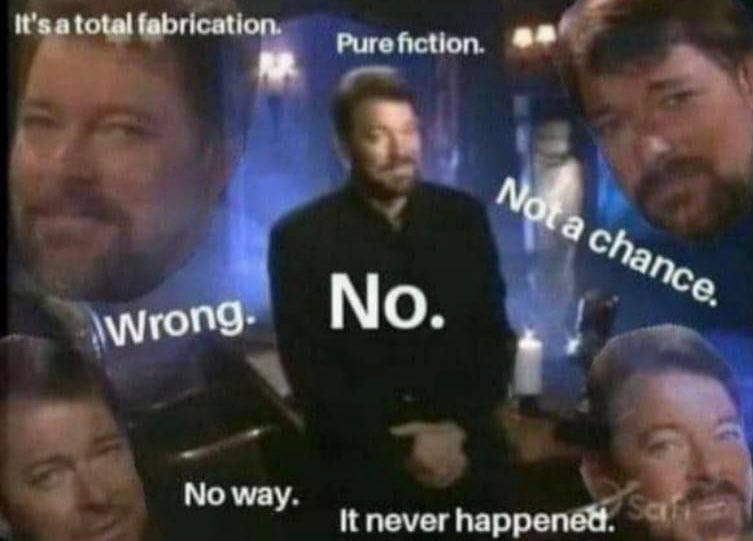
    Patron saint of the internet.

    Time is circle. I am regressing to the 2000s internet cynicism: everything is made up, and sincerity–believing something somebody said at face value–is the mark of a sucker. It feels like 4chan levels of distrust and hostility have become reasonable. Everything sucks, everything enjoyable is a fabrication designed to manipulate you, and naivety and sincerity are the traits of the dumbest people on the planet.

    Shills and plants have always been writing columns and butting into conversations on politics and policy; none of that is remotely new, although now it can be done with ease on a global scale. You are not restricted to sending a contrarian to the company hearing on establishing a union or the town hall meeting; you can JAQ** off in the comments section of Al Jazeera or the Beeb, or the feminist or Marxist subreddits, or the Xwitter of the NOAA or NASA or NIH. Arguments are made for the people silently reading and not of realistic hope to change the mind of somebody with a strong opinion. But this–suspecting somebody is posting about something innocent like cats to curate a persona that is less clockable as a bot–hits differently.

    Humans have always been a narrative-oriented species. That part hasn’t changed. Humans have always desired attention and adoration and the warm feeling that comes of delighting someone with a story–in sum, humans have always told tall tales, and this included the internet 1.0 of BBS boards and Usenet and mailing lists when the only thing you could gain from making shit up was esteem and a sense of connection. But there is now a monetary incentive to being ‘delightful’ because, in internet terms, accumulated ‘likes’ and posts and this abstract idea of ‘activity’ can be converted into money via selling the influence of that profile. An old profile with lots of stories and a ‘persona’ behind it is worth immense advertising money and can be sold or stolen.

    I’m wondering why that feels worse than just somebody looking for attention. Probably because that attention-seeking person is being genuine, in their own way. Or at the very least not trying to monetize my attention; they genuinely want it. And I am haunted by the increasing sense that the rot of the ‘dead internet’ is becoming the whole organism.

    ——–

    *Nobody is going to make first contact right now unless their primary objective is stewardship of an idiot species, of saving us from ourselves. If we’re held to the standard of showing the wisdom to be part of the intergalactic community nobody is going to be rocking up looking to meet us. Even if we hit some concrete criteria like achieving warp we’ll be approached as a liability that might become Some Other Planet’s Problem, not as kin.

    **”Just Asking Questions”
  • Through a lens familiarly

    A continuation, I reckon, of a re-read of Stephen Fry’s Greek myths, certainly not because Hades II had a recent full release or anything so puerile as that, though this time I’m all the way at the Odyssey.

    Telemachus, son-of-Odysseus, looks just like his old man–a “chip off the old block” as Helen-via-the relentlessly-English-Fry puts it. That is the reaction he gets when meeting anybody who knew his father — immediate, reflexive, almost awe. Telemachus at this point in the story does not remember his father, as the latter was summoned to the Trojan campaign when the former was but an infant. But, from birth, in his mother’s eyes, the ghost of his father hovers over him and everything he does.

    I was struck by how familiar this was–this was a motif in my own life.

    That was common enough when I was growing up close to the small town where he grew up, visiting often. This is a small town in a “small state”, in the sense that it is a rural state and everybody seems to know or have connection to each other who has lived there long enough. It was not a recognition I anticipated I would get ever again once I had moved out of that temporal and geographical sphere. Yet, as fate had it, one of the administrators in my department at a world-class school in a world-class city knew my father in childhood. One Christmas party I was chatting with her and my mentor when she said, seemingly out of nowhere, “You look so much like your father.” (My mentor, who knew my roots were deeply rural, was shocked–I had not told him happenstance had placed an old family friend from another world in our little department in our massive school.) It was unbidden, a burst that comes of no longer being able to hold something back, from being overwhelmed by a thought. I have spent a lot of time thinking about that encounter. I was an anachronism, a powerful anchor for nostalgia, well out of time. I wish I recall what I had been saying, or what my facial expression had been, or what I had been wearing. Something to clue me in to what, precisely, was the last straw.

    I was an adult when I first saw a photograph of my father in his youth, in his high school yearbook. Time had not yet masculinized him as much as it had when I knew him, or even saw photographs in college, and I felt I was looking at a photograph of myself. Me, a bit broader in jaw in shoulder, a bit more heavy of bone, but even dressed the same was I was for my senior photographs in black suit and tie.

    Those gasping reactions I used to get from people who knew my dad — “You look exactly like your father” — are a time-limited state of being-understood. People who see me through the lens of him will die out and should the fates favor me to live that long there will come a time when no-one on earth will see me by my resemblance to my father; or, rather, the people who knew my father before they knew me–who see me in the context of him as the primary relation–will die off. This does not feel like losing “myself” but it is a loss of a link. A loss of a function as a mirror, which can reveal things about oneself by comparison. Not all it reveals will be flattering, but it will be worth thinking about, if I have the courage to do it with an honest mind. The resemblances are not merely physical. I’ll leave it at that.

    Not all are familiar with the dynamics of rural areas — large geographical swaths with small populations, small state capitals, small universities, the same institutions in huge populated states but writ small where everyone seems to know everyone else. The offices that require geographical distribution — doctors, professors, lawyers, the sort of office where you need a baseline of X practitioners per X unit land regardless of population density–that create a small pond for some large fish. The setting of the Odyssey, a collection of city-states we now think of as “Greek” largely, would have been similar — there is room for each large personality to become well-known. I am reminded of Dunbar’s number here — that each person can remember maybe 150 people intimately, regardless of the population density in which they live, and at lower densities the odds favor somebody-knowing-somebody-who-knows-you.

    I had thought in coming to California I had forfeited any likelihood I would be evaluated through the prism of family. It is liberating. Alienation often is. But alienation is decontextualizing, and I have an inordinate respect for context, for understanding a person through their place in the matrix of relationships that created them. Maybe that is why I so like multi-generational epics.

  • Queen Bitch

    Apropos of nothing, certainly not video games that just came out or anything of the sort, I’ve been re-reading Stephen Fry’s Greek myths anthologies, and I encountered what is, somehow, the old-queeniest thing I’ve read in a while*:

    I am very fond of [Hera] and, while I am sure I would stammer, blush and swallow awkwardly in her presence, she finds in me a devoted admirer. She gave the gods gravity, heft and the immeasurable gift of what the Romans called auctoritis. If that makes her seem a spoilsport, well, sometimes sport needs to be spoiled and the children called in from the playground.

    –Stephen Fry, Mythos

    God keep you, Mr. Fry.

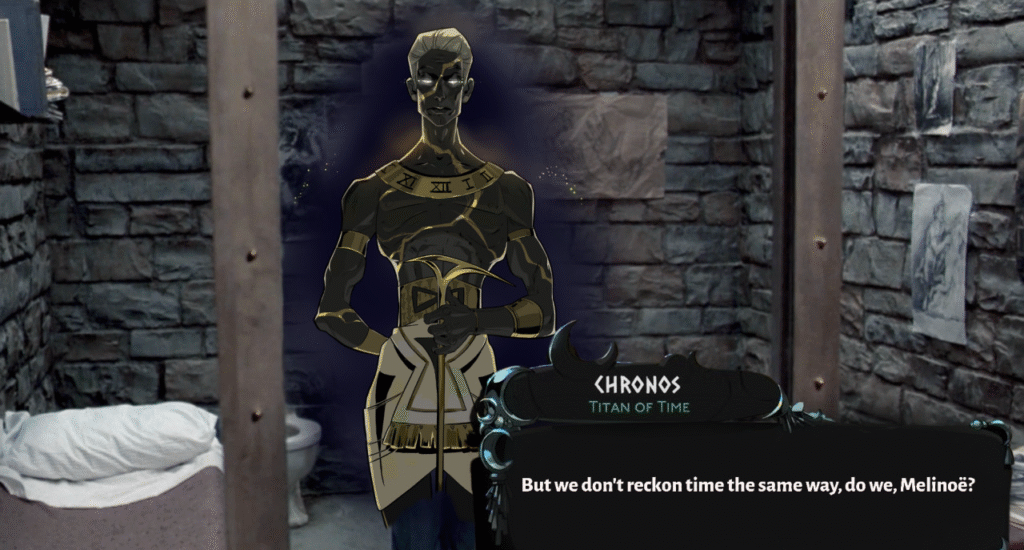
    Also completely unrelated: I still can’t get Supergiant to confirm his voice was supposed to be this:

    (Every time he opens his mouth I hear “Tell me, Melinoë…”)

    But seriously, I love his nasaly, queeny voice.

    *and I’ve been reading In Search of Lost Time