

(I’m not posting the Tim and Eric meme.)
Once a church stood here. But I’ve deconstructed it, scavenged it for my own use, pick the island clean of resources, and even used it as a dump for my volcanic ash and beach sand seriously I can only make so much glass waste, and not a soul or a ‘mon is harmed. It’s abandoned. It’s free real estate. What a relief, that such islands exist, there to be scoured clean of resources and left with the trash, and that nobody is harmed or dispossessed. Ethically clean.
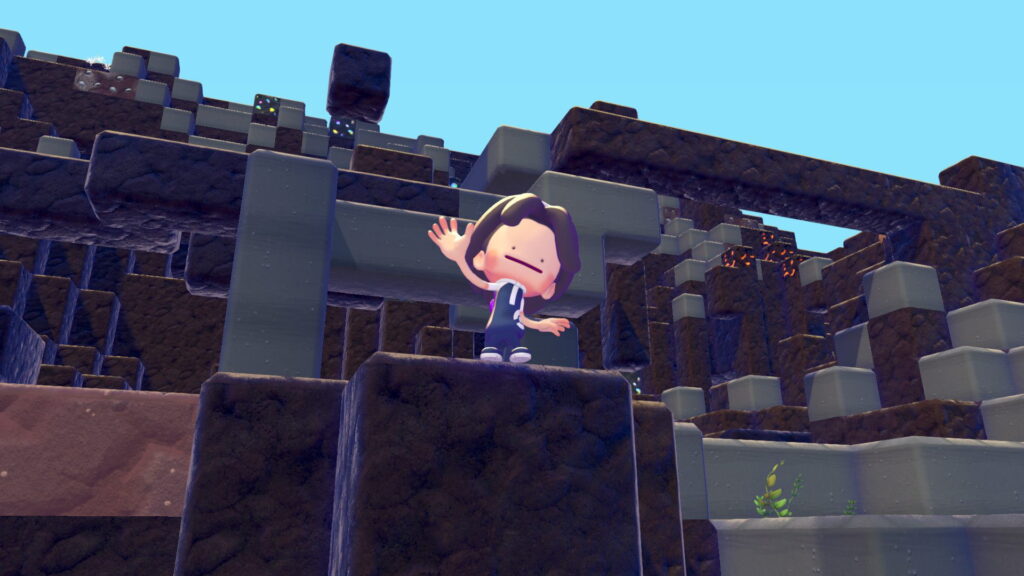
The blank eyes of the devouring maw that sucks up all of value.

I am sinking far too much time into Pokopia. Well, I feel as though I am–I see some of the elaborate builds people did within the first week of release and wonder if I should invest more time. This middling time-sinking feels the ultimate waste — either go into it fully or don’t at all. But that’s always been my problem — obsession with optimization to the point of paralysis, do it all or don’t do it at all, do it right or don’t bother. Even if it’s a damn video game. Somebody years ago on the internet said “Do not treat games like homework,” and it has stuck with me. This means not forcing oneself to finish games one really is not feeling, nor getting into a perfectionist snit. When it stops being intrinsically fun, the value is lost.
(I’m well aware how familiar this (bonus: ‘this’ is about Book of the New Sun) sounds. I can’t be arsed right now to explain how it’s different; it just is and everybody damn well knows it.)
Video games are tricky, especially games with a creative element like Pokopia or, oh, Minecraft is next to come to mind, or games that require strategy. There is a creative element in playing them that goes far beyond simple consumption of Funko Pops or whatever. It is the relationship between the brickmaker* and the architect. To be generative within the milieu that is already established (example: to be one of the most influential Pokopia build gurus) means a time commitment to a very deliberate and intense delve into somebody else’s product, something that does take considerable time and dedication. The Serebii Pokopia controversy lays bare the exhaustive labor that comes of being The Authority on a game–clearly, it is labor, it has value, otherwise why would people try to (1) appropriate it and (2) avoid it. This is the literary critic who has built their career around one author, writ with a more populist bent. It is painstaking, exacting work, the sort we acknowledge with the title ‘doctor’, and not undeservedly. This is something adjacent to science, but within this analogy God is the game creator(s), and we are laboring tirelessly to understand their design. Part of the sale point of the game is the mystery that was created, left to be enjoyed on levels from just-dicking-around (hi) to excavation and cataloguing, experimenting. But games have always been ‘pointless’ and yet what we live for, something that compels us as much as art.
The game designers, however, designed their worlds for maximum engagement and enjoyment–this means a universal constant of (ultimate) fair play, of getting out what you put in being guaranteed if you stick with it. “God” or whoever is responsible for this ‘real world’ was not so generous. The game is rigged not to be rigged against you. It certainly is rigged for you, which gives one a sense of effortless agency.
I’ve talked about the idea of future-nostalgia, also within the context of a video game that gives me an immense sense of peace. Pokopia is this soft post-apocalypse dream manifest — an empty world, green, cleansed, healed from the excesses of former civilization but retaining many of the fruits of that excess. The payment has already been made and we the innocent Pokemon are here to collect and rebuild. There is enough housing–more than enough, for each person to have their own customized space. While this isn’t in Pokopia as much of an issue there are jobs, ‘places’, for everybody; everybody gets to contribute in a meaningful way, best according to their talents. The world has room. And it is eight billion of us all dreaming of a world scoured clean of probably seven billion of our fellow humans, eight billion overlapping dream worlds in 7/8 of which you are in the way.
That is something I notice with a lot of ‘cozy’ games, a lot of speculative-utopian settings: there’s a damn lot less of us humans taking up space, resources, jobs, making traffic. And there are few enough humans that each person has a chance to be known as an individual, in some capacity, by a community, has a ‘place’ for their talents and interests. This is the world dreamed of by the person who sends out hundreds of job applications to get no response, who cannot find work in their degree field, who cannot afford a home, who cannot get noticed or published or discovered or an audience and can only pray for the capricious selection of virality to make them one of the ones who made it. But we want this already-done, not a decision we had to make or an atrocity we had to commit–that is the key cozy component.
It is what the pioneers who went West were promised — an empty world, a canvas that has already been broken in and made hospitable by a previous people, except in the case of the real American West the “people” were not as gone as the pioneers were led to believe. I was reading about the Donner Party again (my Libby hold for The Indifferent Stars Above finally came available after some weeks) which is possibly the clearest illustration of the dire risk taken by families striking out west–basically, the worst that could happen, did happen. This is supposedly my blood, these people (Westward pioneers, not the Donners), and yet I find myself questioning if I would have the stomach to risk such a fate, or if I would have stayed east of the Mississippi, or, going further back, in Europe. It is hindsight that tells me this “open land”, this massive safety valve for the discontent of the masses, was not actually free real estate but seized from a dispossessed people who were cleared out with genocide and disease to make room for the white influx. Whether or not the first wave of disease was intentional or not is immaterial; it happened. I understand why the pioneers reacted with rage when they got to the promised land and found it taken. They had indeed been lied to–sold a bill of goods. They had risked and lost immensely for that lie. They were indeed brave, they did hold up their end of the bargain. But no disappointment, no pain, excuses taking it out on an innocent party. The overwhelming bone-deep feeling of ‘it’s not fair!’ does not excuse harm done to others. Coexistence would have been one thing, a compromise, but they wanted what was promised–what, indeed, is owed to every person, what every person deserves, freedom, self-sufficiency, dignity, but cannot be seized from an innocent other if you lack it. But rage for elites thousands of miles and years away by wagon doesn’t have much of an outlet; it tends to boil over onto what is closest, what manifests the ‘obstacle’, what, if only it did not exist, would make the world perfect. The fly in the ointment, the other person laying down a boundary. If I had the knowledge of history I would have migrated acknowledging that I was an immigrant into somebody else’s land, not pushing into terra incognita, and would make my calculations knowing this. And, had I migrated late enough in history, it would indeed be a (relatively) cleared-out frontier; all that unpleasantness would be in the past and I could reason that me not going west was not going to bring those Indians back to life. I can understand the bitterness of people who do awful things at being vilified; later generations get to recoil from what was done to ensure their current hegemony or prosperity and pretend they would never, while reaping the benefits. People are awfully eager to bury the hatchet when things have already shaken out in their favor–because they get to be technically right (eye for an eye makes the whole world blind and all that) as well as sitting safely in a position of material advantage.
I will bet in a generation or so Israel will be all over itself to apologize for the genocide its ancestors committed, but, oh well, what is done is done, and here we Israelis are in a Gaza that was ethnically cleansed to make room for us. A people being very contrite from their wadi bungalows and seaside condos. I know this because my own people did it and I find it exhausting, the land acknowledgements and all that. Either give the land back or shut up; at least conservatives are being honest when they say they do not intend to make right. It is very convenient to have a cultural belief that contriteness after the fact erases the burden of sin. It is a belief rooted in truth–that the past is past, and cannot be changed, and we are flawed–but who benefits?
We’ve (white Americans) also overpopulated such that we can’t just go back from where we came from–Europe (the world, really) hasn’t the capacity or desire to absorb all of us, as Americans looking to expatriate in this political climate are finding out. So, yes, there is nothing to be done, the guilty parties either got their cosmic justice or never will, and it all works out rather neatly because the sins are in the past. 仕方がない.
We’re still dreaming of the frontier–just an ethical frontier, where this time the former occupants really are all gone and have left behind a world of ruins upon which to build a new society. The self-poisoning excesses of the former society killed them, ultimately, but we (the future people) benefit from the hyper-accumulation they’ve left behind. It’s all out there to be salvaged. The infrastructure and general world-shaping that was barely keeping up with an overpopulation is, transplanted to this new, much smaller population, abundance for all. Much as Marx argued that industrial capitalism must precede communism, hyper-exploitation and excess set up the infrastructure for a comfortable post-scarcity. The evil’s been done, the bill paid, and we the innocent current generation inherit Elysium. And we are truly innocent–we did not do any of the misdeeds of the past, did not commit the sins of our fathers–but we must acknowledge also that we benefit. Those who ‘lost’ the conflict and might be owed something have been buried by clean, healing time, the slate wiped clean.
So, you can find a church and deconstruct it brick by brick, move it to your own homestead, and what you’ve done is entirely a creative act, dispossessing nobody–indeed, an act of redemption, of recycling, of thrift and industriousness. The people who originally built the church are conveniently gone to allow that. And there is excess for everybody, and the world was allowed to heal from its accumulation, but we get the benefits.
————
*All my fire Pokemon: I told you to get to work on firing bricks and you’re just lounging around; when there is clay in the community box that means SOMEBODY needs to step up. I don’t have this much trouble with the concrete mixers or the furnaces**; somehow Pokemon know that raw materials laid out beside them mean it’s time to step up.
**It’s also the fire Pokemon. They’re good about the furnaces. I have to drag them by the ear to the community box and show them up close and very specifically that there is clay waiting to be fired, and yes, the community box is usually right next to the furnaces, so they’re clearly walking past the entire setup with selective vision. The recycling Pokemon ignoring the trash in the community box also need to step up or I need to deputize Scyther*** to be an enforcer because he’s clearly the only one who checks the damn box.
***I put logs in the community box and it is always Scyther who is on top of it. Thank you, Scyther, specifically; I hope you have a good day.