Cleaning out the apartment and finding that the fucking moths keep getting to my wool despite seeding the closet/containers with anti-moth packets. I remain dedicated to natural fibers and find them on balance preferable to synthetic but the fucking moths seem to be of the same mind. I have a thin merino cardigan that is already covered in patches and it looks like my favorite turtleneck-sweater is about to go the same way. Tensions are rising and hostilities are imminent. At least they have thus far spared the vintage Pendleton cardigan I restored from a state of looking like it was used to soak up motor oil.*
Anyway. I got my bike out of the closet yesterday. And it’s just been propped up in my bedroom where I’ve been staring at it. Tires flat as pancakes and I can’t get the headlight to work, but still a beautiful commuter bike I put a lot of customization into: frame lights, racks and baskets, Gatorskin tires, cushy gel saddle, sprung for the next-tier-up model with in-frame cording with my such-as-it-was grad student stipend. The specific model of bike was discontinued years ago–the frames for the descendant models look more rounded, for lack of a better word. I wonder if I should have gotten a step-through but at the time I was doing a granular comparison of frame strength (like it would matter in the city but I use the will-this-be-sturdy-if-society-falls heuristic for a lot of big purchases) and settled with the mixte.
In search of lost spine
I was a disciple of the vehicular cycling school after poring over Sheldon Brown‘s website back in undergrad. It was one of the best examples of web 1.0 excellence — a database lovingly curated in obsessive detail of a specific topic, free from ads or endorsements that were not the author’s personal take. (Well, the page was free from ads back when I read it around 2007-2008 (i.e. immediately before Brown’s death, so he was still doing upkeep), but…) Simple wall-of-text pages of granular information and embedded images. No “like and subscribe”. I do not fault people hustling for social media presence nowadays for playing the game but I do hate the game. Anyway, as I tend to Get Into Things obsessively and try to become an expert in whatever I am Getting Into, I’ve read a dissertation’s-worth of stuff on bike commuting and was trying to use my bike as much as possible in liu of my car. But, sometime in the past few years I had one too many close calls and put my bike in the closet. As somebody on Reddit wisely pointed out in one thread on urban commuting or cycling in X city or like, and as I thought I replied to but can find no evidence of that so it must have been one of those in-my-head retorts, that fear has indeed made me fatter and more depressed, but here we are. My mental health is worse when I drive everywhere. Some of that was unavoidable, like having a thirty mile one way commute in a city with pitiful public options for that route, but some of it has been increasing timidity. I still walk places in walking-distance but those middle-distance, cycling-distance places now get the car if there isn’t a train or a bus stop handy.
A lot has changed. One change, entirely internal and localized to me, is age: I have become more timid and aware of my own fragility as I approach forty, and I was never much of a daredevil even with the aegis of youth. Defensive driving, or defensive riding–i.e. acting as though other people on the road were actively out to get you–was not something I had to be taught; it was my basal-level awareness that I only ‘noticed’ when I was consciously trying to notice, like breathing. The other, global change in environment is the ubiquity of smartphones and resulting distracted driving. I try to temper my very strong ‘everything sucks since 2020’ gut feeling with deference to that which is measurable, verifiable, and able to undergo peer review. My general sense of ‘danger’ on the road happens to increase with age which increases in parallel with, correlated with, time, which has also been correlated with the general enshittification of everything anywhere: politic, climate, law, the ‘social contract’ if you want to get into what exactly that might be but has something to do with the fact that I cannot leave my bike locked up in the garage and have to haul it up/down the stairs, a process arduous enough and that ends with me getting slammed in the back of the head by handlebars or wheel enough that I avoid the entire endeavor entirely. Paradise is receding and people are proving they are not ready to be saints when it requires any actual sacrifice of them. This isn’t surprising–history has been clear on this, that people get miserly, mean, suspicious, and reactionary during hard times; anything to justify or ennoble saying ‘fuck you; I got mine’–but it is depressing to see happen nonetheless.
I have soothed my own ego by telling myself that David Byrne, cycling advocate that he is, said that even he will not bike in Los Angeles. Except upon renewed searching I am not finding evidence of him actually ever having said this and I am beginning to suspect it was a hallucination on my part, possibly a refraction of the statement that he does not drive in New York, but does drive in Los Angeles. There is the implication of relative safety or lack thereof in that and maybe over the years I’ve gotten it twisted up in self-soothing.
The fragility of visibility armor when nobody is looking anyway
I see the smartphone as the kernel, manifest, of what has chanced since 2008 – social media-fication of the milieu and the ubiquity of smartphones, coupled with an increased fuck-everyone-else attitude. Brown and Forrester were cycling in an era when the average driver could reasonably be expected to be watching the road, un-distracted. The advice at the time was to confidently and aggressively take the lane–be visible, and that was sufficient to keep you reasonably safe. It works. When people are watching the road.
I wondered if the stats around wreck patterns had changed past few years. Used to be that being outright ‘rear ended’ was the rarest type of accident, because it relied upon somebody not looking dead ahead, as should be the minimum attention paid to the road, or on acting with intent. It didn’t often happen in comparison to sideswipes, doorings, intersection misunderstandings, etc. Every study of such I’ve found published since around 2015 confirms my hunch, and nonmotorist/motorist traffic fatalities are increasing after hitting a low around the same time point. The wrecks are indeed becoming enriched with the type of wreck that was rare when people were at the very least looking dead ahead: rear-endings and drifting out of one’s lane.
I suspect the strongest deterrent to mowing people down was still the sheer pain-in-the-ass that was dealing with the legal and social consequences, or, rather, it was the deterrent that kept in check those for whom care for one’s fellow person was not a consideration, who can cause a disproportionate amount of destruction as single actors. The selfish actions of the few stick out in mind against the background of general mutual care and consideration and so make it seem like “nobody” cares about anybody else anymore. I think people realize as they say it that is not true, but they are fumbling with a way to express the totality of impact from those individuals who, indeed, do not care about anybody anymore (and probably never did), and are now unchecked.
If, as Romain Rolland says, adolescense is like a purifying fire that strips you of all influences imposed upon you in childhood, wherein your true self is refined, me becoming a bike advocate must be an example. My first memory vis-a-vis road cyclists is of my father venom-spitting mad at a cyclist pulling a child behind him in one of those little trailer-buggy things. In his defense I will first say: working in the ER exposes you to the worst that could happen, over and over again, and in the most visceral (heh) and immediate manner possible. And I agree with him as regards the pull-buggies, specifically: they seem disastrously careless. A child seems safer riding tandem on the frame itself or in the barrow of a cargo bike. But what I recall is him calling the cyclist ‘selfish’–“thinking the green gods will protect your child from being smeared across the pavement because you’re not using fossil fuels”. Sacrificing the child for one’s own ego. And in the way that vague ideas, themes, get linked in my mind and become intractable–I swear they dig into brain tissue with back-barbed hooks–especially in childhood, I viewed urban cyclists as selfish, self-satisfied people who would hate me, personally, for being a passenger in an (at that time as all vehicles were) internal combustion engine vehicle. There was that idea of the environmentalist-therefore-socialist as willing to sacrifice the one for the many and judging you for not being willing to do that with your own flesh, metaphorically or literally. Socialism and collectivism had a sterile, joyless, homogeneous valence, to my mind, as a kid, given what I’d been told of it, and would materially or philosophically strip my life of everything that gave me pleasure if it was not also giving pleasure to others. In other words: strip it of solitary, ‘selfish’ joys.
Styrofoam wedge
An-y-way, diving back into the cycling community means, along with diving into the vehicular cycling argument, diving back into the interminable helmet wars, or at least the records from circa 2016 which was when the last issue of Yehuda Moon and the Kickstand Cyclery** was posted. I’ve here linked a rather balanced official record of the conflict and I hate to admit that the AI summary Google gave me*** when I was searching about for sources was pretty fair. The comments on any of the strips that touch on helmets get vehement and personal. I read the comments the same way I scratch a forming scab–I absolutely should not but I cannot resist.
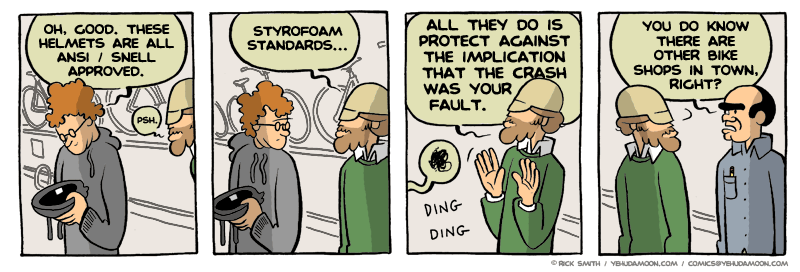
Yehuda: Styrofoam standards… all they do is protect against the implication that the crash was your fault.
(the customer makes a disgruntled noise and the door dings as he leaves)
Joe: You do know there are other bike shops in town, right?
I’ll get back to the finer points of the narrative in a bit, but what’s illustrated here is another salvo. Anyway, these arguments tend to get nasty and personal and raise hackles. People get defensive, immediately.
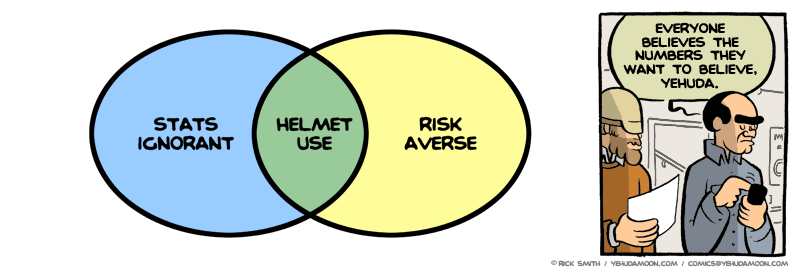
Case in point. (I do realize the Venn diagram is Yehuda’s stance and that Joe is avoiding the argument–which will amount to no changed hearts or minds–by equivocating. They do find common ground in taking shots at recumbents.)
This is a thorny issue, as is getting into why people take it so deeply personally. Opposing legislation that impacts one’s own freedom is one thing but people get vitriolic about, seem offended by, personal decisions to wear or not wear a helmet.
The numbers I want to believe
I feel robbed of something wearing a helmet.
The very act of putting it on makes me aware of ‘danger’, gives the valence of the activity while it is worn danger. It was a concession, a materialization of unnecessary risk that did not come up when I would, for example, walk somewhere, which has its own risks. I refused to wear a helmet while cycling for a while because I wanted something in my life to be free of that valence of fear that now shrouds everything. I wanted joy in my life, spontinaeity. In sum, I wanted this:
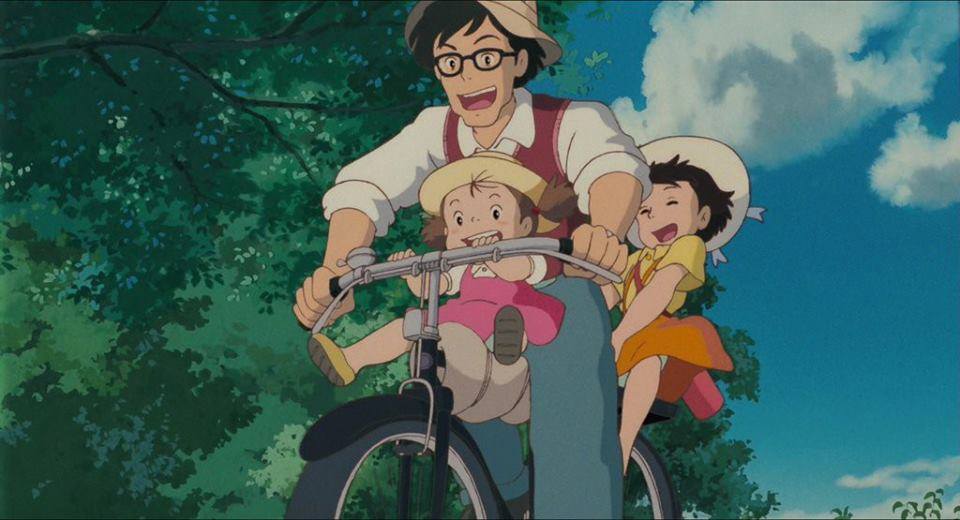
Kusakabe-san is a responsible father and an educated man who cares deeply for his family. He seems to see no danger in biking with his kids perched on the bike and the entire sequence is of uninhibited, wholesome joy. Bumps and bruises and rocky roads are not an existential threat. In other words, existentially safe. Kiki and Tombo are racing down a mountain freeway against traffic and while the narrative and music do acknowledge that this is risky, it is youthful, joyful risk, not the risk of a fully armed soldier going into battle. I’m never free of the awareness that each trip out my door is dangerous but it seems so unfair that the choices that are better for the environment and one’s health, indeed, the choices that are more pleasurable, feel so much more dangerous. This is the small child in me pouting.
Joy, lack of inhibition–I guess these are the things I so desperately seek and have a difficult time experiencing because I am always waiting for the other shoe to drop. I do not know how much of this is my individual pathology and how much is my growing up in the Millennial zeitgeist and it doesn’t much matter–it is there, hanging over my neck. Helmet detractors are correct in that it would be prudent to wear a helmet at all times, in a vehicle, walking, and that requiring it only of cyclists is unfair and puts a disproportionate risk-valence over cycling, effecting the choices people make. And I was bitter, I suppose, that something that did give me such pleasure — cycling — was assigned the status of risky-to-the-point-of-needing-protection, but something I did not enjoy — driving — did not warrant the same headgear, not because driving is inherently less dangerous but because it is seen as an unavoidable necessity and therefore in poor taste to give more consideration than necessary, for the mental health of the people stuck doing it. Buckling a seatbelt does not trigger in me the same apprehension as buckling a helmet. This is a defect of cognition. I acknowledge that. And we are contending with the intractability of the laws of physics which care not for anything fair or indeed for environmental prudence.
But.
But.
I suppose with e-bikes now going at near-motorcycle speeds the distinction between cycling and motorcycling is getting blurrier, and it becomes moot anyway when you are the object being hit, when your own velocity doesn’t matter. When we prioritize freedom to over freedom from–in this case, freedom to get a hugeass fucking car and speed over freedom from being hit by a speeding hugeass fucking car–risk and mitigation become the necessary companion of freedom. Hey, at least you, also, are free to speed in a hugeass fucking car, to swing your fist without regard for somebody’s face. It’s all equal. If the speeding was kept to designated areas like freeways and multi-lane linear stroads we wouldn’t have as much of a conflict of freedoms here, but it’s increasingly not. The contempt for boundaries–in this case, those on the map, and in the speed limit signs–and viewing them as a personal assault on one’s freedom is getting worse. I cannot shake this. It is the same contempt with which people speak of ‘safe spaces’, of the very idea that a safe space should exist, somewhere, even if not necessarily where you are. I have mixed feelings about the asinine coddling of thought the stakes of which violating can be debated but the frustration bleeds over into contempt for boundaries with stakes set by the laws of physics, by the fragility of bone and the sheering of skin. These are hard stakes. Hard as pavement. A body hits pavement according to the same rules of physics and it is an invariant assault force in a way that speech is not.
One’s own way of driving one’s own whatever-cycle matters greatly when it comes to risk, as does the speed of traffic around you. I avoid arterial roads on a bike and while on a bike the freeway does not exist in my mental map as a viable path. It is just a mental obstacle, bloody-red, to-be-avoided. My bike frame is lit up like a Christmas tree when it’s dark; seriously it looks like something from Tron. I myself don’t wear bright colors but my bike is a light-cycle and I have the obnoxiously bright rear and head lamps.
To worry is to suffer twice. I wish I could suffer only once. Half-as-much suffering, only dealing with inevitable suffering, means a life of more joy.
Right?
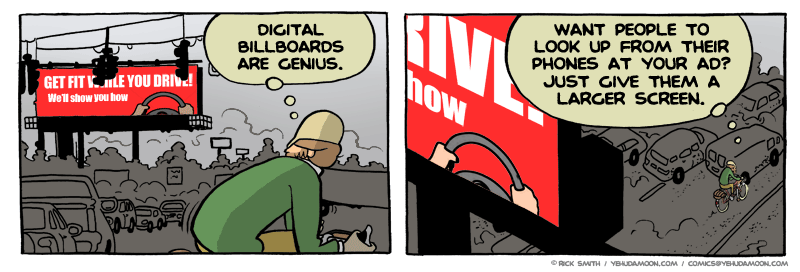
Yehuda: “Digital billboards are genius. Want people to look up from their phones at your ad? Just give them a larger screen.”
Anyway my point was
I see where I could give the impression that this is more helmet-or-not agonizing than biking-or-not. It isn’t. I’d have to start biking again to even make more than an intellectual exercise of the helmet consideration. But so much of the discussion of bike safety gets tied up in discussion of safety equipment and the discussion of what, exactly, is accurate or inaccurate perception of risk. And that *is* tied up with my biking-or-not agonizing.
In which I talk more about the webcomic, specifically. (Also massive spoilers for Yehuda Moon and the Kickstand Cyclery)
I have a soft spot for Yehuda because he practices what he preaches–he lives very simply, to the point of not having a set home for a while and having “everything he owns on his bike” and disdains cars to the point he only drives once during the comic’s run because he lost a bet and used a fleet of barrow-bikes in liu of a truck on moving day. He’s the inflexible, militant, strident, wool-and-tweed steel-frame utility bike hipster**** retro grouch and can be insufferable but he is actually walking the walk, and has a good heart. Joe is the retired racer who just wants to keep the damn shop open, and does things repellent to a bike purist like Yehuda like use a car when the weather is inclement and wear a helmet.
Most of the ‘antagonists’ of the story are rather cartoonish–not to say that they do not exist as such in real life, exasperatingly simple people–but the lurking antagonist in the personal life of the characters, who when unknown is cast as a sort of wildly selfish bogeyman, is a man defending his wife from the fallout of a horrible mistake. A man who was not even present for the act itself, but is complicit in doing what he can to wipe the slate clean. We never meet Councilman Turner’s wife and we have no idea how contrite she was about the whole affair–simply that she performed a hit-and-run that left a cyclist dead. For a comic that is largely (fun because I agree with it) polemic this is considerable pathos and depth given to an antagonist, who even, in a way, tries to make right with his cycling advocacy and is clearly sorry about the whole affair. But, this is a man with divided loyalties, and the potential consequences to his wife are life-ruining.
There is another example of a sympathetic portrayal of a bystander who did not come forward–there’s also the woman Yehuda starts dating, Idle, who was a passenger in the car of the man who tried to kill Yehuda and very nearly succeeded by running him off the road in a snowstorm. Yehuda is usually such a polemic crusader I was surprised he would take up with somebody who, even through passive refusal-of-action, even with the extenuating circumstance of a realistic fear of violent retaliation, was contributing to the anti-cycling atmosphere. He certainly is more forgiving of the woman he is sleeping with than the man who is his ambivalent political ally, but, in Idle’s defense, she did come forward and try to make right when she saw an opportunity to do so safely. Councilman Turner was, presumably, never in any mortal danger from his wife and still kept his silence for years, though his guilt is manifested in actions like leaving flowers by Fred’s ghost bike. I did feel immense sympathy for Turner and his divided loyalties. And, I suspect by the shockingly stoic and civil way they took the revelation, Yehuda and Joe felt it as well, even though it was their dear friend who was killed in the sort of act the impunity of which endangers them daily. Their response was shockingly muted, though grim, for directly-wronged men, one of whom regularly flies off the handle and is perfectly willing to engage in open conflict and escalation at relatively minor provocations.
The point I can’t escape: Fred might have lived were he wearing a helmet. Cause of death was not explicitly stated (could have been a fractured neck or something) but Ghost Fred manifests with a head wound when he’s getting up in his memories about the crash. I do not recall this once being addressed.
—
*The water after that first soak in Woolite was just something vile, like ichor from the black lagoon.
**So I re-read the entire thing in one sitting. So it took several hours. So there went my entire Saturday. So it goes.
***The AI asked: “Are you weighing the decision of whether to wear a helmet on your daily commute, or are you researching public policies and helmet laws?” No I do not want to talk about this, Google; I’ve read everything you’re going to paraphrase.
****Calling him this at the risk of starting up the debates on what exactly is a hipster. If you’re going by the definition of artifice and pretense to these tendencies and consumption patterns, he’s not. Also yes I realize I just said in the first paragraph I have the same clothing preferences but I am willing to own, say, a synthetic raincoat in place of oilcloth.