rowan rabe . ink

Tag: Ursula K. Le Guin

  • Hyper-optimization hyper-normalization

    I just wrote a bunch of shit down somewhat tangentially associated in my thought process (yes, that is my entire blog). I’m not editing this because it’s been sitting open in my browser for like a week. Well, I strongly feel it’s all related.

    Equipment Improvement Cycle and the Striving Meritocracy

    RPG mechanic rhetoric as life advice is not new to me, personally, because I hang out with nerds who grew up with RPGs and are of a strategic bent, but the past several years the language of ‘maximizing’ and ‘optimizing’ has been prevalent in the mainstream. It’s a comforting response to a world that is fundamentally becoming less fair and a useful belief to encourage in the masses; it’s the meritocracy promise writ in nerd language. It is also useful in that it encourages consumerism–we start to think that purchases we make in real life will ease our lives as purchases in weapon shops ease our battling. To purchase, to upgrade, is an integral part of progressing, of moving the narrative forward. Consuming becomes doing something to materially improve your life–you can feel you at least did something productive today, something that will have an impact in material reality. It’s bad on Instagram if you have hobbies or cats–a nonstop flood of things that will, supposedly, materially elevate the craft or the cat’s QOL.

    I swear I’ve written about this before — offering the purchase of productivity, when somebody is already feeling kind of shit for doomscrolling. The ads are so tactile–unboxing, opening, the basic physical pleasures one is not experiencing while scrolling but which we sense are on some basic level healing–that they almost feel like a vicarious screen break.

    Minmaxing life run, or just maxing and excising the ‘min’

    Mid-aughts in the leadup to the Marvel slop movies and the mainstreaming of ‘nerd’ culture there was an in-group heavy, T-shirt sloganeering, pithy take on nerd culture–when it was still being marketed as a true subculture, an offshoot of goth/alternative/hacker culture Hot Topic cashed in on.* Marketing fitness to nerds by using terms such as ‘leveling up’ and ‘grinding’ to mean putting in hours of basic hygiene and basal-level exercise was prevalent, but I could not think of a self-respecting normie–the kind of guy who is fully seeped in Manosphere culture and rhetoric now–who would be associated, voluntarily. I have not yet seen this sort of (formal) marketing for Ozempic/other GLP-1 agonists–the pharmaceutical companies are toeing the line right now by presenting it as a last-resort response to obesity, and their ads feature people who are truly obese, not chubby but looking to lose vanity weight–but I will bet in five, ten years the message will shift toward optimization of the self. I will be interested to see if the average BMI of the “protagonist” of the GLP-1 commercials goes down with time. The thing is, losing weight does make one feel better, physically; one has more energy, physical endeavors are easier, one’s own body is lighter. Anybody who has had weight cycle knows the benefits are not merely aesthetic or psychological.

    Conflict/Quest Story

    The superhero-narrative-as-jingoistic-propaganda–a more upbeat war propaganda than what I think of as “shoot and cry” films, wherein American soldiers suffer greatly because they’ve had to kill innocent people in combat, and they had no choice–that basically is the Marvel universe started a bit late, a few years after the 9/11 hypernationalist fervor into which a nation itching for a Noble War and a Reason to Live after the End of History was pitched. It functioned as a post-hoc justification for that decade of American invasions, a balm for the public conscience. It does not much matter if it was a conscious decision or not; this was its function. The extent to which this comes of a desire to redeem image after [every war since WWII] I do not know. But it is useful to the powers that be, no matter its source, and so it is encouraged. To have a populace that believes in the myth of its own national good-guy-ness is useful and the general hard right shift in tenor post 9/11 occurred in the penumbra of late 90s WWII romanticism-cum-nostalgia for younger days of the cohort that was aging into retirement.* So much of our media, at that time, catered to the generation that fought World War II, my grandfather’s generation–god knows the war figured large enough in his personal life narrative. All ages were saturated in Good War and Just War narratives, wherein being a part of a military band of brothers was the cure to the modern ails of alienation, ennui, lack of meaning or purpose. These narratives were a balm for the stupor of too much domesticity and predictability at the end of history (wherein History is when exciting things happen and one could make a difference)–in these narratives, and, therefore, during a Just War, one’s individual courage and grit meant something. Being a good bloke with a can-do attitude was enough during the War to make you heroic, a Somebody, part of a community, in the same way that being same pre-de-industrialization was enough to guarantee you a solid job and economic stability. It does not matter if any of this is correct in any objective or measurable sense. It is what the perception was, and perception molds behavior, which includes voting.

    Narrative is contextualization, which is the cure for alienation. And the superhero narratives are narratives of conflict.

    I’m rehashing somewhat poorly Graeber and Wengrow’s ideas in The Dawn of Everything about the narrative we attach to human history –that History happens, or that life actually progresses, when there is something monumental to document, usually conflict, and all other times are a holding period in the grand narrative of life. Ursula K. Le Guin addresses this sentiment in “Betrayals”, a short story in the collection Four (now Five) Ways to Forgiveness:

    What would that world be, a world without war? It would be the real world. Peace was the true life, the life of working and learning and bringing up children to work and learn. War, which devoured work, learning, and children, was the denial of reality.

    This is in the broader context of discussing a people whose entire lives have been shaped by conflict and who are at a collective loss for how to find meaning in peace. It is a beautiful collection of stories meditating on multi-generational war trauma, on how ‘victim’ is not a moral standing but a relational standing in a power structure–the experience of being a victim can give insight and empathy but does not preclude seizing the advantage when one has it and acting against others as acted against in the past, so long as that power structure, that way of thinking, remains. But, the basic idea that peacetime is when ‘true life’ proceeds–the idea that life and narrative are not defined by conflict–in itself was powerfully put.

    ————

    *Incidentally, this was the era of mishmash nerd culture wherein the peak of nerd cache was a graphic T shirt integrating two or three fandoms — Luke Skywalker in the TARDIS kind of thing. A lot of the core aesthetics of nerd culture from that era are still prevalent, just now in the mainstream, but the mishmash cross-franchise stuff I have not seen nearly as much.

    *This cohort was also aging; nostalgia itself, the recalling of youth and the feeling of your life being ahead of you, is a powerful sell. That their youth coincided with this grand war reinforces in the mind the “real life is conflict” association.

  • I know that’s a wolf under that sheep’s clothing. But we’re having a lovely conversation.

    This one’s a real post. Apologies in case anybody has been getting spammed with shitposts. I’m automating crossposting and there’s more debugging (and testing, hence the posts) than anybody ever expects, even though I should damn well know better from script kiddie days back in high school. So that will continue for the near future.

    A pilgrim comes seeking fellowship.

    Somebody finally said in /r/printSF something I’ve been suspecting–and I do love it when my kneejerk gut takes are proven to be Correct and Wise. There has been a flood of posts fishing for the sort of answer your English teacher would want you to give about a book in AP English, written in AI style. I had not pursued it–my response to my own AI paranoia has been to disengage from everything, which is healthy for somebody who already has a tendency to be a recluse–but of late what were once the last bastions resembling old school message boards on the internet for niche ephemera (the wall-of-text subreddits) are just not engaging me, even though they are trying to start discussions that are in my wheelhouse (Le Guin, Wolfe, old school ‘literary’ scifi, the weeds of theory, etc). The posts have the tenor of a recent convert to the beauty of literature, a pilgrim coming to confess and pray at the altar, seeking the fellowship and validation of the congregation. And, as people generally believe their ‘religions’ are good and should be appreciated more, this is an excellent way to engage them. Yes, including me.

    I’m seeing this pilgrim-crawling-to-the-altar and “hello fellow kids” everywhere now even more than I once was; it was bad enough when I suspected people of karma farming and astroturfing, but it was at least a human putting the work in–I could only hope, sometimes, a human who was asking some questions they genuinely wanted to ask as part of their karma-farming, something. Now we are also being triggered into providing some deep, insightful discussions to train an AI algorithm to have deep, insightful discussions. In any case, OP made an astute observation with some concrete evidence of seeding, with more being added down the thread.

    Weighted Blanket of the Absurd

    Master Shake’s distracting-from-his-hustle philosophical irrelevances that have the bonus quality of having made me laugh hysterically at 2AM as psychological armor.

    Yes, I’m well aware this might be AI-calling-out-AI. Anything might be anything. Fuck it. If I’m going to bother participating on the internet at all I at least need to delude myself that there are some signs of life out there. I’m coping with my aughts-adolescent cynicism and ennui with absurdist nihilist flip. Which, let’s be honest, isn’t the most unhealthy coping mechanism I’ve used, and can be quite fun. There’s that old saw about the funniest people you know being the most depressed people you know and having a lot of practice in defusing psychological agony with humor.

    Ultimate attention economy redux

    I still maintain I am right about this.

    Let’s for the moment focus on the aspect of AI that relieves one of having to do things like pay attention to and think about things that are boring, like books and philosophy and history and Big Ideas, that the gatekeepers of your degree/ license to work a more than subsistence job tend to think are Big, Important things for humans to think about. The sort of person who becomes a teacher tends to be the sort of person who believes in the inherent value of Truth and Thought and cultivating the life of the mind and becoming a well-rounded human-cum-citizen, and that sort of person is the the gatekeeper standing between you and your license to work a bullshit white collar job that pays something more than a subsistence wage. You used to have to indulge them, to some extent, or go to effort and expense to get somebody else to do it for you, but there is now an algorithm that pays granular and close attention to those gatekeepers talking amongst themselves in the brainy tl;dr wall-of-text subs about the things they’re going to ask you to write about and grade you on. That’s a lot of attention-energy somebody else already expended and you don’t want to on things that don’t matter to you.

    A bullshitter or conman used to have to be a good listener, and good at guessing what people wanted to hear. That skill, bullshitting, is being de-professionalized, too, now; the algorithm whispers into your ear what to say to bullshit or con. Quality bullshitting and knowing what people want to hear is a skill–another one that is being lost. Again the middle is falling out of an entire profession and the only conmen who make a living will be those exceptional individuals with genius charisma. Workaday mediocre conmen need jobs too–more argument for UBI I guess.

    I feel the desperation of realizing every safety valve and escape is being shut off or turned into a honeypot or corrupted–‘escapes’ for ‘intellectuals’ or ‘genuine people’ or however we style ourselves are weirs.

    Marketers desperately seeking organic ‘cool’ cred for their product isn’t new; shilling and guerilla marketing are nothing new; influencers are just now up front about it, which I find refreshing. There is a desperate cynicism in capitulating to it all being about the game–we’re far from the gen X obsession with not ‘selling out’. Indeed, to care about ‘selling out’ or ‘authenticity’ is seen as a naive, childish, unsophisticated concern, and while gen Z /alpha may be well on to something, it is part of the pattern of their generation never being raised on ‘hope’ or optimism for the future like Millennials-and-older. When I was in middle school ‘poseur’ was a deadly fucking insult if you were in any sort of ‘scene’ with pretensions to authenticity–skating, music, art, fashion. I remember rumors about who had used a butter knife to scuff up the underside of their skateboard to make it look broken in with the sort of wear pattern you would get with ‘hardcore’ use. That was a fighting accusation. And these so-accused were not attempting to be influencers or anything with a monetary reward; they just desperately wanted to be cool and authentic. Authenticity had enough intrinsic value to be something to lose, something precious. It was, in the minds of these middle schoolers, a very real and deadly serious thing. I wonder if younger generations see that sort of totemic belief as naive in the way that believing in ‘capitalism’ (as an ideology of ‘freedom’ or something) seems now, or ‘free enterprise’, or ‘the American dream’.

    Considerations of ‘specialness’ aside, this is why people in subcultures condemn ‘selling out’–you make something profitable and the vultures come in and shit all over it. I’ve watched it happen. Anti-gatekeeping rhetoric is being co-opted to stifle conversations about this.

    I realize it’s not just getting people to buy shit, monetarily, in a material sense. It’s also political astroturfing, and the everything-sucks-fuck-you pissed off adolescent nihilist philosopher* inside me firmly maintains it’s all the same thing anyway. It is and it isn’t. A healthy criticism of all parties so often just becomes this nihilistic centrism that, functionally, is no different from political neutralization. Trying to sell me mediocre terrycloth hoodies on Instagram is obnoxious but I’m not going to pull the galaxy brain take that it is equivalent to influencing elections. Same tactics, yes–a ‘sale’ is a sale, of ideology or terrycloth hoodies–but equally urgent a threat it is not. The corrosive effect on mutual trust that comes of suspecting either in every interaction is a social enshittification agent, all linked, ultimately, in the big cosmic sense, on big time frames, but in the immediate sense one makes you regret buying bad clothes and the other effectively legalized suspension of due process.

    It was mentioned in the original post that many of these suspect accounts also posted in job hunting subreddits, which are utterly lousy with recommendations for resume editors and other magic bullet solutions for desperate over-educated under-employed professionals DOGEd or AIed out of an already shit market**. Maybe this is my naive Millennial belief in the concept of ‘earnestness’ or ‘validity’ but this seems particularly scummy, preying on a need instead of a desire. Doing so is not new but it seems to be one of the few hustle avenues still (or even increasingly) profitable in a collapsing postindustrial economy.

    Say something interesting, damn you.

    Anyway, back to the reddit thread.

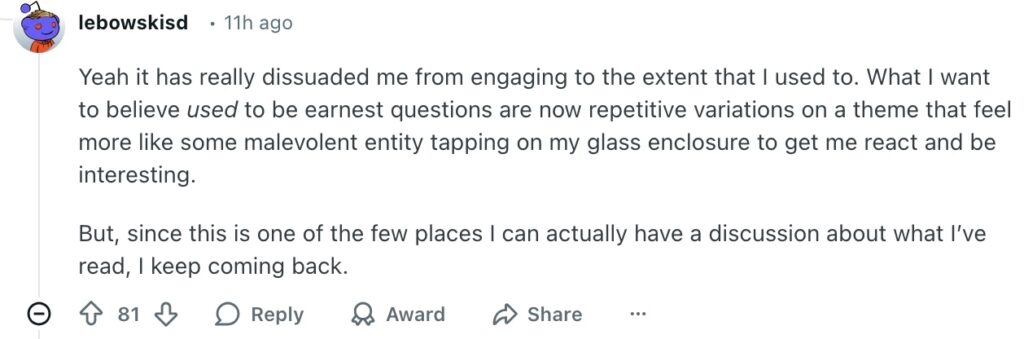
    Reddit user lebowskisd: “Yeah, it has really dissuaded me from engaging to the extent that I used to. What I want to believe used to be some earnest questions are now repetitive variations on a theme that feel more like some malevolent entity tapping on my glass enclosure to get me [to] react and be interesting. But, since this is one of the few places I can actually have a discussion about what I’ve read, I keep coming back.”

    The Dude(‘s D?) puts it well. Some entity listening in to the place where the eggheads go to escape and trying to prompt discussion to harvest.

    Reddit user Beneficial-Neat-6200: “Agreed. Over on r/wallstreetbets the prevailing theory is that the value of rddt more related to monetization of user content for Ai training than from advertising”

    This is probably correct. I still see a market for vendors of niche products to hobbyists, many of whom, if they are on Reddit, have disposable income and tend to limit Google searches of product reviews to Reddit or other websites where ‘real people’ used to hang out. They’ve always been lousy with shills, and everybody knows it, but it was also one of the few places to get an honest opinion mixed in there.

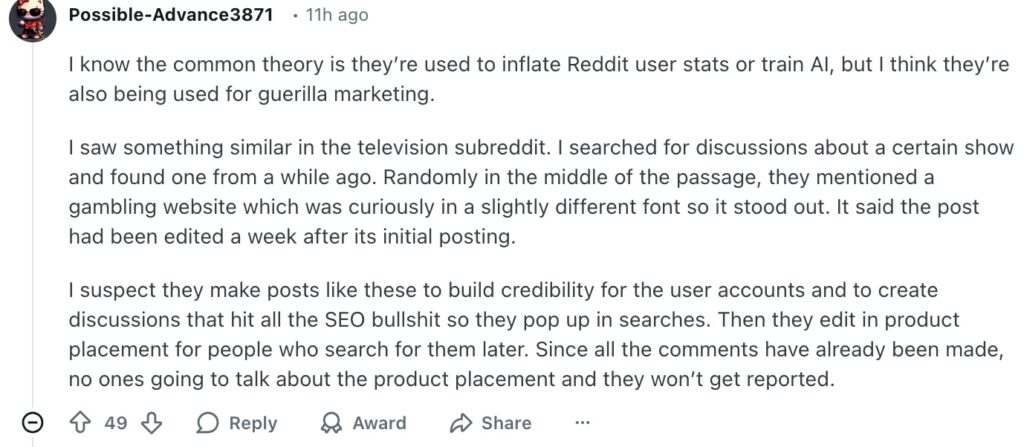
    Reddit user Possible-Advance3871: “I know the common theory is they’re used to inflate Reddit user stats or train AI, but I think they’re also being used for guerilla marketing. I saw something similar in the television subreddit. I searched for discussions about a certain show and found one from a while ago. Randomly in the middle of the passage, they mentioned a gambling website which was curiously in a slightly different font so it stood out. It said the post had been edited a week after its initial posting. I suspect they make posts like these to build credibility for the user accounts and to create discussions that hit all the SEO bullshit so they pop up in searches. Then they edit in product placement for people who search for them later. Since all the comments have already been made, no ones going to talk about the product placement and they won’t get reported.”

    I admit I had never noticed this pattern before, even though I’ve been trawling through ‘old’ threads looking for info my entire internet life. Such product placements probably just got caught in my bullshit filter and immediately disregarded as brand shit, but I never bothered to look up the editing timestamp because I did not care. But this is critical–it is a piece of what, exactly, bolsters the monetary value of a ‘trusted source’.

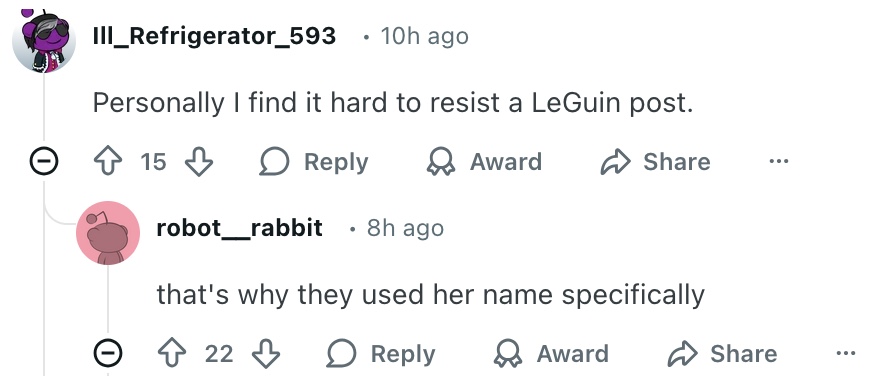
    Reddit user Ill_Refrigerator_593: “Personally I find it hard to resist a Le Guin post.” User robot_rabbit: “that’s why they used her name specifically”

    Me too, Ill_Refrigerator-san. The authors being featured in these suspect posts seems to be a who’s-who gallery of what I have heard referred to as “your favorite author’s favorite author” – highly-praised literary luminaries who may (Le Guin) or may not (most of the rest of them) be popular. Also likely to be the favorite authors of the sort of person who is going to put themselves into the position of gatekeeping your degree or interview vis-à-vis going into teaching, or the authors people list as ‘favorites’ if they want to seem intellectual and deep and from that trustworthy, above petty considerations such as money and popularity, genuine.

    Reddit user chrooooo: “A movie based on a Le Guin will be announced soon.”

    Fucking hell, you may be right. Now I’ll be suspicious and surly instead of mildly, reservedly interested. While I never had much hope for adaptations from other sources, Ghibli Earthsea burned me too badly. I’ll be bitter about that one until the earth falls into the sun.

    Daily I am more convinced of the existential need to retreat to a shack in the woods.

    Fine. Those online spaces are all compromised. So now what? Limit ourselves to the people within easy physical meeting distance? That’s lonely work if you have niche interests. The internet was the first time, for better or worse, all these niche weirdos found a welcoming lounge-cum-echo chamber, and it was the most high quality social interaction many of us had for years, especially if we lived in a small town in what is now MAGA country. Part of how those spy camera/microphone ‘glasses’ are going to pay for themselves in data harvesting is through eavesdropping on these conversations we take offline, if we can, when we can. When might somebody get paid hourly to hang out in a bookstore or coffee shop wearing those***? Your employment manual will recommend very obviously ‘reading’ a book that may start the conversations your client wants, or painting, or wearing a shirt with an unfortunate opinion. If there is a hierarchy in pay based on how pleased clients are with the information you get there will be an incentive for the best bullshitters do this work–a resurgence of the ‘peer influencer’, who influences people who do not like influencers. AI paranoia is going to creep into IRL conversations–not just in the sense of AI being fed as answers through an earbud or lens so you can get laid or get a job or sell something, but also in the sense of being harvested, used to train skinwalkers to seem more human. ‘Authenticity’ will always be the most coveted thing a marketer will seek, no matter what the product being sold.

    Paranoia is isolating and exhausting. I keep seeing reasons it is an accurate response to one’s environment, not an individual pathology, necessarily. The same issue with depression or anxiety being an appropriate response to life circumstances.

    ——-

    *This is the same entity that thought Trent Reznor’s rendition of Closer at Coachella was fucking sick as fuck.

    **Hi.

    ***Even if like one out of a thousand of those conversations yield anything interesting it is still of value to information brokers. Also if you’re hiring I have two elderly cats with high needs and could use the scratch.

  • Possesses power

    Christmas at the childhood home, which means a lot of lazing about. I catch that Hobbit-like tendency to generally overindulge, in food and in indolence. This also takes the form of not checking the news to torment myself with goings-on that I cannot do a damn thing about, not today. I am one of those people who live too much in the mind who–while I am intellectually aware it is not and therefore torture myself for it–feels doomscrolling like to activism, awareness like to action.

    All going according to custom past few days–I’ve been comfortably pillowed by the sand–but this morning I got a push notification of Breaking News.

    It’s tedious to announce, with some flourish, as though it would make any difference if I could be arsed, that I put the phone down after some confirmation of what, exactly, happened, made coffee, and played vidya instead. “Instead.” Instead of what? Self-flagellation is just narcissism with its back turned. What the Odonians on Anarres would call “egoizing”, or performative. I’m not going out protesting, which, while it may arguably have once pushed policy, and may even now act as PR for the American intellectual-worldly class in showing the world there are Americans who Do Not Approve of the actions of our government (I doubt The World gives a shit), seems to have no effect on this regime. Feeling bad about that inaction doesn’t make it any better, in a moral sense.

    And yet I wonder…

    ———–

    Of course I hit this part of the game today.

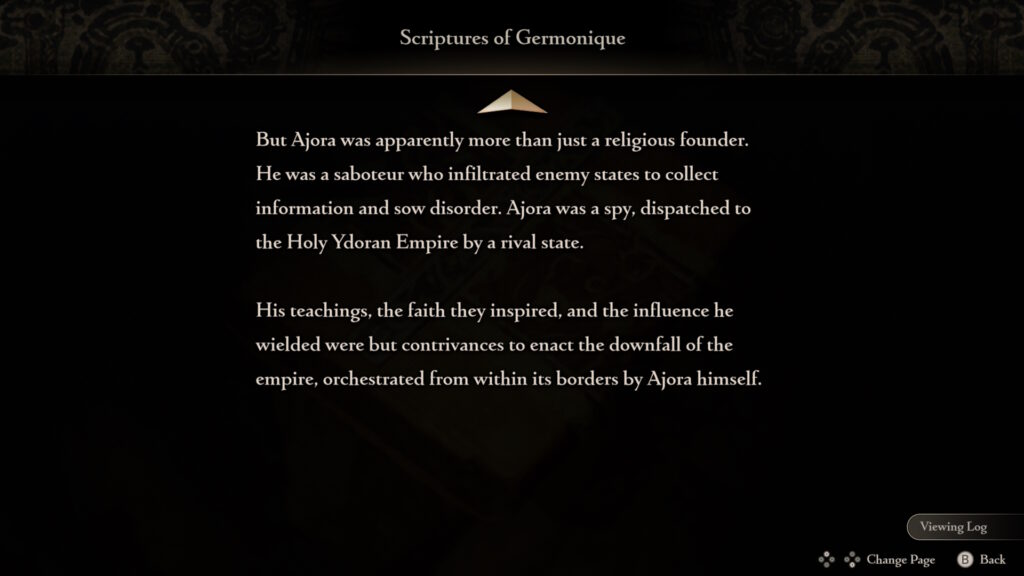
    Elder Simon: It exposes the deception of the Church–that its doctrine is founded upon lies.
    Ramza: A book?
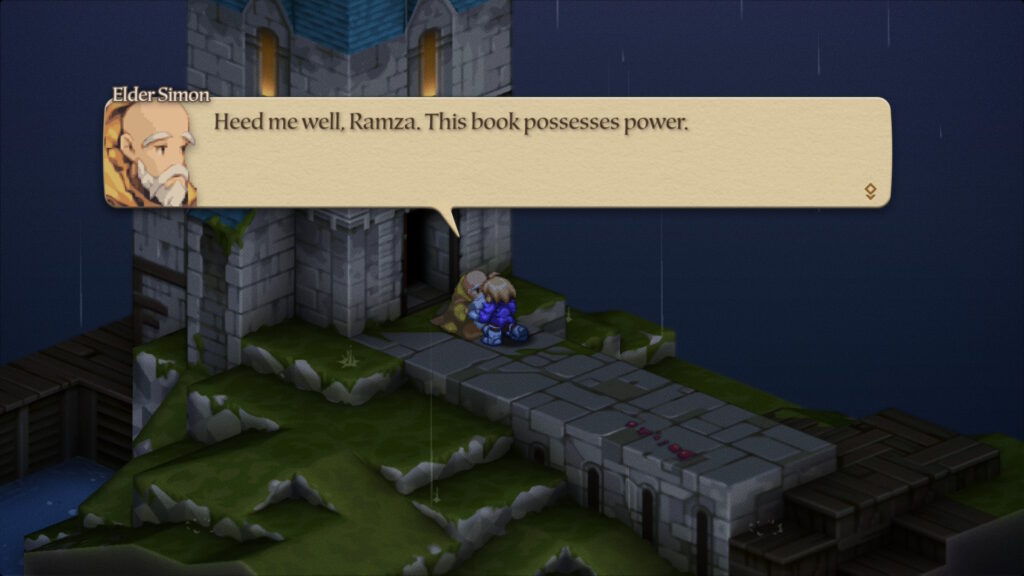
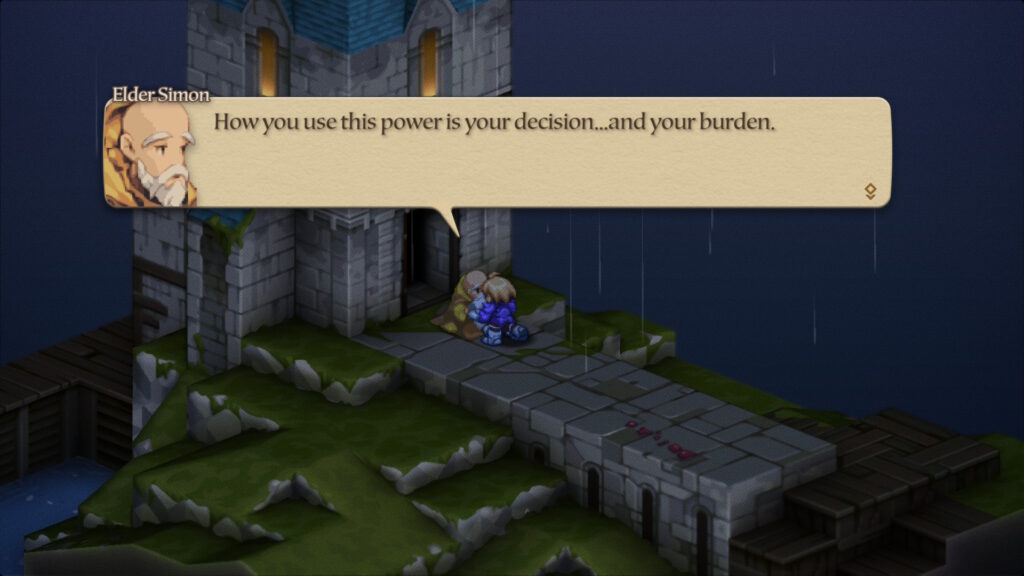
    Elder Simon: That is why we fear it so, and have kept it hidden since the beginning… Heed me well, Ramza. This book possesses power. How you use this power is your decision… and your burden.

    -from Final Fantasy Tactics: The Ivalice Chronicles

    (I don’t even have to explain this; you can guess exactly what is going on in the narrative if you’ve ever, once in your life, consumed narrative media.)

    This is so typical of the intellectual writer-ly class, the sort of person who likes video games enough to write them, or books, or movies or what-have-you: the idea that ideas and Truth have such inherent power that they can change everything just by being revealed. If you are the sort of person who is in thrall to ideas this is bone-deep truth. But even the most rarefied of the intellectual class limits itself to hemming and hawing and acknowledging if this Truth negatively impacts their material conditi0ns. No, I do not know if I am talking about Elder Simon-the-character or the writers of FFT or the players of games; everybody in that feels culpable. Even within the context of the game that “truth” is going to come escorted at the barrel of a gun**.

    But here I am reminded of why I have a fondness for this game:

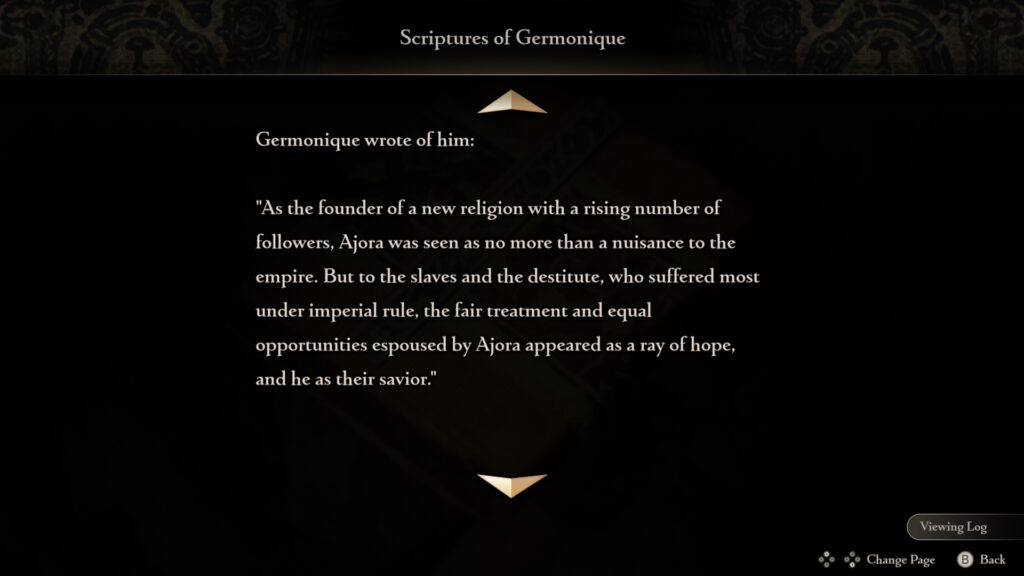
    “But Ajora was apparently more than just a religious founder. He was a saboteur who infiltrated enemy states to collect information and sow disorder. Ajora was a spy, dispatched to the Holy Ydoran Empire by a rival state. His teachings, the faith they inspired, and the influence he wielded were but contrivances to enact the downfall of the empire, orchestrated from within its borders by Ajora himself. Germonique wrote of him: “As the founder of a new religion with a rising number of followers, Ajora was seen as no more than a nuisance to the empire. But to the slaves and the destitute, who suffered most under imperial rule, the fair treatment and equal opportunities espoused by Ajora appeared as a ray of hope, and he as their savior.”

    Scriptures of Germonique, or: that powerful book of Truth Elder Simon was going on about

    There is acknowledgement of the fact that it is by appealing to material conditions that one makes a movement. I haven’t much sympathy for an Empire-as-entity (i.e. not individual people in that empire against whom atrocities of opportunity are committed) that is undermined this way; I don’t give sympathy to the target because the intent of the opposing power was their own imperial gain, but I don’t respect that opposing power, either, other than on an strategic level. Is that opposing empire a “liberator”? Sure, to the people who materially benefit, but the opposing empire gets no moral accolade for acting on its own interests. Don’t run an empire on a fundamental inequality, then, if not because it is wrong in a moral sense, then only because it is strategically unsound on a century-scale. All you can hope for the people is that there is more net material justice in distribution of resources and ‘rights’ as a result–that the burden of the underclass of humanity is lightened, and not just shifted to another part of the underclass.

    This sort of we’re-the-good-guys-actually justification is what I’m talking about:

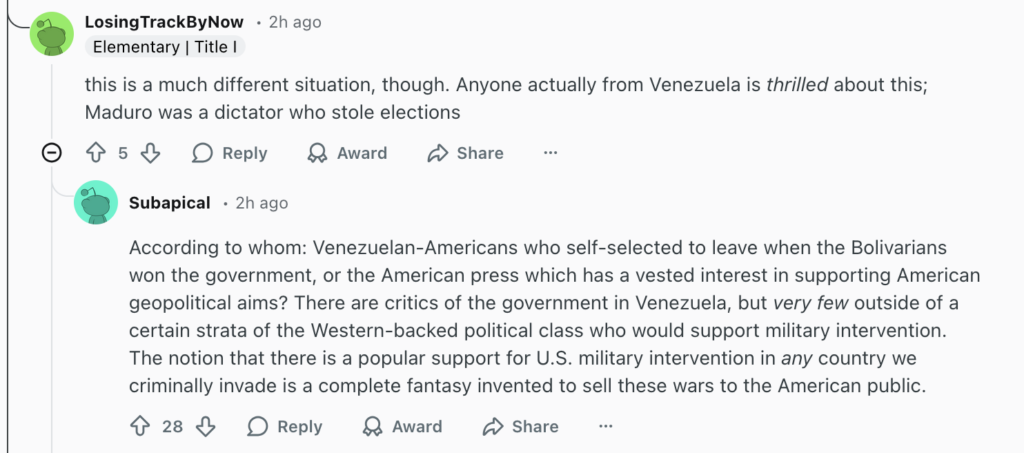
    Meanwhile on Reddit (link is image)

    Both of these things are be true:

    1. Maduro was a dictator who stole elections, and the people of Venezuela would just as soon see him gone.
    2. The United States materially benefits from “seeing Maduro gone” (which is really just a pretense for invasion). It is not doing this out of a desire to set things right, and may well make things materially worse for the people of Venezuela.

    Venezuela has oil. North Korea does not. That’s it. That is all, total, and sum, what is motivating the US. Never look to the smokescreens and platitudes of empire. If this magically somehow ‘liberates’ people along the way, I am glad, truly, for those people. But I’ll never consider the US liberators or a force of ‘good’. If things go well for the people of Venezuela it is the whim of chance, the struggle of the people themselves–not the benevolence of the US–that is to thank.

    I do not think things will go well.

    I’m a Millennial American. My coming-of-political-awareness was defined by Afghanistan and Iraq. Of course I am biased toward pessimism. May time prove me wrong, and if and when it does, I will have no share of joy or pride to share with the American military.

    *The Dispossessed by Ursula K. Le Guin — I firmly maintain performing awareness is a self-indulgent, attention-as-absolution-seeking activity, so it fits within the Odonian idea of “egoizing”.

    **I have spent a great deal of time grinding my white mages to be able to carry guns–which, in an ironic way, is a skill of the orator class, or the class of battlefield persuasion.

  • Le Guin was right about everything part 58 of

    “The one I liked best was the one where Mr. Spock had to go home because he was in heat,” I said to her.

    “Except he never, you know,” she said. “They just had a fight over the girl, him and Captain Kirk, and then they left.”

    “That’s his pride,” I said, obscurely. I was thinking how Mr. Spock was never unbuttoned, never lolled, kept himself shadowy, unfulfilled; and so we loved him. And poor Captain Kirk, going from blonde to blonde, would never understand true love, would never even understand that he himself loved Mr. Spock truly, hopelessly, forever.

    Ursula K. Le Guin, Searoad: Chronicles of Klatsand, “True Love”

    Searoad: Chronicles of Klatsand was just reprinted and contained several short stories I had not yet read, including this one, with a quote I have seen before online but have now encountered in context.

    Wisest writer in history. 12/10 insight. Genius.

    “Jim!”