It’s been A Week, I’ll tell you hwat.
Adults and kids do not like to hang around each other all that much. I suspect this is why kids have been–forcefully, by being told to get out of the house or otherwise stay out from underfoot, a request happily complied with by the kids–self-segregating during free time for most of recorded history. I do well with kids in circumstances in which I do not have to force them to do anything arbitrary. I’m not a good ego for other people. But they’re always going to be guarded around me, an adult. My presence, no matter how benign I try to be, is a check. I feel obligated to say “Language!” to cursing, etc, when the truth is I could not care less so long as nobody is being bullied or hurt. The tension is worse when I am trying to get them to sit down and do more school after school. This sense of obligation-to-control grinds against the fundamental mismatch in energy between adults and kids, and nobody has a good time forced into proximity.
Now we have after school care with “enrichment” and the attendant pressure to make that time not just monitored, but productive, marketable, and I get the sense nobody, adult or child, really wants to be there. Doesn’t much matter how ‘fun’ the enrichment is or how much the subject under study is independently desired by the student; it is within the context of an entire afternoon under lockdown. On days with a really rough group I wonder why we don’t just let kids and adults go their separate (desired) ways and mind their own business for a while. There would be less resentment and pushback when it *is* time to rejoin for dinner, etc. Kids want the dignity of autonomy.
I’ll show you untrustworthy.
I get it. The child is still looking out from within me. I’m still in the position where I have to get kids to sit down and do something they do not want to do and probably learn absolutely nothing. And I hate that. And creatures in captivity make their small rebellions where they can, for the nourishment of their own souls and the nurturing of their own dignity, even if it’s something like wielding shoes like a mace by swinging them around by the laces and trying to whack people, for absolutely no offense given I can discern. “He just wants to get sent home. He hates school.” Duh. I’m still dealing with the shoe ninja terrorizing the townspeople. Nothing excuses harming other people, no internal pressure or angst, nothing, but I see the forces pushing the rebellious instinct, somewhere deep down in the brain.
We award adults such impunity and leeway for selfish behavior that we can afford kids no freedom. We’re creating those future adults who go wild at a taste of freedom and fight to keep it. Resentment of lost time and jealous guarding of finally-getting-yours does not make an adult likely to vote to curtail their own freedom to swing their fist because of somebody else’s face. It is no excuse, but it is a cause.
What are the wages of self-control in this system? Nothing–you still don’t get to do what you want, but you’re not getting yelled at, and to many kids that is scant reward next to getting to do what you want.
I’m not playing along if you don’t see me as ‘in’ on the joke.
I see myself in the kids who give me some of the most guff.
I’m lying when I say the police department called me to ask some third graders to help them solve a mystery? No shit, kid. You don’t see yourself as ‘in’ on the joke but as being viewed with condescension, so you’re not going to play pretend. You’re not going to roll with it. Let’s just play Clue or whatever for an hour–we’re stuck here with each other–but your dignity won’t allow it. But I’m getting paid to (1) run an hour of Clue and (2) keep you corralled for that hour, so our desires are fundamentally at odds. Neither one of us wants to be here. Might as well make the best of it. You might even learn something. We might, through banter, even have something resembling fun. But wardens and prisoners cannot forge a rapport without suspicion.
I see myself most in the kids that just want to be left the fuck alone to do their own thing–I think of, from one of my classes, the girl in the back of the class buried in a notebook trying to get some goddamned writing (? whatever it’s her business) done and pretend she has a scrap of autonomy in choosing the course of her daily life. I check in with those kids but if they do not want to participate I leave them alone. They’re not bugging anybody, and I recall too vividly the desire for solitude. She might well have an interest in the subject matter I’m hawking, but on her own terms. Her internal world and intellectual life are taken away from her because some kids, apparently, cannot be trusted not to set the house on fire if they’re left home alone (I doubt this is as prevalent as one thinks, especially if kids are not given the desire to rebel to preserve a scrap of self-determination), or because apparently, some adults cannot be trusted not to drive like it’s fucking Mario Kart through a neighborhood (this one I believe fully). Or, more likely, because writing BTS self-insert fanfiction is not a marketable skill, not something that will get you into college or impress employers, never mind that you are creating your own soul and learning to–useless in the age of generative AI–write. The latter part at least used to be marketable, applicable. Transferable. Self-fulfillment and self-actualization are not skills you can sell as labor and in this age quality of life goes only to the (1) wealthy or (2) winners of the rat race.
The adults in your life do mean well, after a fashion. They are responding to material circumstances.
Frogger only has trouble around cars
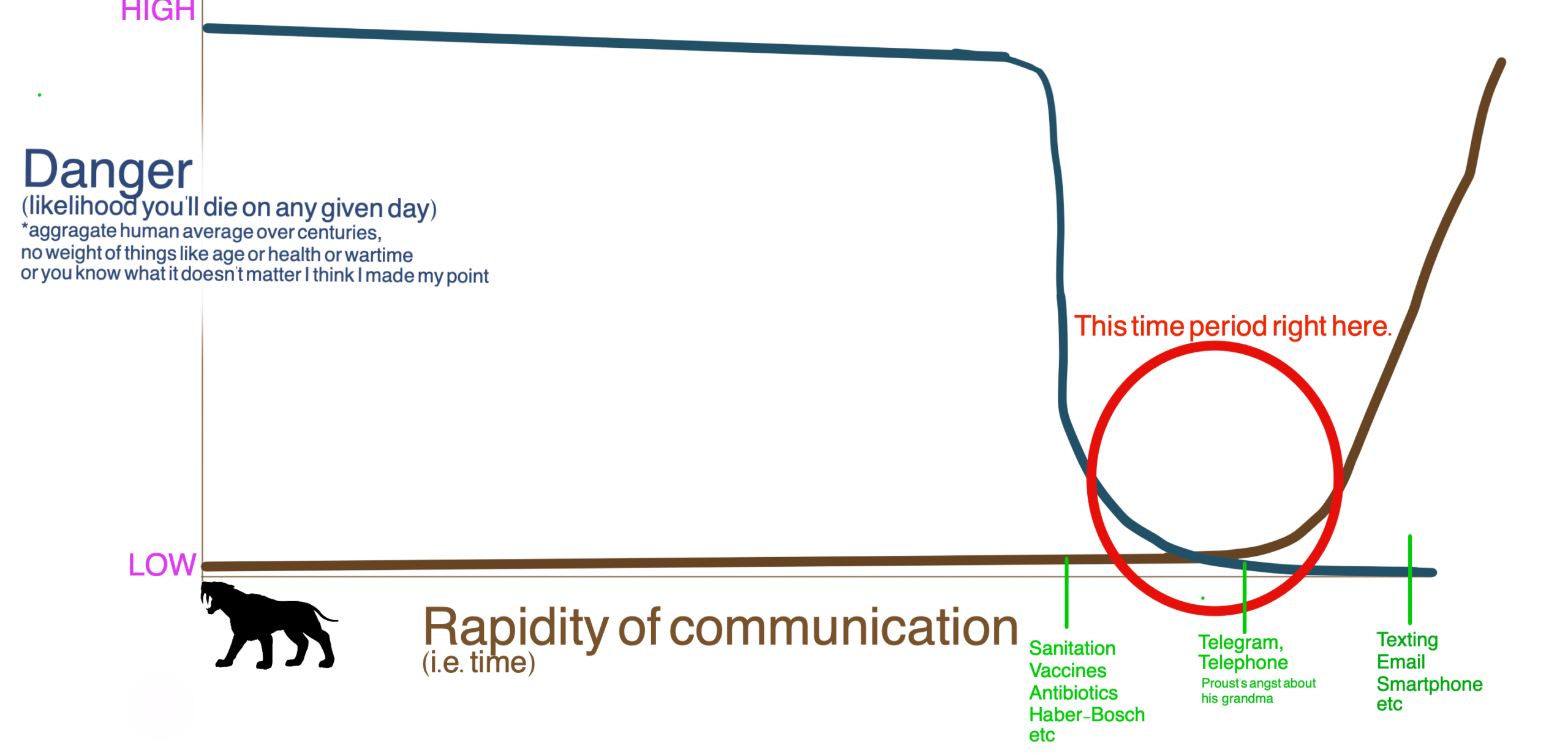
To that point, the concern I do acknowledge is actually worse now is traffic. Before even touching the arms race that is consumer choice and, therefore, in a system with zero checks for public welfare, car design, people are faster, meaner, and more impatient, and in the US infrastructure favors the driver at the peril of the pedestrian or cyclist. There is a sense of danger even to the most restrained pedestrian–not helped by incidents like the one this past week in Santa Monica. Is this another example of incidents being publicized to give an outsized sense of danger, the new Adam Walsh looming in the imagination of parents? I do not much buy that there are pedophiles in trenchcoats lurking in the bushes or traffickers waiting to snatch up suburban kids with involved parents (when there is an endless supply of vulnerable kids nobody wants that will come right to them), but I did give up cycling around the city after one too many close calls. Perhaps in self-defense my basal instincts have started to more strongly object to risk as the body ages. But–I don’t on the regular see mystery vans handing out free candy, and I do hear every night drag-racing up and down the linear drag by my apartment, and into the goddamn neighborhood. And I do see roadside memorials. And I, personally, this body, have been almost hit one too many goddamned times. This is something that, had we the political will, could be fixed yesterday, but the American obsession with “freedom to” over “freedom from” again atomizes us against systemic development. (Reminded of this again helping my partner schedule an Amtrak ticket to the hometown and being utterly baffled how the richest country, materially and in military power, in the history of the world, can have such a embarrassingly anemic rail system.)
There has always been this panic that traffickers and drug dealers target “good” suburban kids from “good” families because they are evil and that is what evil people do, for the sheer joy of wrecking a life and out of resentment for the better circumstances of others, but traffickers and drug dealers are ultimately businessmen and there is no profit to stirring up unnecessary scrutiny and trouble by targeting kids with parents who would dedicate their entire lives to fighting to get them back. This “myth” of the “value” of the virginal blonde young valedictorian girl from a Christian family catching a high price on the market of flesh just doesn’t hold water, not in the face of the economics of scale that one can leverage with the endless supply of foster and runaway kids, or kids whose own parents sold them. Parents who give one shit, you don’t need to imprison your kids. Your care and attention existing at all is safeguard enough. This one shit will not keep them from other kinds of mischief, born of material deprivation or lack of opportunity or otherwise, but it is a safeguard against the bogeyman kidnapper. (And, I acknowledge the ‘enrichment’ is a desperate attempt to stave off that lack of opportunity and class disadvantage, but that is another matter. Or is it? Anyway.)
The mental contamination of regimented time
I know they get a “lot” of recess time interspersed. That is good, the bare minimum. But I think of the difference between days when I have “free time” until X o’clock and when I have unlimited “free time”, or at least the timing of responsibilities is at my discretion. During the former there is always that asterisk looming at the periphery of my awareness. Doesn’t matter if I end up spending the same amount of time doing as I wish as I would on the “until X o’clock” days. The mind is clouded. There is a sense of termination, a sense of hurry. A tendency to feel it is not the “right time” after all to start on something. And so, I don’t get much of anything done. And I am further burdened by guilt and a sense of lost time. This pairs poorly with a part-time job that starts in the middle of the day.
I look back to my own childhood during such circumstances (“you have free time until X and then we’re doing X”) and I do not recall such a mental block insofar as Getting Things Done is concerned; I would just lose myself in the task until it was time to stop and so save irritation clouding my mind until that point. So I am perhaps projecting an ‘adult’ sensibility onto these kids in that regard. I do recall the feeling of helplessness and rage, inability to set my own schedule. I do think that is the same.
Luxury desires
Worrying about ‘freedom’ and ‘free time’ and ‘autonomy’ are luxuries we indulge when we are higher up on Maslow’s pyramid. They are worries for one with a full belly and a roof and a lack of bombs going off about every which way. So, I realize these observations are mostly relevant to the American culture I live in, and that of other ‘advanced’, ‘safe’ cultures unbeset by warfare, but this is all that I know firsthand, so it is what I can talk about with anything resembling insight